

Hospitality in Saudi Arabia is on a huge journey. In 2016, the Saudi Vision 2030 was unveiled: An all-encompassing plan that looks to transform one of the world’s largest economies from the premier exporter of oil, to an international benchmark for modern society and business. Authorities immediately began funnelling billions of dollars into sectors such as finance, aviation, and perhaps most importantly, the tourism and hospitality industry.
It is hoped by 2030, tourism will become the Gulf state’s second largest economic contributor (behind oil and gas), generating 10 percent of national GDP and creating an extra one million jobs in the country.
In order to achieve this target though, hospitality in Saudi Arabia must evolve. Historically dependent on business and religious tourism, these two segments can only go so far in creating one of the world’s most touristic countries. Saudi Arabia now has become increasingly focused on leisure and lifestyle tourism as to appeal to a larger, more international demographic.
This shift has seen a groundswell of support, as the likes of Accor, IHG, Hyatt and others flock to the Kingdom to be part of a movement. But Vision 2030 is far less about setting a finish line for authorities and businesses to race towards as it is planting a seed for the country to grow and evolve.
From the moment the Vision was announced, the Kingdom’s past, present and future businesses were endowed with new confidence that they could innovate. From the country’s most well-established hotels, to eco-retreats that opened a few weeks ago, and onward to immense giga-projects still nine years away, we look at the already-transformative effect of the Saudi Vision 2030 on KSA.
Hospitality in Saudi Arabia: The past, still revelent and moving forward
First opened in 1975, the InterContinental Riyadh was among the first luxury hotels to open in Saudi Arabia. As the top-of-the-tree brand celebrates its 75th anniversary globally in 2021, Tariq Yousef H. Dowidar, area general manager of IHG government hotels and GM of InterContinental Riyadh, discusses the significance of the property.

He said: “It marked the beginning of the brand’s strong legacy in the Kingdom. This also means that we lead the InterContinental brand, setting an example for all owners and hotels to follow. We have maintained our exemplary service and great relationships with our clientele, government and royals. We are also proud of having been owned by the government from our very inception.
“We continue to benefit from being a part of history, a landmark for all governments and internationals events such as OPIC, GCC conferences and head of state visits.”
There is one big way he stands to benefit from the Vision though. As the GM points out, it is as much about celebrating Saudi Arabia’s history as it is its future. This is where the InterContinental Riyadh comes in, according Dowidar.
He added: “Part of the Vision is celebrating the history of Saudi Arabia, being an iconic landmark. We are proud to be part of the Kingdom’s heritage.”

Jumping ahead in the timeline, we move to 2003, where both the Radisson Blu Riyadh and Four Seasons Hotel Riyadh opened for business. Both still dong well today, the hotels harbour different secrets for their longevity – while one has been transforming in a literal sense with refurbishment, the other has shifted in a service sense.
Guenter Gebhard, Four Seasons Hotel Riyadh senior GM discussed his new refurbishment: “In keeping with the Saudi Vision 2030 and the growing interest from international travellers to visit the Kingdom, the hotel’s recent renovation incorporates residential-style rooms and suites being ideal for families and long-term stays, unique artwork that immerses guests into the Kingdom’s fascinating cultural history and a compelling range of modern facilities.
“Our extensive renovation, which is currently still ongoing, leaves the hotel well placed to maintain its leading edge in the market. Our people and the passion they bring to their work every day, in addition to our loyal guests, some of which have been staying with us for 18 years, will also allow us to keep up.”

Speaking of the Radisson Blu in Riyadh and other properties under his remit, Basel Talal, Radisson regional director for Saudi Arabia, Kuwait and Levant added: “With the new business mix including local staycations, more families and leisure stays, our hotels have, as a result, now implemented new service offerings to better meet the leisure traveller’s expectations and needs. The hotels are putting a large focus on offering concierge services for international leisure travellers arriving to KSA to be able to offer them expert advice on all the diverse activities offered in the kingdom and to further personalise our guest’s stays.
“Our hotels will have the chance to align their future product and services improvement to better cater to the new business mix expected from implementing the Vision 2030 of activities and initiatives.”
Harking back to what IHG’s Dowidar stated, Radisson’s Talal agreed that the Vision is as much a recognition of history as it is the future. With this in mind, historical hotels such as the Radisson Blu have been combining the two.
He added: “Older hotels naturally have more of a history and can better understand the culture and the needs of most segments. Combining the history and the experience gained, there is a lot of potential for hotels while they plan for their renovations, to have the opportunity to create more defined facilities that will assist them in meeting their guest’s expectations.”
Moving onto 2010, we shift our attention to the holy city of Makkah. While religious tourism in Saudi dates back centuries, the segment continues to receive attention to this day. Raffles Makkah Palace for example is now applying modern methods to one of the world’s most traditional practices.

Makkah is one of Islam’s most important sites, home to both the Great Mosque of Makkah and the Ka’bah. This means pilgrims come in their millions to carry out both Umrah and the Hajj pilgrimage. A highly seasonal hospitality market, Makkah hotels often house Muslims that have waited their entire lives to visit the city.
Raffles Makkah Palace’s acting managing director said he intends to show travellers that the holy city can offer more than only a place to sleep for pilgrims. Salem Al Shahrani, who looks after Raffles Makkah Palace, Makkah Clock Royal Tower and Swissotel Almaqam Makkah, says he is looking to innovate the city’s offerings.

He said: “The perception has normally always been that Makkah is just a place to perform Umrah or Hajj, but we are trying to have different offerings at the Raffles Makkah Palace. We want guests to dine, and use the spa, for example. We have one of the best spas in the Middle East. We want to show that the hotel has so much more to offer than just accommodation. It has restaurants, a pool, spa, gym and more.

“We have ultra-luxury amenities. We have a combination of all the luxury elements that the hotel is providing. Our concierge is available to guide guests and inform them about amazing historical destinations in Makkah and where to visit to see some sights.”
The Raffles name is world-renowned for its impeccable service and standards. Its Makkah iteration is no exception, home to restaurants such as Al Majlis for Levantine fine-dining with Mediterranean influence; to Al Qasr for all-day dining; and a specialist ice cream outlet called The Creamery.
Al Shahrani said he intends to use the hotel to show religious hospitality can be an experience of its own.
He continued: “We are trying to take this industry from where it was, which was a lodging industry, into more of a luxury hospitality industry. People used to come to the hotel and use it as just accommodation, but we are revisiting the entire process of the guest journey, we are moving it more into hospitality and luxury. We are ready to accommodate guest experiences.
“We also introduced a limousine check-in for them too. We are heading in a different direction to promote our product. We really want to stand out with our offering.”
While Al Shahrani is championing one of Saudi’s most traditional hospitality segments, he explained he still stands to benefit from the modernising initiatives under the Vision, by welcoming tourists.
He explained: “The way Saudi Arabia is opening up its tourism is something we are very happy about. This is something we are really looking forward to.
“One of the most significant improvements in our tourism is the government allowing for many nationalities to access Saudi Arabia with an e-visa. Now we are seeing many Muslim travellers are able to get an e-visa to come to Makkah. This truly makes their life easier. This e-visa eliminates the waiting list process and makes travel so easy. It has totally improved the guest experience. It also encourages them to travel around the country and see what is being offered elsewhere.”
Hospitality in Saudi Arabia: The present, progressing
The excitement around now being able to show more and more people the wonders of the Kingdom is not exclusive to Al Shahrani. It’s an electrifying sense of national pride that zaps across the entire country, with scores of Saudis ready to welcome overseas visitors with open arms.
There’s a sense of mystique still shrouding much of Saudi’s tourism destinations, with many people never setting foot in the country before. Perhaps no destination encapsulates this idea of curiosity better than AlUla.
‘The World’s Masterpiece’ – one of the oldest cities in the Arab world – dates back thousands of years. From the ancient ruins of Hegra, to the untouched labyrinth that is Old Town AlUla, the AlUla site is one of the world’s last remaining examples of Arabian culture through the ages.
Still, much of the world has had no idea it existed up until now.
Thanks to Vision 2030, the site has a US$15 billion masterplan through to 2035 to bring its natural splendour to travellers across the world. With its first hotel already opened (more on that later) Phillip Jones, Royal Commission for AlUIa’s chief marketing officer explained the importance of the destination.
He said: “This is the tip of the spear, we’re one of the most advanced giga-projects [in terms of completion]. We don’t have to build anything huge, we like to use the natural space. Our target will be on the luxury end, so it will never be a mass tourism destination. We’re going to be the destination that introduces a lot of the ultra-luxury brands not yet seen in the region.
“Our target is to be exclusive without being pretentious. It’s focused on nature, sustainability and it’s not overdeveloped. Everything coming to AlUla is made purposefully for this landscape, so you won’t find any high-rises, for example.
“If you want to experience something very different from Dubai, I really recommend coming here. There’s 7,000 years of history and heritage to celebrate. The beauty of AlUla is that you’re looking at monuments and moments in history, and it’s with one or two other people there, not 300.
“It’s individualistic and it’s immersive, so everything we’re doing here is to protect the setting.”

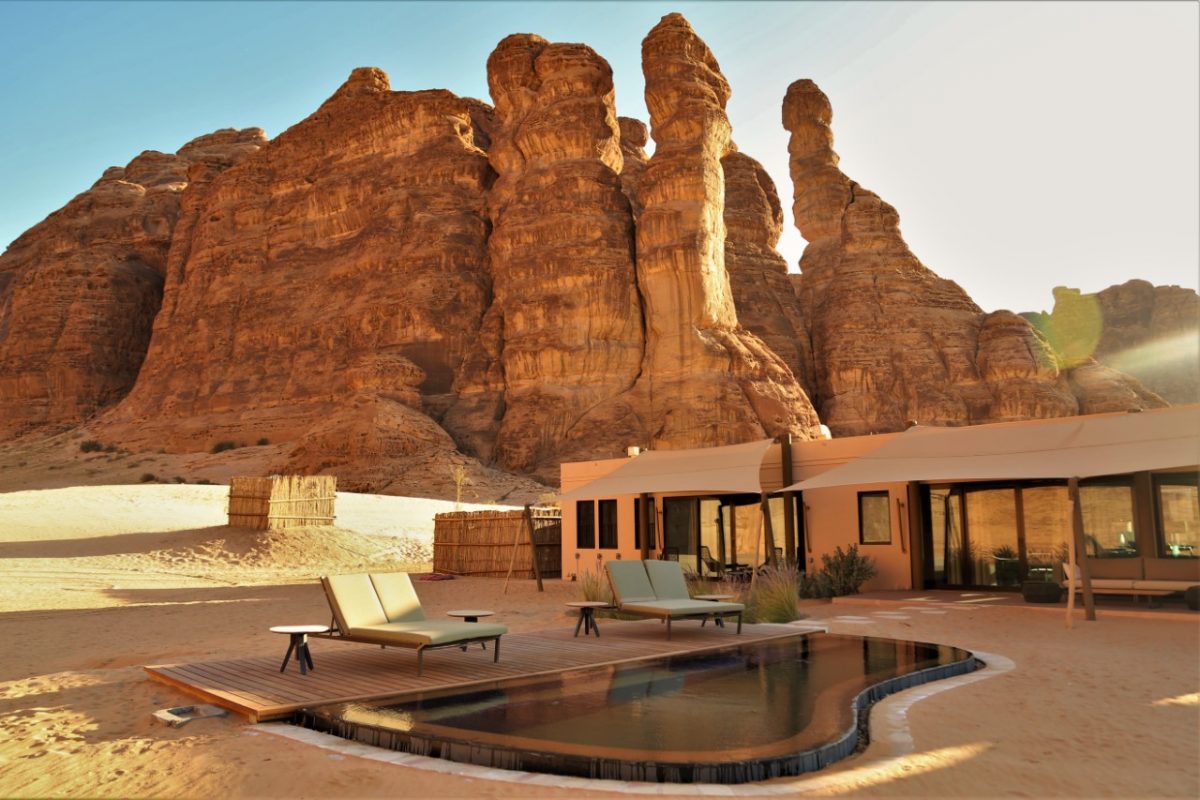
The topic of individuality brings us to AlUla’s first hotel opening: Habitas AlUla. The sustainable hospitality brand has launched its first property in the Middle East at an ancient oasis in the desert canyons of the Ashar Valley.
The resort offers 96 guest rooms that span three tiers. These include the premium Celestial Villas, Alcove Villas and Canyon Villas. There is also a yoga deck, wellness and fitness centres, restaurant and swimming pool.
Each of these spaces is constructed from ethically-sourced organic materials. The hotel is made out of a minimally invasive build model. It was designed in a low impact way that does no harm to the environment.
Oliver Ripley, Habitas CEO and co-founder revealed what inspired his brand and why AlUla was the perfect canvas. He said: “We came together because we wanted to create a new kind of experience. When we travel somewhere, it’s not the physical experience we remember, it’s the people we’re with and the memories we create.

“Now the industry wants community and connection. For me when I travel, I felt I kept staying in places that felt isolating. So when it came time to create Habitas, we never set out to create a global hospitality group, we just wanted a space where friends could come together.
“Habitas is for great food, organic food, local communities, amazing music, parties, and wellness. That doesn’t just mean going to a spa and having a massage though, it’s also about mindfulness and consciousness.”
According to Ripley, he never planned to bring his ultra-luxury eco-brand to Saudi Arabia, though was blown away by both its beauty and its passion for storytelling, both vital components for any Habitas.
He continued: “AlUla came completely by surprise. I came to KSA for the first time in 2019, thinking I had an open mind. But naturally, I had my preconceptions of what was in store. I was blown away. First of all were the people, the young Saudis that I met were so kind and hospitable. Beyond that, they were so proud and excited to tell me about the changes in their country and it really caught me by surprise.
“When I came to AlUla, it honestly felt like I had landed on Mars. It’s a surreal experience at first. When we were invited to build a hotel here, our partners thought we were crazy. We brought our partners to AlUla and suddenly all their preconceptions were melted away as well.”

For Ripley, Habitas is all about having conversations, and Saudis clearly have a lot to talk about. One of his worries though is that many of the more ‘traditional’ hotels entering the Kingdom do not understand this new nuanced form of hospitality.
He urged: “The world in general needs places like this to gain deeper understanding and compassion towards things. There’s a lot of more traditional brands coming to Saudi Arabia, and they follow the same template. Habitas is all about creating a social architecture where people can talk and meet to become friends. I feel traditional hotels focus on bigger rooms, creating more isolation, but the world is changing.
“It’s an incredible opportunity for us to be able to participate in Saudi Vision 2030 and sparking conversation around it.”
Hopsitality in Saudi Arabia: The future, explained
Looking ahead, Ripley’s worries about traditional hospitality might be wrong. Some of the world’s most well-established brands are now expanding rapidly in the Kingdom, but they are doing so under the careful direction of the Vision. The Red Sea Project is a perfect postcard for the future of Saudi hospitality. This October, The Red Sea Development Company (TRSDC), announced nine hotel management agreements for Saudi’s Red Sea Project.
The developer behind the world’s most ambitious regenerative tourism project is partnering with international brands to operate resorts in the first phase of development at the destination.
There are 16 properties in the first phase of the development, totalling 3,000 hotel keys. The nine projects in question count for 1,700 of those.
Many of these brands are what Ripley could call a ‘traditional’ brand. Though as we talk to Ludwig Bouldoukian, Hyatt’s regional vice president of development for the Middle East and Africa on the Grand Hyatt The Red Sea, his plans are anything but traditional.

The property will have 430 keys, making it the largest of the 11 hotels slated for the island. It will also have “world-class” F&B outlets, and access to wider amenities such as a marina and a golf course on Shurayrah Island.
Bouldoukian said: “Hyatt wanted to be part of this unique project – it’s something that’s never been done before. We’re creating a space where guests can contribute to the environment while staying at one of the Red Sea Project properties.
“This project will be the gate that opens up tourism in Saudi Arabia. Saudi does not yet have any project of this size or ambition, so when it opens, it will have a lot of attention. Hopefully, it will help change a lot of mindsets for international travellers. Why not try a holiday in Saudi Arabia? That’s an incredible vision.”
Mirroring the cooperative, inclusive philosophy of the Saudi Vision 2030, Bouldoukian assured his Grand Hyatt resort would not be in the competition with any other hotel on the destination. He firmly wants to work with all hoteliers in uplifting The Red Sea Project and thus the Saudi Kingdom as a whole.
He continued: “The Grand Hyatt on the Red Sea is the biggest hotel on the development in terms of rooms. It will be the anchor of the entire Red Sea Project. The aim is to make the Grand Hyatt the epicentre for all the guests of the other hotels to come and use us to move around the island.
“It’s no fun just to stay in one place the whole time, the Red Sea Project will give guests the choice to explore all the hotels. There are multiple F&B outlets, lots of fun things to do too. The aim is not only to attract families and young people, but also the corporate side, that’s why our resort has a conference centre. We really aim to become the anchor of the island.
“We know that our guests will also want to visit the other hotels and experience what they have to offer. We want to keep the Red Sea Project fluid. We want to be the anchor that attracts people to the whole destination.”

Saudi Vision 2030
So, how is the Vision coming along? Well, through one lens, we are still many years away from hitting the economic targets set out by authorities. But looking at it socially, the optimism, passion and excitement created by the Vision is already near-immeasurable.
From young Saudis eager to share their stories, to hospitality operators already rethinking sustainability, to old icons in Riyadh and Makkah taking lessons from other segments, it’s clear the transformation has already begun.