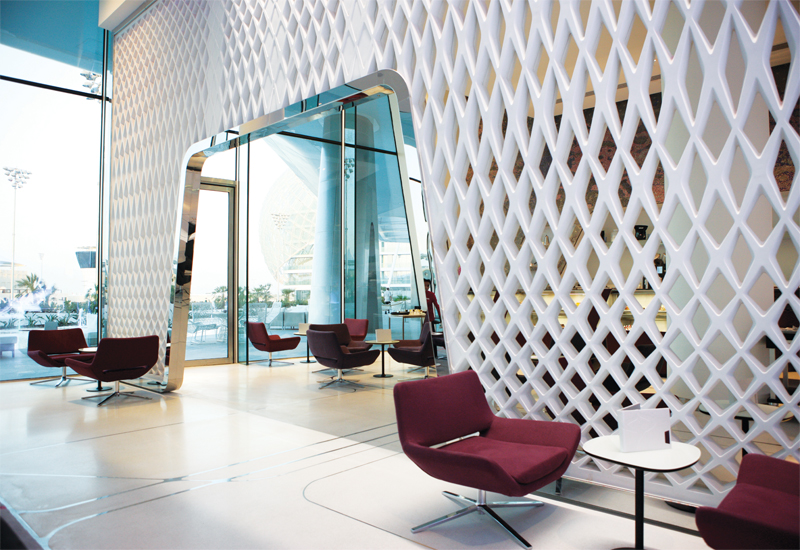
Investment in artwork is all too often under-estimated when it comes to FF&E budgets, but with art able to both engage guests and act as a new revenue stream, Louise Oakley says it’s time for a change in mind-set
The art scene in the UAE has exploded in recent years, from Christie’s first auction in the Middle East in Dubai in 2005 and the launch of Art Dubai in 2007 to the opening of a series of galleries and art consultancies in Al Quoz and Dubai International Financial Centre.
Many of these art specialists have since developed a strong corporate business, with companies such as The Jam Jar LLC and Embellish Art LLC offering turnkey solutions from concept to installation for the hospitality industry, and home-grown galleries such as Gallery One and The Big Art Company creating, finishing and storing art in-house in their warehouses in Dubai.
Hospitality interior design companies are also prioritising art, with Hirsch Bedner Associates (HBA) launching Canvas, an art consultancy focused on enhancing exceptional hospitality interior designs with well-conceived and fully realised art collections.
Meanwhile, Creative Resource Associates, which now has an office in Dubai, is offering art consultancy as part of its fees for upcoming hotel projects.
The only dampener on the sector is the construction delay on TDIC’s Guggenhiem, The Louvre and Zayed National Museum on Saadiyat Island, expected to push opening back by around two to three years to 2016/2017.
Still, the planned galleries have captured the minds of art enthusiasts worldwide and exhibitions in the region remain frequent, consumers are spending — more than 30 countries take part in Christie’s Dubai sales reflecting the interest in Middle Eastern art — and, now, the art world is turning its attention to the hospitality industry.
As Rashida Khanji, MD and art consultant at Embellish Art LLC, which has recently partnered with Kempinski Manama in Bahrain, says “art is a must in any hotel”.
“It creates a bond between the viewer and the space. It completes the space and is a requisite to a hotel’s credibility,” says Khanji. “Art is simply creating a perception that eventually becomes a reality to the viewer.”
She advises hotels to: “Choose your art wisely for a well-chosen piece of art can easily put you in a league beyond competition”.
This was exactly the rationale for Mövenpick Hotel & Apartments Bur Dubai’s decision to transform an empty space on its first floor into a gallery and invite artists to showcase their work, explains executive assistant manager Markus Eppinger.
“The main reason was to differentiate from other hotels and ensure the guests remember the hotel according to the art,” says Eppinger. “We really believe in it.
“Art is not only decoration, it also creates the culture and the soul of the hotel,” he adds. “It improves communication between the hotel and guests and boosts the relationship between us and the guests.”
Deepa Bhatia, head of art consulting at The Jam Jar and ex-interior designer, says art can also be used by hotels to mirror the cultural heritage.
“The hospitality industry is trying to portray the UAE’s culture, so if you go into a hotel you will see some reflection of the country. The current trend is very Middle East and Arab — they want tourists to come in and see the culture of the country,” says Bhatia.
At Gallery One, director of marketing, sales and innovation, Rupert Diss, agrees, broadly summing up the current trend as “Arabesque”.
“We’re able to position hotels through art by making them culturally astute,” says Diss.
He believes the demand from clients for art that “winks” at the Middle East is inherent to the region, but says there are a range of options for those seeking to be different, from Arabian animals and mosques to desert scenes, mashrabiya and Arabic calligraphy.
“The challenge for us is to always refresh collections and make them up-to-date and of the region — all of them are an expression of the region but deliberately so,” Diss says.
Khanji says location and heritage are both important elements to consider in the selection of art.
“Today’s top inclinations with hotel art include originals and limited-edition prints that focus on the heritage of the region,” she says. “Photography has always been a successful category for ‘art enthusiasts’, which points to the popularity of not only black-and-white, but also sepia-tone and tinted photography.
Undeniably, art is today a central focus for hoteliers due to its appeal to consumers and its ability to add personality and character to any room. There is a surge in the demand for mix of modern and classic art (in murals, paintings or sculptures) depicting locational history or theme of the hotel.”
As well as the Arabian art theme, another trend, says Samantha Chambers, design and operations at The Big Art Co., is a move away from murals towards feature walls.
“There is a trend to more sculptured wall installations — we’re finding we’re doing more artwork with special finishing materials,” says Chambers, who is currently working on casting 3D curved sculpture walls at the Catalan restaurant in the upcoming Rosewood Abu Dhabi.
“There is a real fine line between when a wall is just a wall finish and when it becomes a piece of artwork,” asserts Chambers.
At this level, the art must be specified during the very early stages of design, with art consultancies looking to be appointed by the owner, interior designer or contractor.
Matthew Whitaker, director of Canvas at HBA, says: “Very often we will liaise with the design team during the first conceptual phase to actually design spaces around an artwork idea.
“Our most successful projects happen when the client understands just how important artwork, framing and accessories are to the final look of the hotel. This level of detail is what the guest actually interacts with, as they would a sofa or chair,” says Whitaker.
Back to budget
Some Dubai hotels have acknowledged the value of art and its contribution to both the look and feel of their property, as well as the longer term impact on guest experience.
The newly-opened Jumeirah Creekside is already being billed as an art hotel, thanks to its collection of 480 unique pieces and in-house art manager; Ritz-Carlton DIFC has developed a partnership with Opera Gallery to display collections on a quarterly basis in addition to its 130-piece collection of contemporary art; and Mövenpick Hotel & Apartments Bur Dubai’s GM Robert Barker is credited as having a passion for bringing art to his guests, running five exhibitions annually in the hotel’s Gallery.
However, these examples are in the minority and for many hotels, artwork is still at the bottom of the list when it comes to FF&E. Unfortunately, the design scenario presented by Whitaker is rare in this region. Investment in art suffers as projects run over budget and installation often comes late in the game — just think of how many hotels have bare walls well into soft opening.
Martin Wojnowski, regional director at CRA, who previously worked with Design Work Portfolio and LW Design Group in UAE and is an artist himself, says that hotel chains are often at the mercy of the owner.
“Hotel groups are very much keen on getting fantastic artworks — it’s part of the corporate guidelines [for many, such as] Starwood and Marriott — but what they are asking for and what they are going to get from the owner is sometimes two different stories. They have to live with what they get,” says Wojnowski.
“I’d love to select an artwork along with selection of FF&E but it doesn’t work like this. In my experience, artwork is being sort of left out as part of the accessories package and usually there is a very limited budget allocated to it, which is constantly being reduced, so by the time the hotel is nearly ready to open they are suddenly panicking — ‘so what about the artwork?’,” he explains.
Often, this results in hotels outsourcing to studios in India or China, where pieces are mass produced and “not of the standards you would actually like to see in a public space,” says Wojnowski, who estimates that 1% of FF&E budget goes towards art.
The Jam Jar’s Bhatia says some clients approach her just six weeks out.
“The first challenge is sourcing the right art, especially in the budget and timeframe,” she says.
“Sometimes it’s left so much to the end that budgets are exhausted and we don’t have enough budget to suggest an art package because they’ve put all the money into the FF&E of the hotel and so we get very constrained,” says Bhatia.
Diss, who has previously worked with Jumeirah Group and IHG, explains: “Hotels have an item list of stuff — bedspreads, curtains, TVs etc — and within a list of 400 items there’s an innocent line which says ‘art’. They’re all running around getting things built, talking about that chair, and what colour it is, and art is this thing right at the end.
“They apply the same thinking to those 500 pieces in the corridor as they do to the in-room private dining area and yet if you think about it, art is an enduring investment; it’s going to stick around,” says Diss.
At new hotels, if art hasn’t been adequately covered in the pre-opening budget, then no GM is going to want to invest in it because it comes straight down to his bottom line — even though artwork is a great way to inject life into a hotel.
To cater to these situations, Gallery One has launched the first art rental service for the corporate world — ArtLease, which offers various collections of art paid monthly or quarterly over a 12, 18 or 24-month period. Monthly payments start from as low as AED 1500 (see box on page 44).
Another affordable alternative would be to look to art schools and partner with up and coming young artists keen to showcase their work, suggests Wojnowski, instead of following large commercial enterprises.
“Good artwork doesn’t have to cost a fortune, which is another story — unfortunately in the region I see a lot of people being driven by commercial pursuits more than artistic ones so even artists are told to produce splashes of colours for incredible amounts of money rather than doing something intricate,” he says.
“So it also boils down to the fact that artists are pricing themselves out of the market here. There is a great opportunity for a gallery in Dubai to source young talent from Europe, those people from art schools — it’s very difficult to get into a good art school anywhere in Europe — and the level of talent is incredible and they are not expensive,” he adds.
Revenue stream
On the flip side, art is not just an investment — it can also generate revenues, and GMs restricted by their P&L should consider the options.
“We’ve pitched to a couple of hotels to take [art] to a retail proposition,” says Diss. “Hoteliers are saying this is a big revenue stream for us — we’ve got the real estate, that being the walls, put the guest into our environment and then they have the chance to buy it. We’ve pitched it to a couple and they’re very keen, because they’re getting the return.”
For example, Gallery One can create bespoke art pieces for hotels which can then be mass produced and sold in the hotel. The group can even create its own branded art collection.
“One hotel company has asked us to take the art proposition globally and they’ve got about 120 properties worldwide,” says Diss. “Art is going down a journey of hoteliers saying ‘we identify a revenue stream here’.”
Movenpick in Bur Dubai already retails artworks in its shop and also takes a share of the sale of artwork during exhibitions.
“[Robert Barker] is getting a lot of enquiries about paintings — this could potentially be a stream of revenue for a company. It’s definitely an opportunity for a hotel to sell photographs, pictures, so it’s a very interesting little niche,” says Wojnowski, who designed the hotel’s retail space.
Eppinger says that the hotel covers Dubai Municipality fees for the artists in residence, but gets 20-25% of the sale of any artwork sold during their exhibitions at the hotel.
With several pieces from artist Ashleigh Manley — who is returning to the hotel in October for two weeks, where he will paint based in the lobby — selling for between AED 10,000 and AED 15,000, it’s a decent return on a previously unused space.
Mövenpick also keeps several of the artworks from each exhibition, which are displayed in the gallery permanently, in the lobby, prefunction areas and other public spaces.
“From the originals we ask the artist for prints — we can use them for postcards and this sort of thing [in the shop],” says Eppinger.
“Some people are interested in the originals but other just want a small picture or print of the original which reminds them of the hotel and the art in the hotel. They buy it at a reasonable price and they will take it home, that’s good for us, they will remember the hotel,” says Eppinger, adding good guest relations is the core philosophy behind Mövenpick’s approach.
The same is true at Ritz-Carlton DIFC, which, by virtue of its location within an artistic hub, views art as “an essential part of its DNA”.
“Our collection was chosen to appeal to guests from a diverse range of nationalities and cultures, whilst also supporting local artists, and the diversity of the pieces we have very much represents this,” explains general manager Lothar Quarz.
“On a local level we are extremely proud to have formed a unique partnership with Opera Gallery, DIFC, which provides us with unique pieces to display in the hotel on a quarterly basis. We have just received a new collection, which includes a range of 18 stunning sculptures, including several pieces from French Sculptor Pierre Matter,” he says.
HBA’s Whitaker adds: “We created a collection of works for Ritz-Carlton that was relevant to the hotel’s interior design, but that also provided continuity for compelling stories that were woven throughout as a backdrop for the guest experience”.
From the consumer point of view, Bhatia adds that individuals and hotels alike should invest in originals.
“People are more aware you could buy an artwork where the value increases in time. Hotels are now recognising they could buy an emerging Emirati or local artist whose value of art could appreciate. The value of buying local based artists is increasing; people like to have Middle Eastern artworks,” she says.
The Jam Jar consulted Aldar on the Yas Island hotels and Bhatia says one idea that could be replicated by other groups was a coffee table book showcasing all the different artists they worked with on the project. Not only does this educate guests, it could be given as a corporate gift, retailed by the hotel directly or used to generate additional marketing and PR.
She adds that it is important hotels communicate their choice of art collections to the guest.
“If they have used emerging Emirati artists, it would be nice to use a picture of them with a bit of a biography or place name plaques or info plaques below the artist’s work in public spaces — you can definitely engage the hotel guest more to come in and have a look,” says Bhatia.
“If the hotel has invested a lot of money in the artwork and if they would like to showcase the artist’s works online, on their website, that would be a great way for them to engage their guests,” she adds.
The Ritz-Carlton, Millenia Singapore has gone one step further; guests can experience a self-guided podcast art tour of the hotel’s modern art collection, which includes limited edition pieces from names such as David Hockney, Henry Moore, Andy Warhol and Sam Francis. Valued at approximately US $5 million, 90% of the 4200 works were especially commissioned for the hotel, including around 350 museum-quality pieces
“The podcast of our self-guided art tour offers a unique and personal experience for our guests and potential guests and an opportunity to showcase our esteemed art collection,” says GM Peter Mainguy.
At Le Meridien, all guests engage with art from the moment they check in as each keycard “is a work of art in itself”. The keycards are created exclusively by Hisham Bharoocha, Sam Samore and Yan Lei, members of the LM100™ — a group of artists who work with the chain to develop interactive guests experiences.
And for those that shy away from adding to their art collections for fear that they should get such a subjective discipline ‘wrong’, Whitaker says that even if not every guest likes it, they will still talk about it.
“Art is subjective,” observes Whitaker. Obviously, our intent is for the viewer to like what we have chosen, but even when they don’t like a particular work, they still are actively engaged with it, have formed an opinion, and the artwork has become a point of conversation”.
While aesthetic appeal, cultural demands and guest engagement should all remain at the core of a hotel’s approach to its artwork, for those hoteliers who are seeking investment in this part of their FF&E during pre-opening or keen for a facelift to their public spaces, it’s time for a shift in mindset.
Art is not something that is desirable in hotels, it’s a necessity — and one that if properly strategised, can also provide a potential revenue stream, an abundance of marketing opportunities and a range of guest experiences.
Strapped for cash? Try renting ART…
ArtLease by Gallery One is a new corporate art rental service being spearheaded by Ruth Kirwan, corporate sales manager.
It comprises three collections of a range of media and framing styles: A, which is 12 prints; B, 24 prints; and C, 48 prints and each one is paid for on a monthly contract. As a guide, a 12-month contract on collection A could start from AED 18,000 with monthly payments of AED 1500 while a 12-month contract on Collection C could start from AED 75,000 with monthly payments of AED 6000, although Kirwan says the collections are devised to be a visual guide and that templates can be adapted to a hotel’s specific requirements.
At the end of the contract, the hotel owns the art, or can exchange it for an entirely new collection.
The main aim, she says, is for Gallery One to be able to better service all of its clients.
“It’s a longer way of going about it but an easy option for those that don’t have the budget for it,” says Kirwan, adding that it is a useful option for both new launches and refurbishments. “You don’t really end up paying much more than if you go to one of our stores, we didn’t want to do that, we want people to come to us.”
The company has recently partnered with Kempinski The Palm, which used ArtLease to supply the artwork for its iftar tent — reflecting the flexibility of the scheme.