

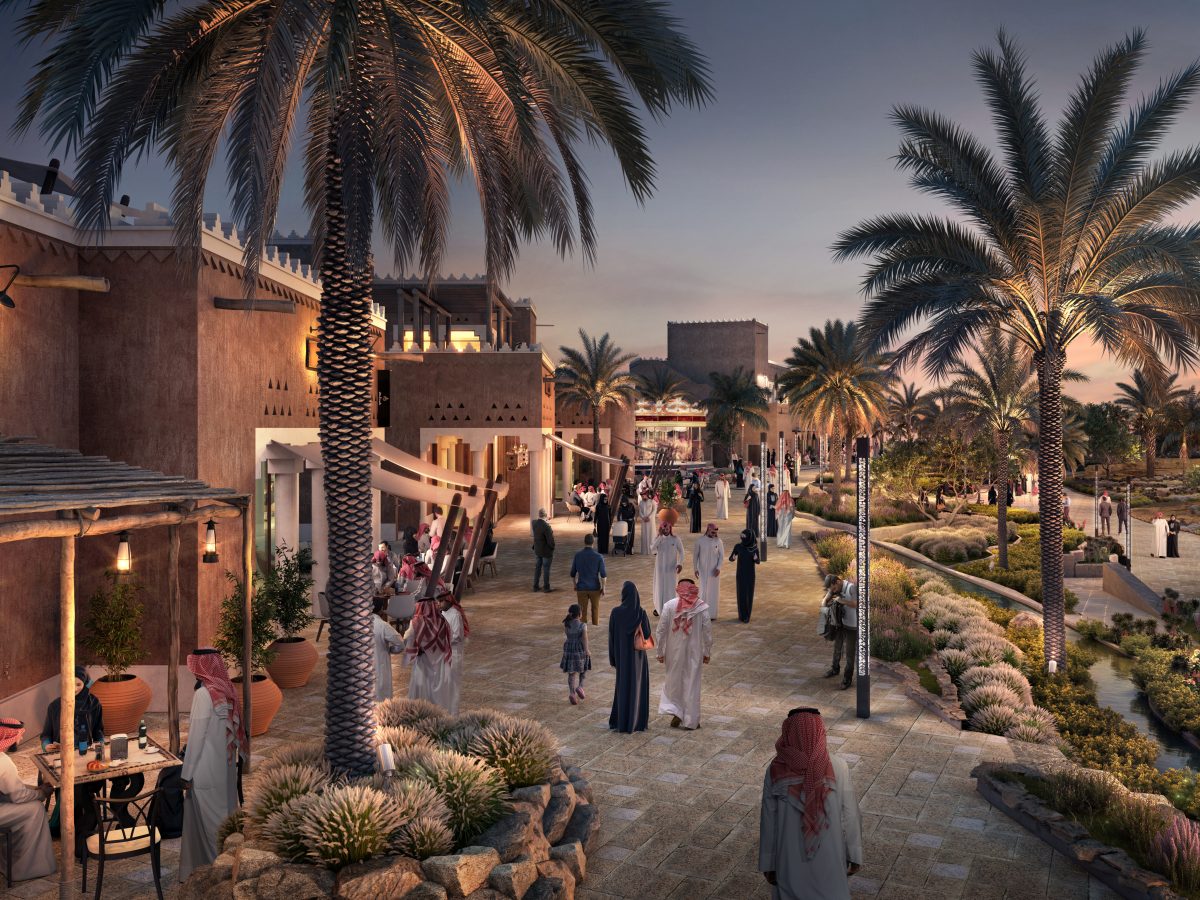
Diriyah Gate in Saudi Arabia is currently in talks with the Kingdom’s Culinary Arts Commission to develop an on-site ‘culinary laboratory’ to help usher in a new era for contemporary, high-end Saudi cuisine. The laboratory will bring together top chefs to experiment with local Saudi ingredients, planning how these flavours can be infused into the menus of lauded restaurants dotted along Bujairi Terrace.
That is according to the Diriyah Gate Development Authority’s (DGDA) chief of strategic management Talal Kensara. Speaking to Caterer Middle East at Arabian Travel Market 2022 (ATM), he said it is not enough to leverage the likes of Hakkasan, Long Chin and Bruno on their own, these venues must also provide a platform for Saudi cuisine.

Chefs invited to help elevate Saudi flavours
He said: “One of the initiatives we’re doing is developing a culinary laboratory with the Culinary Arts Commission where we will invite chefs to explore and experiment with how they can infuse some of the local, fresh ingredients we have into their dishes.
“Especially in Diriyah but also the wider Kingdom – looking at how that can be worked into amazing dishes. We have highly-skilled chefs willing to try and develop that cuisine. We’re experimenting also with how we can present traditional Saudi cuisine in a more contemporary way.”

Along with global culinary leaders such as Hakkasan, Long Chim, Bruno and Tatel, Bujairi Terrace will also include Angelina, Brunch & Cake, COVA, Flamingo Room by tashas, Café de L’Esplanade, Mastro’s, Sarabeth’s and Villa Mamas. There are also local Saudi-owned brands GRIND, Somewhere, SUGAR, Sum + Things and TAKYA.
Saudi Arabia’s most celebrated ingredients
Kensara said there is currently one key ingredient DGDA and the Commission are already eager to incorporate into these restaurants: Dates.
He said: “Right now, we’re still working with the Culinary Arts Commission on all the details, but a key focus is dates. Diriyah is known for producing dates, so we want to be able to showcase the scope of that ingredient. We have in Saudi more than 25 varieties and we want to infuse that into our dishes.”
The strategy chief went on to say that he needs these restaurant brands in the early days of Diriyah Gate to help establish it in the market. Bujairi Terrace is one of the first tranches of the giga-project to open, recently confirmed to open later this year.

“Bujairi Terrace is a new thing in Saudi. W need the big restaurant brands here – they are the foundation to show we are a fine-dining destination. Beyond that, Diriyah also needs to incorporate local ingredients and local flavours into restaurants’ well-known dishes,” he explained.
Hotels to embrace local flavours at Diriyah Gate
The commitment to elevating local flavours is not exclusive to Bujairi Terrace, it will eventually make its way to Diriyah’s near-40 hotels, he said.
“We need the big guys at Bujairi Terrace to experiment in our laboratory to develop Saudi cuisine before we can ask hotels to implement it. Hotels and their restaurants, of course, need to be commercially viable. We’re allowing hotels to bring their own restaurants, though we would like to have them infuse Saudi touches.
“Hotel dining has its own preferred brands of course but supply and demand must play their part. If we decide to tell all the hotels they can only serve traditional Saudi food, we’re creating a gap in offerings for our guests.”
The original seat of the Saudi royal family, Diriyah served the first Saudi dynasty as early as 1744 to 1818. Today, Diriyah is a living piece of history, home to the ‘Jewel of the Kingdom’ UNESCO World Heritage Site At-Turaif – the original centre of the city and considered one of the Arab world’s most important cultural and political sites.