


Saudi Arabia has appointed Aiman Al Mudaifer as acting chief executive of NEOM, replacing Nadhmi Al Nasr, who led the project since 2018. This transition comes as NEOM progresses into its next phase within Saudi Arabia’s Vision 2030 economic diversification strategy.
Al Mudaifer, who has overseen the Saudi real estate division of the Public Investment Fund (PIF) since 2018, brings extensive expertise in real estate and infrastructure investments across the kingdom to his new position.

The company acknowledged Al Mudaifer’s “deep and strategic understanding of NEOM and its projects,” emphasising the leadership change as key to achieving “operational continuity, agility and efficiency” aligned with NEOM‘s objectives.
Located in northwest Saudi Arabia, NEOM has announced 11 major projects, backed and owned by PIF and supported by local and international investors. The giga-project’s vision includes sustainability-focused initiatives such as powering its development through clean energy and using public transport and autonomous vehicles as primary travel modes. It remains central to Saudi Arabia’s development agenda, aiming to establish itself as a futuristic, sustainable city featuring smart technology and cutting-edge infrastructure.
Recent updates
Progress on NEOM’s wide-ranging developments “continues on all operations as planned, as we deliver the next phase of our vast portfolio of projects including The Line, Oxagon, Trojena, Magna and The Islands of NEOM,” the company stated.
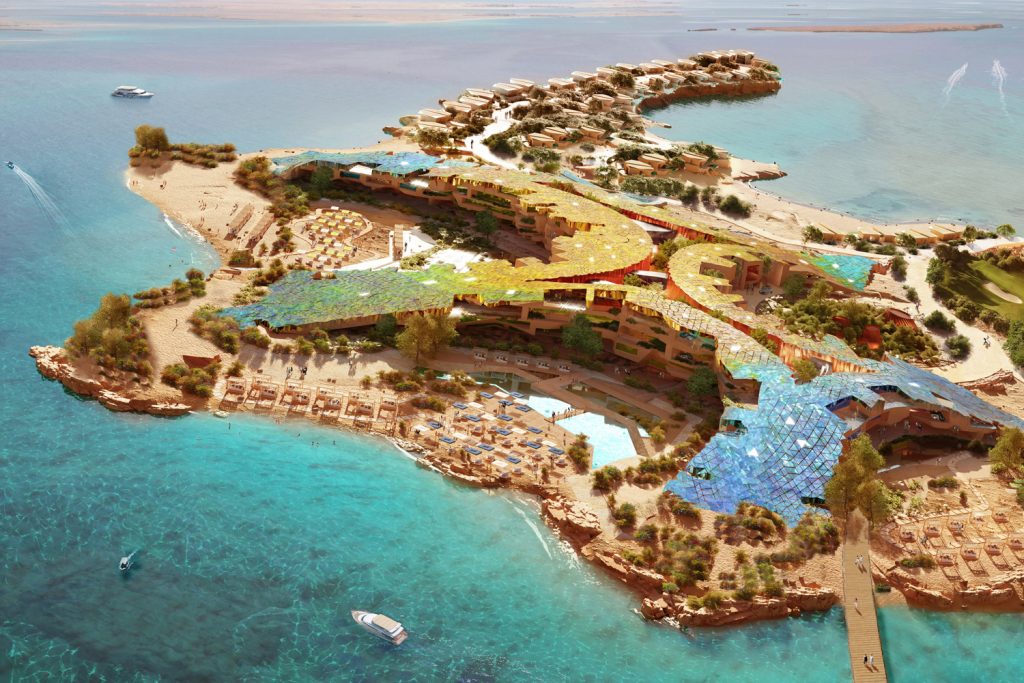
Last month, Sindalah Island opened as the project’s inaugural development. Sindalah, set over 840,000sqm, features an 86-berth marina, five-star hotels, and high-end retail outlets, and is seen as the “first physical showcase of NEOM.” Positioned as NEOM’s gateway to the Red Sea, the island reflects the project’s commitment to innovative, environmentally friendly urban planning.

Saudi Arabia’s Vision 2030, launched in 2016, seeks to reduce economic dependence on oil, stimulate private-sector growth, and address employment among Saudi citizens. Key projects such as NEOM and the Red Sea Project are central to this national strategy, aimed at diversifying the kingdom’s economic base.
As the kingdom navigates this transformation, finance minister Mohammed Al Jadaan recently noted that adjustments to Vision 2030 initiatives are possible, depending on economic and geopolitical conditions.
In April, Al Jadaan highlighted the kingdom’s flexible approach, indicating that Saudi Arabia might “downscale” or “accelerate” some of the projects under Vision 2030 to suit current needs. He stated, “A lot of the targets have been over-delivered, there are challenges obviously, and this is why I said we don’t have any ego. We will change, we will adjust or extend some of the projects. We will downscale some of the projects and accelerate others.”
Al Jadaan’s comments underscore a readiness to adapt Vision 2030’s scope as required.

In June, investment minister Khalid Al Falih shared an update on the initiative’s progress, reporting that Vision 2030 was “ahead of schedule on all aspects of the implementation.” Speaking at the UK-Saudi Sustainable Infrastructure Forum in London, Al Falih noted that the kingdom had reached the halfway point in its development plans, highlighting a focus on sustainable infrastructure and economic diversification.