

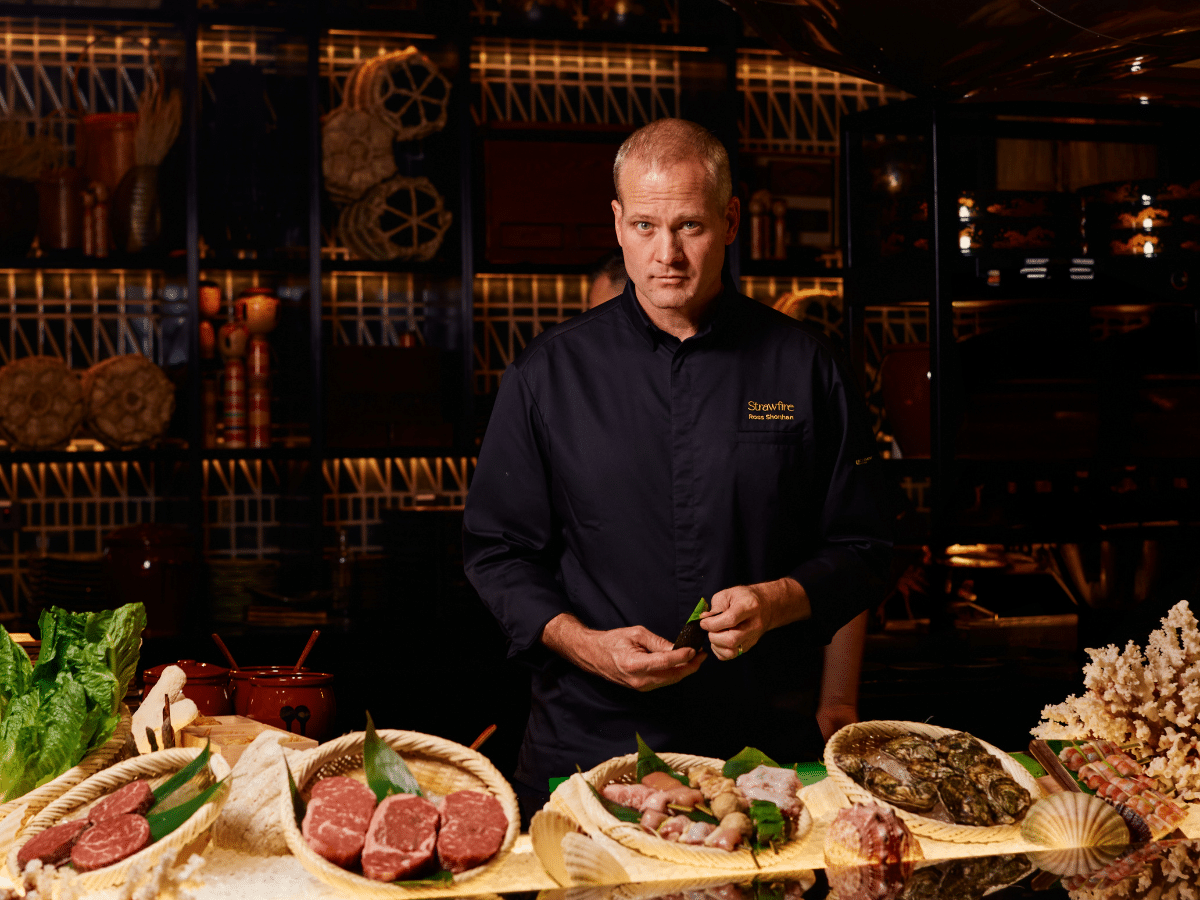
When Strawfire opened at Emirates Palace Mandarin Oriental in November 2024, it brought Abu Dhabi a new dimension of Japanese cooking: warayaki, the art of straw-fire grilling.
Acclaimed chef Ross Shonhan has spent the past year guiding the restaurant through the complexities of introducing a largely unfamiliar technique, building a loyal following, and shaping a dining experience that balances precision, flavour, and subtle theatre. In conversation with Caterer Middle East, he reflects on the restaurant’s first year, the lessons learned, and the refinements that will define Strawfire’s future.

How has business been since opening?
The first year has been extremely encouraging. Strawfire was always designed to bring something new to Abu Dhabi rather than add to what already existed, and we’ve seen that curiosity turn into loyalty. We have a strong base of repeat guests – residents of Abu Dhabi have supported us well, alongside hotel guests – and the dining room has developed a rhythm that feels very true to the city: refined, relaxed and deeply appreciative of craftsmanship.
Being part of Emirates Palace Mandarin Oriental also sets a standard we’re proud to uphold. People come expecting excellence and delivering on that every night is what has helped the restaurant build real momentum.
How did you choose your location?
Abu Dhabi has a quiet confidence to it, and Emirates Palace embodies that beautifully. When the opportunity came, it felt like the right environment for a restaurant built on Japanese discipline and fire-led cooking.
Warayaki is a technique that’s emotional in a way – the flame, the straw, the aroma – and placing that inside the calm, elegant surroundings of Emirates Palace creates a contrast that elevates both. It also attracts a guest who appreciates detail; for a technique that relies so heavily on precision and purity, that alignment mattered.

What has the response been from guests?
Guests have responded with a lot of enthusiasm and fascination. Many people are discovering warayaki for the first time, so the sense of theatre naturally draws them in. But the feedback we value most is that the flavours feel clean, honest and different to anything else they’ve tried in Abu Dhabi.
What we often hear is: “This is Japanese cuisine with fire as a language, not a performance.” That distinction means a lot to us. Strawfire isn’t about spectacle – it’s about bringing out the best in exceptional ingredients through controlled, traditional techniques.
How have you found your niche in Abu Dhabi?
Our niche is precision-led Japanese cooking where fire is a technique, not a theme. Abu Dhabi has outstanding restaurants, but there wasn’t a place dedicated to warayaki and binchotan [Japanese charcoal] in a way that honours their origins. We’ve also found our space through the atmosphere. The restaurant has a distinct energy: warm, quietly vibrant, elegant without being formal. It’s the kind of room where people come for a special occasion, but just as comfortably for a midweek dinner when they want something crafted and memorable. Above all, our niche is sincerity.

What challenges have you faced so far and how did you address them?
The biggest challenge was introducing a technique that’s new to many guests. Warayaki isn’t widely known in the region, so we needed to help diners understand the ‘why’ behind it: why straw, why that intense heat, why the flavour is so distinctive. We addressed it through service education and through the menu design itself. Once guests taste it – whether on seafood, meats or vegetables – the technique explains itself.
Another challenge is consistency. Fire is a living element and controlling it requires a disciplined kitchen. We invested heavily in training and daily calibration so that what guests experience is not only exciting, but reliably precise.
Have you changed anything since opening, and if so, why?
We’ve refined, not reinvented. Strawfire opened with a clear identity, and that remains intact. What has evolved are the seasonal offerings – introducing new cuts, new seafood and small dishes that allow guests to experience the cooking style in different ways. We’ve also adjusted pacing and flow in the dining room as we learned how guests like to dine in this particular space. The spirit stays the same: purity, smoke, flame and Japanese clarity of flavour.

What have been the highlights for you since you opened?
Seeing guests try warayaki for the first time and immediately understand it without explanation has been a real highlight, as has watching the team grow into the technique and take genuine pride in it. Another highlight has been earning the trust of a discerning Abu Dhabi audience – especially the repeat guests who bring friends, family and business partners to “introduce them to Strawfire.” Integrating the restaurant into the fabric of Emirates Palace has been a rare privilege.
What comes next?
Year two is about refinement: strengthening the core, deepening the menu’s seasonal direction, exploring more beef-forward expressions of the technique and continuing to build a team that treats fire with respect rather than bravado. We’re also working on expanding the bar’s identity, as it becomes a destination in its own right.

Do you have any plans for expansion with other venues or into other territories?
We would love to be the first Abu Dhabi–born restaurant to go global, and we’re exploring possibilities, but only very selectively. Strawfire is not a concept you can easily replicate; it depends on skilled chefs, proper fire infrastructure and a guest who appreciates subtlety over spectacle.
If we do expand, it will be because we’ve found a space, partners and a team that allow the technique to be executed to our standards. That may happen in the region or internationally, but we’re in no rush. Integrity comes before scale.