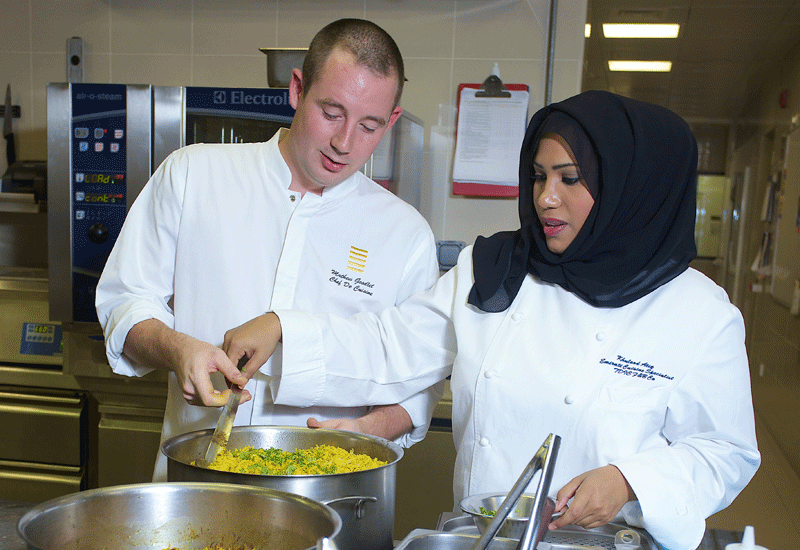
Tourism and Cultural Authority Abu Dhabi culinary development specialist Khulood Atiq is doing everything she can to promote Emirati cuisine to residents and tourists alike
Khulood Atiq is a chef with a mission: to raise awareness about Emirati cuisine in its homeland, the United Arab Emirates, which suffers from a sore lack of restaurants that showcase its food heritage.
At any given point of time, the native population of the UAE makes up just under 20% of the total number of residents. And while the F&B scene is bursting at the seams — you will find everything from British to Thai, and from Italian to Russian — Emirati food is hard to come by.
It is common to find expatriates who make the UAE their home not knowing much about the traditional food, often mistaking Lebanese cuisine to be that of the UAE culture.
However, over the last few years there has been a concerted effort to push native dishes to the forefront of the public eye — from new restaurants and cafés that tout authentic recipes, to events like the inaugural Dubai World Hospitality Championship in November 2013, which championed the cause of local cuisine.
It also helps to have chefs, like Atiq, who participate in food festivals like Gourmet Abu Dhabi and Volvo Ocean Race, hosts TV shows, and writes cookbooks, to support the initiative. But that’s not all on her plate.
Atiq, who works with the Tourism & Cultural Authority (TCA) Abu Dhabi as its culinary development specialist, says she has a lot of plans in place and huge amounts of work to be done to put Emirati food on the map.
In addition to currently writing her second cookbook, Atiq is working on launching a certification programme to educate chefs in four- and five-star hotels about her culture and native dishes, to help them show off the country’s cuisine to the millions of tourists flocking here every year.
Speaking to Caterer Middle East during Gourmet Abu Dhabi, she says: “I will start working more with hotels this year. As I work in the main office of Abu Dhabi Tourism, I plan to start an interesting programme soon after Gourmet Abu Dhabi to help chefs in hotels, and teach them about Emirati hospitality and cuisine.”
Atiq is clearly passionate about her chosen cause; she continues with a smile: “Hospitality is a very important element of the UAE’s culture — perhaps it’s even better than the food!”
She pauses and adds: “When you have guests and then you welcome them, sit with them and serve coffee — that is much better than if you just serve food immediately without welcoming them properly.”
The programme she plans to launch will also work on improving awareness of Emirati food and how to create dishes in an authentic manner.
“We will start with the basics of ingredients used in our food and then move on to the practical parts of cooking.” The course will give chefs the chance to learn about Emirati hospitality for three days, while the practical element, she says, will probably be one week long.
Atiq also plans to foster a sense of competitiveness between the course’s participants by
hosting a contest, and everyone will receive a certificate of completion once the classes are over. The idea is to roll out this course to chefs from four- and five-star hotels first before Ramadan begins this year in June.
Becoming a Chef
Impressive plans indeed – but in a profession where the number of male chefs seem to be more in the limelight than women, it is indeed an achievement for a female Emirati to succeed. How did she end up as a chef?
She says her love for creating good food came from her mother and aunts, who used to cook at home in an era when maids were not so common. She reveals: “I used to watch my mother cooking and tried to copy her methods — that was my introduction to being a chef. My mother would reserve Fridays for baking, and I would watch and try to help.
“She indulged me and gave me a little dough to play with. But I would wonder why the dough I worked on would not become bread, like hers did. When that happened, she would make me leave the room and when I returned she would show me a loaf of bread in place of the raw dough.
Every time she did that, it increased my self-confidence, and I believed I could cook.” Atiq was just five years old. However, it was only when she was eight that she really started to cook in the kitchen.
But when she went to university at Dubai Women’s College, she was dismayed to find they did not have a cooking course at the time. For want of anything else, Atiq picked business. “But I didn’t enjoy studying this subject, so I quit,” she says.
After a while of not doing anything specific, her brother asked her what she wanted to do with her life. Atiq says she replied without thinking: ‘I want to cook’. Her brother supported her and urged her to follow her dream.
She began her career in 2008 as a culinary assistant on a TV show with Sama TV. From 2008, she also worked as the Emirati speciality chef at Mina A’Salam, part of Jumeirah Group for two years, creating menus with Emirati dishes and training other chefs to cook local food.
She joined Abu Dhabi’s Tourism Development and Investment Company (TDIC) in March 2011 as the resident Arabic and Emirati cuisine specialist, implementing these throughout the company’s F&B outlets.
In 2012, she also released a bilingual cookbook with TDIC, titled ‘Sarareed: Emirati Cuisine from The Sea to the Desert’, which details over 80 traditional dishes and also highlights local culture. Not only does it focus on Emirati hospitality traditions, the book also offers a sneak peek as to how the various recipes were developed.
While most of the book’s recipes have been passed down through the generations, the local chef, who hails from Dubai, also created her own authentic dishes using Emirati ingredients, such as dates or a seasonal plant called sidaf.
Challenges
Her achievements are commendable, and she has worked hard to get to the position she is in. A mother of two, Atiq juggles her workload and the expectations of people to be the face of Emirati cuisine with spending time with her family.
“I am a mother, I have my family to think of. At the same time, I have to finish my work, I have to work on all the big events that take place in the UAE. Then I attend festivals outside the UAE as well, because I am the ambassador of Emirati cuisine,” she says.
“But I am so happy because I can do something for my country. When I see that everybody knows about Emirati food and talks about it… believe me, I feel happy,” she says.
When she first stepped foot in the F&B industry, it was not easy for Atiq to remove her abaya to cook with a chef’s jacket. She says: “My family was very understanding and open. My father told me that if I wear my sheila (the scarf that covers a woman’s hair) and cover my body appropriately, then it’s not a problem.”
She says that when her family saw her on TV for the first time, they provided positive feedback by saying that she was very modest and spoke with dignity.
Another issue she faces is tourists not realising what Emirati food is, often confusing it with Levantine offering. “Lots of tourists want to try Emirati food. It’s only natural — if you come from Italy to the UAE, you don’t want to eat Italian food here… you want to taste Emirati food.”
She points to Al Fanar Restaurant & Café which started off in Dubai Festival City, and now has opened a second branch in Abu Dhabi’s Venetian Village in the Ritz-Carlton Grand Canal development. Atiq gives it her stamp of approval and says: “This is the authentic Emirati place. But we need more — one is not enough.”
Leading from the front
She is hopeful for the future because now “I am promoting this cuisine”.
“Everyone comes here and eats Lebanese food, hummus, tabbouleh and so on, and thinks they tried local food. I tell these people that they have not tried Emirati cuisine,” she says.
In addition to her inaugural effort with a recipe book, she has one more cookbook in the making. She anticipates it will be released within another two years.
After participating in Gourmet Abu Dhabi for three years, Atiq says visitors are becoming aware of the presence of Emirati food, and ask if there is a booth dedicated to the cuisine. She adds, smiling: “Everybody wants to try the food and people ask: ‘where is the Emirati chef?’”