

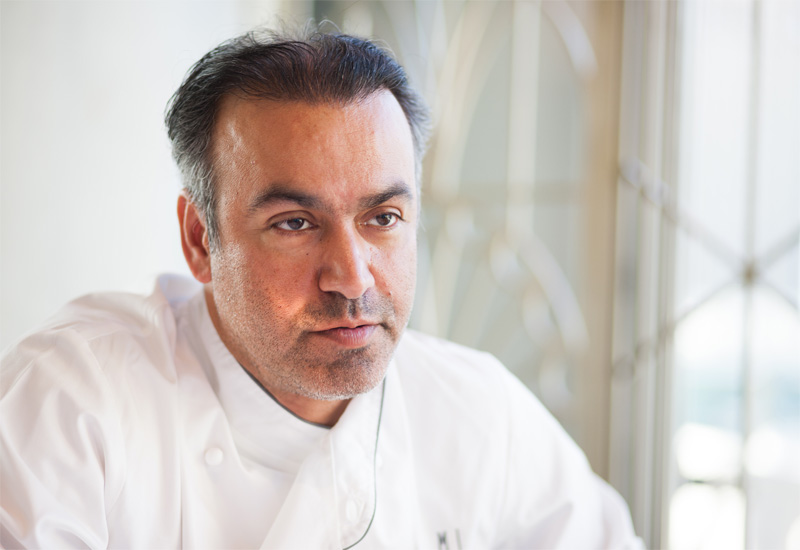
Atelier M founder and chef, Mohammad Islam, discusses the influence of Jean-Georges Vongrichten on his career, his vision for F&B in Dubai and why quality produce is paramount
Pier 7 in the Dubai Marina is the new kid on the F&B block, housing a single restaurant on each of its seven floors. The first outlet, Lebanese brand Abd-El Wahab, opened in May 2013, with Mexican outlet O Cacti following suit later in the year. The building is operated as a standalone development by The Emaar Malls Group LLC, with each restaurant able to be fully licensed.
In the midst of, or rather, on top of this F&B development is a chef who managed to get not one, nor two, but three floors to give birth to his vision — French-Asian concept Atelier M. The venue can seat 114 in the dining room on the seventh level, 90 in the bar on the next, and 70 at the open-air rooftop lounge.
On the seventh level of the tower facing the Marina, vintage interiors with glittering chandeliers stare me in the face, and as I walk past the welcome desk, an open kitchen reveals itself to my right.
I see chefs hard at work in a busy and bustling environment. In the middle of this is chef Mohammad Islam, founder of Atelier M, directing the flow of work, slowly looking over at what his team is doing, occasionally speaking quietly.
After spotting me, Islam walks over with an easy stride, and we start talking about him and his food. Born in Bangladesh, he had moved to the US to study engineering, but soon decided cooking was his forte. Does he regret moving?
“No I don’t honestly, because I was really bad at it. I had very little or no interest [in engineering]. There were so many smart kids at my school and I was struggling to get by, to try and keep my parents happy. When I told them I was going to be a consultant, it was a shock!”
He started off by working in kitchens of many top-tier restaurants including The Dining Room at The Ritz-Carlton in Chicago. He then worked as the executive sous chef at Mercer Kitchen in New York City with three-star Michelin chef Jean-Georges Vongerichten for five years, whom, he says, taught him a lot.
“Initially, I was always working in four-star restaurants or Michelin restaurants. I was asked by Jean-Georges to work at Mercer and I was very disappointed. I said, ‘I’m going to open a restaurant like this and serve simple food? What are you talking about?’ That was 23 years ago. He told me to try it and that I will see another side of cuisine I’ve never seen — simplicity. I did learn a lot there, it broke my tunnel vision.”
With those lessons in mind, he explains that the basic concept behind Atelier M is something he is most comfortable with. He says: “It is contemporary French cuisine with an Asian twist. We use the same classic technique but with completely nouveau-style cuisine and products.”
A New Hope
While the chef had ideas for his own restaurant in Dubai, Atelier M was not his first brush with the Middle East.
Initially, he was considering working on a project with Emaar in 2007, in Souk Al Bahar along with three other locations. Unfortunately, he says, that did not come to fruition. However, that was not the end of his Dubai dreams.
While Islam had been a frequent visitor to the emirate since 2004, he made a permanent move in 2009. He was appointed COO at Signature Clubs International (SCI), a company that was 100% acquired by commercial, residential and hospitality developer Enshaa in 2009. SCI was, as Islam calls it, the mother company of the Capital Club concept.
After working with Enshaa for nearly three years, he tied up loose ends in the US, Africa and India before diving into fresh ideas. And he has previous experience being a restaurateur — he owned the Aigre Doux Restaurant and Bakery in Chicago from 2007 until 2009, which was often frequented by US First Lady Michelle Obama.
Being a restaurateur means being involved in every aspect of your creation. Islam certainly agrees it’s something he’s extremely hands-on with. “My idea was to start F&B outlets in the UAE. You know, 2010 and 2011 was not easy for many of us, so I decided to wait a little bit. In 2012, I went back to Emaar and I said I thought I’m ready to get a location and start,” he says.
In October 2012, Islam found Pier 7 and decided it was where he wanted to be. He narrates a story which almost makes his decision look like fate. “I had seen the same location in 2008. I came from the US to look at this and at that time I said to the CEO of Emaar, ‘look it’s a great location but knowing Dubai for the last four years, people here don’t like to walk’.”
When Islam viewed the site four years ago, he said the access to Pier 7 wasn’t fully developed which made it hard for people to get there. He says: “You need to have valet for this area. You can’t expect people in four-inch heels walking down Marina Mall to come here.
It will be very difficult. You want to have gourmet food … you have to provide such a service. So I sent them a few proposals on how it should be and actually they changed it. They made the road bigger, brought it down all the way, added valet service, and guests can walk right to the elevator … so then I was ready to take it.”
He smiles and adds: “I love Dubai, I’ve been coming here since I was a kid. I love the diversity of Dubai, which I’m always excited about, and obviously the market is amazing. I think there are 30 million visitors coming in and out, so I think you can be quite successful.”
The Product Wars
But what makes Atelier M stand out? Islam says it’s the product he uses. He frequently refers to it, and believes in the power it wields. He boasts: “The difference here is that we are bringing in product that nobody has in Dubai. I’m working very closely with 15 to 20 different purveyors globally that no one has.”
Bold claims indeed — and why not? When Islam starts expanding on his supplies, he’s convincing.
“I have hand-churned butter coming from France, nobody has it in Dubai. I have a certain cheese purveyor bringing certain products for me. I have Blackmore beef coming in from Australia; I have original Kobe from Kobe, Japan. I have chicken that was voted the best in the world. My food is all about product. It’s very simple cuisine.”
Imports are well and good, but is Atelier M’s chef joining the “local produce” movement currently gaining traction in the region and supporting local farmers? He says: “Some of them yes, but it’s very difficult. I’m working with someone now to grow my tomatoes for next winter. I’ve given him heirloom seeds and we are seeing what it’s going to look like.”
He is candid about the problems he faces, but is equally determined to try his best to support local farmers. “It is very difficult, sometimes I bang my head against the wall but I think as long as we can support the farmers, it will be good.
We are working with three farms in Beirut right now; one will have all my avocados and tomatoes. We are also working in Iran with some farmers for their black pomegranates and lemons. I have four farmers in Al Ain who are bringing my herbs. I’m looking for chicken farms so hopefully we’ll be doing a lot of stuff here.”
He adds proudly that he doesn’t try and meddle too much with the food, and says: “A great product, a great kitchen and some beautiful plates will do the job.”
Return of the Restaurateur
Speaking of kitchens, Islam was heavily involved in all decisions related to the design of his kitchen. Islam ordered the cooking suite, which has a minimum capacity of 110,000 BTU — he says this can cook for up to 200 people.
Did he just pick the kitchen design, or was there more involvement? He reveals that he started the project from scratch on his own.
“I took this,” he gestures around the restaurant, “when it was shell-and-core. I sat with the designers for the first three months to make them understand how I wanted this restaurant to look. I wanted something from ‘1920s retro meets today’s world’.” The main designer on the project, Aaron Shaw, belonged to UAE-based Kristina Zanic Consultants.
Now that the restaurant is newly opened, Islam says his focus is firmly on Atelier M. “I want to make sure I create chefs — not only the food or the business. Yes, my vision is to do a few more projects here that include Arabic cuisine transformed to a nouveau style which I have been working on for over a year.”
He continues: “I’m sure I’ll come up with some other ideas with crazy thoughts. For example, I want to make a tanoor restaurant — a restaurant that cooks lamb in the style where you bury it in the desert. We even brought in an oven company from France, Bonnet, and spent three nights in the desert to see how it really works. Let’s see!”
It’s clear from our conversation that Islam is creative and wants to make an impact in an area where he believes there is a massive gap in the market. He also rues the lack of chef-driven restaurants in Dubai. “I lived in New York City for many years and I’m used to having restaurants that are chef-driven, rather than having concept-driven restaurants.”
He thinks very few people in the UAE have started building concepts from scratch; Islam decided to change that status quo. He smiles and says that he’s testing the waters to see how consumers respond to his ideas in the UAE.
Present and Future
What does he think about F&B here? He says: “I think that F&B in Dubai is fantastic. There are a lot of great restaurants here, and there are a lot of bad restaurants here at the same time.” He quickly adds, “It’s not that this situation is there only in Dubai, it is in every city you visit.”
Islam pauses and says: “I think the market here is driven in these directions now: people really understand food — what’s fresh, what’s good for you … healthier, with more organic products involved. In the last two years, awareness has already started because a lot of the restaurants coming in are bringing things to the table that people hadn’t seen before.”
He mentions product quality in the region being an issue. “Product is not easy to get here; I’m ordering three weeks before I need to receive ingredients. Meat and fish I can get anywhere in the world, in the middle of nowhere, it’s not a problem. But produce? You go to the best three or four restaurants in Dubai and you’ll see broccoli, asparagus, and green beans. That’s it! There’s no variety here.
“But it’s very difficult to bring some products here. I’ll give you an example. I brought heirloom tomatoes this summer from Lebanon and what I got here tasted different from there.”
Islam cannot stress the importance of chefs being involved with every aspect of their brand, and goes back to his point about chef-driven restaurants.
“The benefit of having chef-driven restaurants is that we are physically present here 24/7. I am not living in New York and coming in once a month and telling my chef de cuisine to do what he wants. We work together. We are working together to create something regionally that will be amazing.”
