Michelin-starred Mathieu Viannay says passion and a desire to learn will always be what makes a chef successful
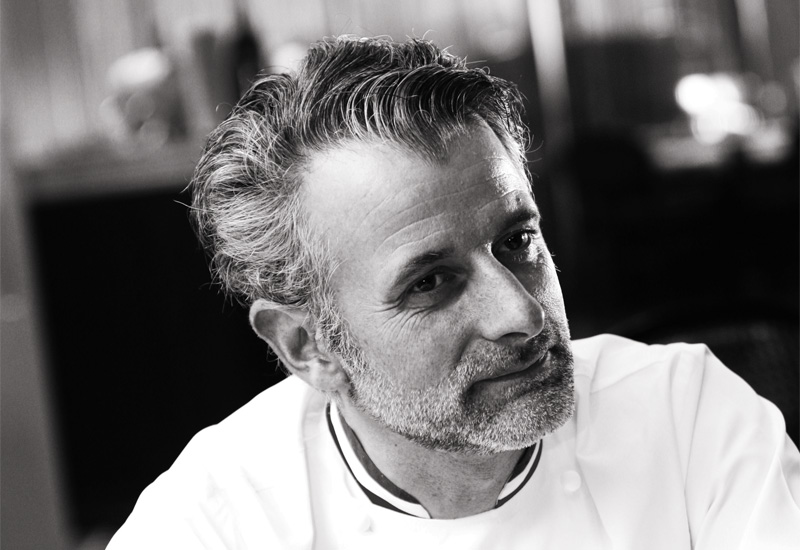
I couldn’t contain my excitement when I managed to bag a last minute interview with two Michelin star French chef Mathieu Viannay, who was in town for Gourmet Abu Dhabi in February.
There I sat, pen and paper at the ready, waiting for Viannay in one of the discrete booths at the magnificent French outlet Brasserie Angélique at Jumeirah at Etihad Towers, whose surroundings of black, ivory and gold scream Parisian chic.
I was given a little time to absorb the surroundings – from the crystal chandeliers to the stunning glasses and silverware which carry matching engraved patterns; the attention to detail at the eatery is quite beyond belief.
Guest chef, Viannay, I assumed was in the kitchen, busy briefing the chef brigade on the night’s four-course set menu, and in the à la carte section: the four starters, the four main-course options, and the three deserts. It was going to be a busy night for him and the outlet, which was fully booked.
I started wondering whether he believed the outlet was authentic-French, or just an exceptional imitation.
“No restaurant outside of Paris can be truly Parisian,” he says, snapping me out of my thought bubble.
You can take the restaurant out of France…
“This is a stunningly beautiful restaurant and I’m privileged to be here. But, it is a French
restaurant in Abu Dhabi. It has a French touch, and an Arabian touch. While encapsulating what France is about, it has its own local flavours and approach,” he adds.
I take his word for it. He should know. At the end of the day, he has dealt with enough French outlets to be able to state that as a fact, and is renowned for being the saviour of famed Lyon eatery La Mère Brazier.
Established in 1921 by bourgeoise cook Eugénie Brazier, La Mère Brazier quickly gained popularity and soon put Lyon on the map for its gastronomy. Brazier became the first female chef ever to get a Michelin star and for many years the restaurant proudly held its three Michelin stars before it headed for bankruptcy.
It was rescued by Viannay who invested just short of €1m (US $1.3m) and re-opened it with his name above the door in 2008.
He’s definitely a worthy candidate, having achieved Un des Meilleurs Ouvriers de France in cuisine which earned him the right to wear the country’s national colours on his chef’s collar. And then there’s the two Michelin stars to add to his CV.
But it’s not all about stars, Viannay tells me. What matters is that “you’ve got a full restaurant, all the time”, he says as we divert to talking about his thoughts on casual dining.
“All customers now want casual dining – good, but casual. In my restaurant, though it is two Michelin starred, it is not stuffy. It is relaxed. I think this is very important. I’ve gone down the route of trying to make it seem like à la maison – like it is at home. It has lots of dining rooms which cater from two people, to 10 people.
What customers really want
He emphasises some more that the product must be “good”, so I ask what in his mind “good” translates as. He maintains that organic is a major part of what is good.
“Customers want good products, simple but good. Organic vegetables and meat are very important as are organic eggs. I think it is important for the final product as it improves the taste.
Local is also important as it contributes to a better world. In my restaurant I work with a lot of producers and farmers near Lyon and it’s important — if I buy organic product from Chile and fly it over, it’s not in the best interests for the planet,” he says.
But another part of what is “good,” is the person behind the stove — who he insists must be passionate.
Viannay is a huge wine fan, so huge that he debated between having a career in oenology and cuisine. But he says his first job in a restaurant when he was 18 was a “revelation” for him.
Confirmation that he was making the right career choice with cooking, came in the format of
passing his two year course at the l’École supérieure de Cuisine française Grégoire-Ferrandi. But wine is still his passion.
“I always said when I have my own restaurant; I will have a strong wine list to go with it for me and my customers. In my restaurant I have thousands of different wines,” he says.
It’s not about the stars really
This passion he believes is essential and assures that F&B is not an industry one can be forced to engage in. It has to come from within.
“If you want to be a good chef, you work very hard, for five years, ten years — like a musician or artist you learn your trade over 10 or 20 years — only then can you be called a real musician or artist — you can’t just click your fingers and call yourself a chef overnight,” he says.
Good chefs are always learning, he adds: “I am learning everyday — I am 45 years old, and I learn every single day. I come here, I learn through the surroundings, a new place, new products and different ways of working.”
He adds that his trip to Abu Dhabi has also taught him many new things: “I have learned grande écart,” he says.
Surprised, I ask Viannay what else he’s learned. He doesn’t realise he’s denting my vision of him as the ‘all-seeing, all-knowing’ chef.
“Like veal — he explains. I’ve had a challenge with the product here. While good, it’s not the same as I’d find in my restaurant. I make veal truffle in my restaurant, but here it is impossible to replicate. The veal is so red! So I have to change the recipe accordingly,” he adds.
So I take it he’s not got any plans to open a restaurant in the UAE then? Well, at least until the supply of veal meets his standards?
“Well if it’s possible why not,” he tells me, revealing that he is currently in talks to open a restaurant in Japan.
French-onion soup and sushi?
“We are planning a French restaurant in Japan — like my one in France, with the same recipes.” French-sushi is my next contemplation…
“No, no French sushi,” he laughs. “I like sushi — but just in Japan — authentic Japanese sushi. It is nothing like the sushi you find anywhere else in the world. The fish moves in your rice! It is very expensive, maybe €200 or €300 for dinner, excluding alcohol, but it is the best in the world — an experience.”
Back to Abu Dhabi, he comments given the right opportunity he would be here, creating something “casual, not three-star, but good and based on traditional recipes.”
Au revoir
My time with the respected French chef is drawing to a close but not before he dashes over to the kitchen to prepare a quick entree for me to try — the Pâté en Croûte de Volaille de Bresse — or, in not-so romantic sounding English, chicken pate.
I quickly browse through tonight’s menu: steamed Atlantic sea bass fillet, razor clams and shellfish jus; mousseline of pike and lobster with mini veg and crustacean sauce and the crisp chocolate caramel with vanilla milk foam, I can see why this chef has earned his stripes.
I prepare to bid farewell to Viannay and ask whether he has anything else he would like to add. Unsurprisingly, the passionate chef seems more than keen to get back to his day job: “No, I must go and cook now,” he concludes.
The story – Mathieu Viannay
Viannay was born in Versailles in 1967 to a sophrologist mother and mechanical engineer father. The family later moved to Paris where he spent his childhood. Viannay graduated from a two year course at the l’École supérieure de Cuisine française Grégoire-Ferrandi in 1990.
Four years later he moved to Lyon and in 1998 purchased an old bar on Avenue Foch. He turned it into a little bistro, Les Oliviers allowing him to make a name for himself. In 2001 he opened his second restaurant, Mathieu Viannay.
In 2004 he became Un des Meilleurs Ouvriers de France in cuisine, allowing him to proudly wear the country’s national colours on his collar. His first Michelin star came in 2005.
In 2007 Viannay teamed up with esteemed chefs Christophe Marguin and Fréderic Berthot to open 33 Cité next to the Parc de la Tête d’Or.
A year later he went on to his biggest venture which was rescuing La Mère Brazier from bankruptcy while at the same time converting his restaurant Mathieu Viannay into a bistro. The year 2008 was also the year that Viannay earned his second Michelin star.