

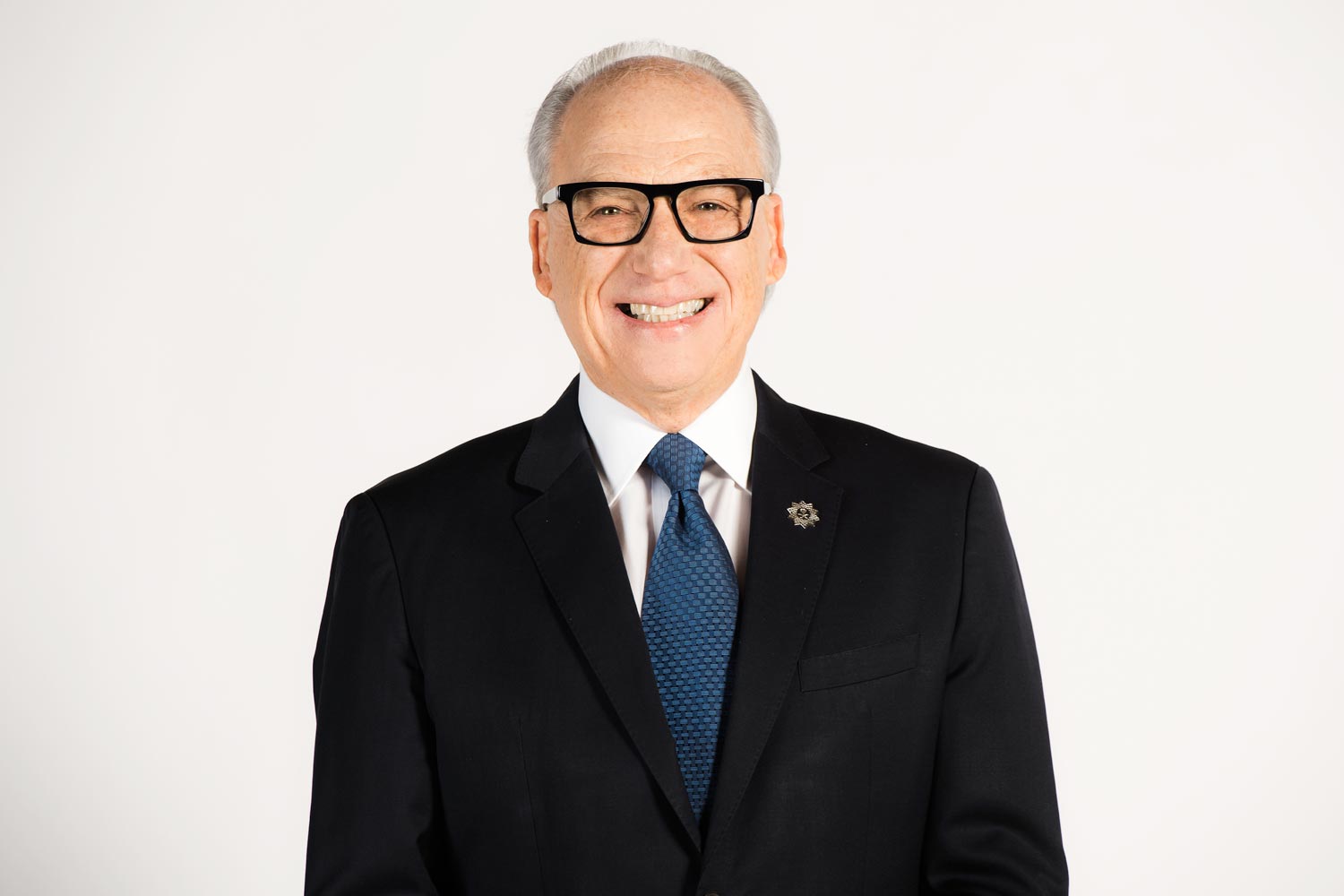
Jerry Inzerillo is one of the hospitality industry’s most influential figures, having notched up more than five decades’ experience across a wide range of companies including Forbes Travel Guide, Kerzner International and IMG Artists.
Starting out as a busboy at the age of 13 in New York, this year he was named one of Forbes Middle East’s Top CEOs in the Middle East thanks to his role as CEO of Diriyah Gate Development Authority in Saudi Arabia, part of Saudi Vision 2030.
With his thick black glasses, sharp suit and New York accent, Inzerillo looks and sounds like a character straight out of a Martin Scorsese movie. When we meet he is a natural storyteller – he often digresses like a Scorsese narrator, starting his sentences with “I’ll tell you a quick story”.
All the while, he’ll casually mention how he met Vladimir Putin or got advice from his long-term friend Quincy Jones. While a quick scroll through his Instagram reveals that one of his “most beloved friends… aka Smelly Jelly Belly” was Michael Jackson.
Born in Brooklyn, he comes from a family of five generations of bakers. His career in hospitality was born out of necessity. “My story started like tens and million around the world. I came from a nice family but we were poor,” he laughs. “The lowest of the low on the food chain in hospitality is a busboy. In those days in New York City, the busboys were unreliable as they were mostly high school dropouts or juvenile delinquents. Who is going to work a 12-hour shift for sixteen dollars?”
Inzerillo spotted a student in black trousers, white shirt and loafers, and asked them why they were dressed differently to everyone else. Once he found out that they had an afterschool job as a busboy, he asked if he could have one, too.
He explains: “I went home to my father, told him I had a job and he was proud. In New York, there were child labour laws, if you were under 16 years old, you couldn’t work past 8pm. I made my father lie about my age. He wouldn’t lie because he was principled, but a judge was nice to us and knew we were poor. Instead of writing 1954, the judge made the four look like a zero and I went from 13 to 17 years old”.
Looking back at his career, Inzerillo reflects on a recent comment someone: “Who would have ever thought or imagined that a kid from Brooklyn could not just achieve this, but even conceive it?” Inzerillo traded the mean streets of New York for Las Vegas, Dallas, Miami, South Africa and now Saudi Arabia, where he is in close contact with Crown Prince Mohammed Bin Salman Al Saud.
He says: “Sometimes people that don’t know him think he can be a bit of an imposing figure. He’s so smart, confident and is unbelievably inclusive and fair. We have a lot of input. If you don’t believe in something, we say: ‘Your Royal Highness, I’m a little uncomfortable’. He’ll ask why, we have our input, he’ll listen and will say: ‘Who did you study with? What are my options? What’s your recommendation?’”
Giga-project Diriyah Gate, 15 minutes north of Riyadh, will be transformed into a tourism destination. Built to be sustainable, it will be home to a population of 100,000 and aims to attract 25 million visitors annually. With museums, retail, restaurants and hotels, it will be a place to shop, dine, live and work.
Historical sights are at the heart of the development, however, and it will include a 3km walk offering views across the historic Wadi Hanifah and the preserved At-Turaif UNESCO World Heritage Site.
Saudi Arabia’s blockbuster projects include the futuristic city of Neom, which will have with no roads and bring Moses to life via a hologram, and the Red Sea Project, which will feature 90 pristine islands. As one of the first projects to be announced, has Diriyah has felt like a trailer in preparation for the main attraction?
Inzerillo answers: “There are two points: Not only are they not in competition with one another, they are very careful strategies to complement each other as part of a national strategy that benefits the Kingdom. What differentiates Diriyah is the birthplace of the Kingdom and where the Arabian peninsula started – there’s no debate about that. There is a necklace of jewels, but we are the jewel.”
Saudi Arabia only opened its tourism sector in 2019 and aims to reinvent its image to the world. Inzerillo says: “People are going to say to you: ‘What?’ Twenty years ago, this would normally have been a ten-year task. Now it’s a two-year task because of social media, Instagram and things like that. With Saudi Arabia, as it’s always been closed to tourism, you allow the perpetuation that it’s only desert and camels, but it’s not. Did you know it snows in Saudi Arabia? It’s like saying the United States is only New York and Los Angeles.
“When people start putting the pictures up of every place they’ve been, people will say – where is that? People collect pictures of themselves in front of great icons of the world – the Acropolis, Eiffel Tower and now they need a picture in front of Diriyah.”
So who is the target market? “First, the actual community of Diriyah. You can’t build this beautiful masterplan and leave this community behind. We feel strongly about having local visitations, studying, housing, university, hospitals and mosques for our community – that has an economic and tourism point.”
Saudi Arabia has one of the highest per capita spend on tourism in the world, but when borders were closed during Covid-19, the locals made the most of staycations. Inzerillo, who hopes this will continue and that they visit Diriyah, comments: “There is a huge Saudi market who have a reason to stay. So you break a counter tourism strategy, which is called leakage. You start correcting all the tourism money going out and you make some of that go in. You have the nationalism in Saudi Arabia and people asking, ‘where am I from?’ and ‘where is my home?’
“Then you have the Gulf – instead of everybody going to Dubai, now Emiratis will come to Saudi Arabia. Where did I start? We have pyramids, we have Diriyah. We have it.
“Saudi Arabia will enhance the regional tourism as it has so much diversity and authenticity. Someone will go to Dubai, then go to Petra and then go to Saudi Arabia. The Crown Prince doesn’t look at tourism in a Saudi context, he looks at in a regional context. We want people to come from all over the world to see Alexandra, Abu Dhabi, Dubai, Oman, Kuwait and then Diriyah.”
The staff bringing the hospitality home include locals. A big 81 percent of staff are from the country, 36 percent of those are Saudi females and 16 percent are in management roles. Despite Covid-19, the project is on track and on budget – all $20 billion of it. So far, 20 hotels have signed up and in June the partnerships will be announced.
Inzerillo says: “We signed with major luxury companies. Al Qidiya, which has the theme park Six Flags. In its footprint, it could have one-, two-, three-, four- and five-star hotels. Not Diriyah – we are only high-end and all of our hotel signings are on the five-star level.
“We don’t want F&B to be strictly elite. We have to have food and beverage offerings that serve the community, not just special occasion restaurants that you go to once a month. We have a lot of local cuisine. There are lot of products that come from Diriyah. When the international visitor comes, they’d like to taste classic Saudi food – the way the grandmother cooked it and modern interpretations. Then we have Michelin-star restaurant, Nobu, La Petite Maison and all the major brands.”
Inzerillo acknowledges that building a city from scratch is a once-in-a-lifetime opportunity. But looking at his career, he sounds like he’s had several similar opportunities, including working with Nelson Mandela. He remarks: “Happy accidents can be described as serendipity, especially when you look at the enormity of things that happen – working with Mandela and working with the Crown Prince. What I say to people is not to focus on the outcome. If you serve, things will come.
“When you get to forks in the road, they always say the same thing: Do I go predictable or unpredictable? Do I stretch or stay? You could also say someone up there has a sense of humour – just look at my career.”