

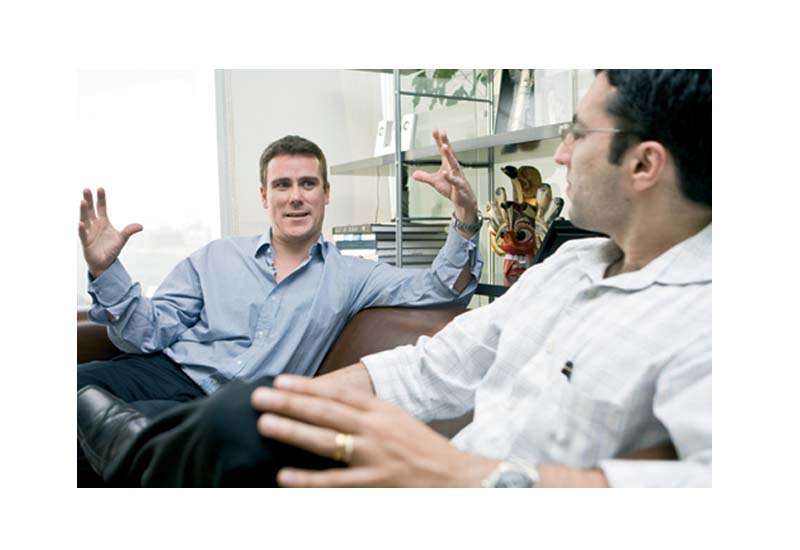
Nowshir Engineer, founder and director of EMDI, the Institute of Media and Communication, speaks to managing director of marketing and integrated communications company, Expression, Scott Feasey, about the role of meetings conferences and events in marketing.
What are people looking for when they come to you?
We are an integrated marketing and communications consultancy; essentially people come to us with challenges. They either need to increase sales, build awareness or launch products. We will look at that and provide a solution for their specific challenge.
How far do you carry that process for them?
From A to Z we will try to handle it because it needs a consistent manager controlling that process. It may be at point D and point Y that there is a third party brought in to assist, however the two controlling factors are the client and us making sure there is continuation with brand communication at points of contact with the consumer.
How do you source your suppliers?
We have a supplier’s guide of approved suppliers that we have worked with. Notes are made by account handlers, so if we have a bad experience that goes into the guide. The other account handlers will know there have been some issues and it means we can keep on top of who we use. Normally we find there are three or four suppliers that have delivered time and time and again. If a supplier gets too bad a mark they are removed from the list.
Would you say there is a leaning to a particular form of marketing in the region?
Sadly in this part of the region people tend to bow to the four gods of advertising outdoor, press, TV and radio and tend to miss quite glaringly obvious and better ways of communicating to their database. Direct marketing is not used particularly well here, mainly because of having no letterboxes, names and addresses and the way we do things here. Events are underused and sponsorship seems to be just to shout, rather than using it to properly communicate with the target market.
Do you deal mainly with long-term client relationships?
We would like it to be more long term, but because clients have immediate needs and we are doing our job properly, those needs wont come back. We go in, we do it and they are happy.
There are, of course, clients with ongoing needs and that’s a good client and a good relationship is built as we learn more about them.
Have you noticed any trends in the marketing sector?
I predict that there will be a greater spend in the coming months on below the line marketing. Whenever you go into a recession, generally clients start falling to below the line activity which is great for meetings, incentives and conferences – things that go directly to the consumer, and the key is there accountability.
Below the line is traditionally more accountable. I’m not sure we will see it in this region, but if we do start to see tightening of purse strings, then I guarantee you will see more below the line mechanics.
Does a recession help improve the product?
I think it does. It is a bit of a sweeping statement to say economic downturn means you get a better product for the consumer, but certainly everyone is fighting harder of the share of a smaller pot, so it tends to focus marketers and clients and you can end up with a better product.
Five years ago probably 80% of your business was the four gods of marketing with 20% below the line. Has the ratio changed?
It is moving, but it is still early days with 60% to 70% above the line media spend. What is interesting is we are now getting clients asking to be creatively different. With them wanting for you to be more creative you are getting different marketing mediums requested.
Would you ever recommend a client to sponsor and brand an event?
Absolutely and, again, I think underused here is event sponsorship. I think events are a hook to hang so much more. Logos, ads, you have this captive market you could do so much more with. Exhibitions are a great way for businesses to get in touch with their consumer, seminars and conferences as well.
If you are trying to raise awareness to a mass market then sponsorship of an English Premiership football team is a great start. If you have that sort of budget then that’s what you have to do, but it’s part of a bigger picture. You can’t just have a name on a shirt – you’ve got to have the website to give the customer a way into the brand.
Do you have to have a lot of other activities to activate a brand after sponsorship and does this remain cost effective?
It becomes very costly at the highest level. Take NIKE and Manchester United. They are not just sponsoring the team, they are sponsoring individual players like Ronaldo who they will choose to be the face of NIKE in a Manchester United shirt. When he says he is off somewhere else, NIKE have a contract with Manchester United to have him for three years. All that comes in and the level and detail comes in to play and people don’t realise that.
But sponsorship is a great awareness builder. You can communicate your product, but signing the deal to sponsor is just the beginning – you have to leverage it in the right way.
Just like buying an empty billboard, you have to fill it. So exhibitions, meetings and conferences are extremely important to be on the marketing plan, but they have to be used effectively and at the right time.
What is the one thing you suggest a company does before they come to you?
That’s extremely hard because there are about 10 things. I suppose the most import thing is to come with a passion and a desire to get results. We want to get results for our clients and we would hope that they are as passionate and adventurous about getting those results.