

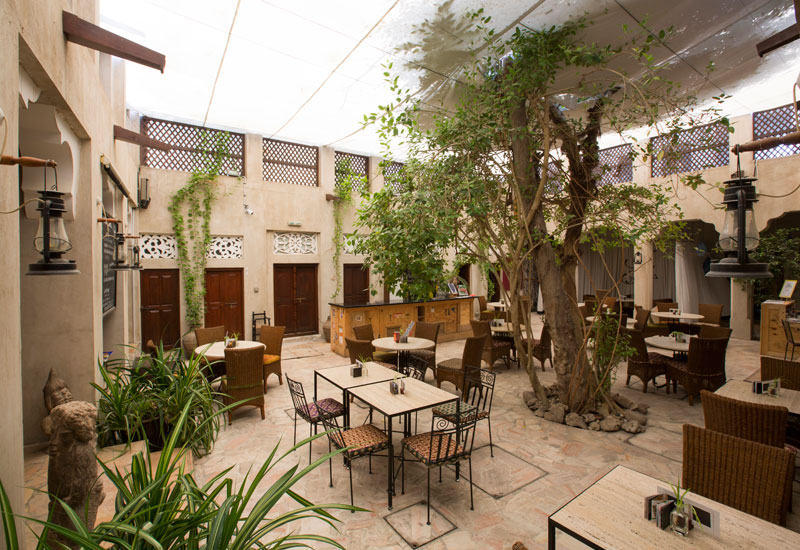
Since first opening in 2008, XVA Art Hotel has pursued a vision for merging heritage and history with a passion for sustainable development, resulting in a boutique property, located in the heart of the Al Fahidi Historical Neighbourhood, the oldest community in Dubai.
“This is a philosophy that goes deeper than occupancy and revenue, this is a very positive way of living,” says XVA Art Hotel general manager Moses Barnabas, sitting in one of the hotel’s three tree-shaded and air-conditioned central courtyards.
“This hotel had very humble beginnings, initially opening as an art gallery in 2003, launching to promote and encourage local artists from the Middle East and North Africa, then as it started attracting more interest, the café launched and then finally the hotel opened.”
Barnabas touches on the hotel’s origins and how three hotel rooms became the 14 we see today. “The hotel owner, Ramona Gail Hauser, is the matermind behind XVA Art Hotel. It has taken years to achieve all of this, growing steadily.”
Each room at XVA Hotel is individually themed, based on local inspiration, including the Dishdash room, Henna room, Gallery room and the Gutra suite. “From the very beginning all rooms were connected to Emirati culture in one way or another,” explains Barnabas.
“Hauser had the fantastic idea of including original art and local culture into the rooms, so essentially you are living and sleeping in an art gallery, and all the art you see here is for sale too,” he continues.
“This touches on how we are different; firstly the structure itself is original and been restored, secondly, its design speaks about Islamic culture, and thirdly the space is used in such as a way that is in keeping with local tradition.”
With its three original wind towers, a lounge and rooftop area, the building itself was originally built for Iranian trading, Barnabas says, as the rulers at the time wanted Iranians to come and develop trade in the region.
As times changed, XVA Art Hotel was conscious of the need to innovate, says Barnabas, noting the hotel has long positioned itself as a socially responsible and environmentally sustainable offering, with a diverse range of projects and initiatives working towards this common goal.
For example: “An ongoing project at XVA Art Hotel is the installation of LED bulbs. Originally, we were using incandescent bulbs, but we wanted to keep the actual heritage lanterns, while changing the internal bulbs to be more energy efficient. Phase one of two is already complete; we are currently waiting for the remaining old bulbs to expire before replacing them with energy efficient ones – I think within the next three months we will have replaced all of them.”
Other key projects implemented in pursuit of lower resource consumption include the installation of water aerators. “Installed in early 2014 in all of the rooms, our water aerators control the flow of water by mixing it with oxygen.” Aerators are widely recognised as inexpensive and simple to install and can reduce water consumption as much as 50%, thus reducing energy cost by as much as 50%. The savings in a hotel’s utility bills will pay for the cost of the aerators in no-time-at-all, according to Barnabas.
Perhaps most the creative and resourceful of all the projects found in XVA Art Hotel are the recycling programmes. “Because we have an art gallery with artists coming from all over the region – their artwork arrives in large wood crates. So we segregate the crates and recycle the wood for furniture in the hotel. Be it a desk, shelving or the counter at our hotel café – we will have reused all materials, there’s no wastage – we’ll put as much as we can to good use.”
This attention to detail can also be found in the hotel’s paper recycling programme. Barnabas adds; “We make our own paper for use in all the welcome notes, menus and guest comment cards, it’s all recycled materials.”
XVA Art Hotel has in-house tailors on-hand to put discarded fabrics to good use too. “Guest towels that can no longer be used for their original purpose are collected and recycled into rugs for use in the guest’s washrooms. Guest laundry bags are made from old pillows – when they’re no longer suitable for their intended use in rooms, you just have to open the cabinets in each room and you will see their new purpose.”
He adds: “We make our own curtains and all the textiles in the rooms too – you’ll find this throughout XVA Art Hotel, we will waste no materials if we can avoid it. If we do have excess materials after all this, we’ll even make bags for slippers to put in each guest room. Everything is being used practically and resourcefully here.”
Food, farming and the sustainable supply chain
XVA Café offers Middle Eastern inspired vegetarian options in the hotel’s courtyards and dining room. “Our vegetarian café philosophy is very much connected to our desire to be sustainable. We wanted to extend this way of living to our food and beverage offerings, to also enhance guest experience.”
In a report on global warming, the United Nations stated that raising animals for food generates more greenhouse gases than all the cars and trucks in the world combined, a fact not ignored by Barnabas. “The vision was always to be vegetarian; unless there’s an event then we will cater to other diets, but from a health and environmental aspect we want to pitch a new experience and vegetarianism is linked to this.”
Urban farming is the next big project to launch at XVA Art Hotel, says Barnabas, in pursuit of sustainability.
“The idea is to grow your own produce in an urban environment – it’s certainly not a new concept, but the reason why we want to take it on here at XVA Art Hotel is because it’s a fulfilling experience for us and our guests.” He continues: “To take fresh produce from our own garden and cook it right here in XVA Café is to educate guests on healthly living.”
He adds: “I envision that our guests will become involved in this whole process – they’ll visit the garden, learn about the health benefits of locally produced food and then enjoy the recipes served fresh.”
Barnabas acknowledgs that the plan is to have a mix of local suppliers delivering food alongside the hotel’s home-grown growing produce. “It’s just practical; we have two rooftops allocated for garden use; as it progresses, we’ll introduce more plants and grow greater varieties of fruit and vegetables.” At present Barnabas says that launching the urban garden is still a waiting game, as the hotel needs to receive all the official approvals in order to go ahead. “Once we have approvals – we are ready to move forward; we’re now waiting for the green light.”
Inline with the urban farming plans, XVA Art Hotel has also been composting hotel waste for over one year now. “Food waste from the kitchens is all composted off-site, what’s goes out in trash is minimal – but where food is concerned we don’t see large wastage, and we don’t want to.”
Sustaining the demand
On the topic of competitors in the region, Barnabas is confident in what XVA Art Hotel is offering: “In all fairness, I’d say we are completely unique; for example, I struggle to find another hotel that has an art gallery promoting artists from the region, artists whose lives have even been transformed because of the opportunities we have offered.”
He continues: “We want rates and occupancy to increase, but that’s not why we do this. It has no impact on room rates. Look at our website; you won’t find a word about all this sustainability, what you see online is the rooms and the hospitality experience we offer. All this work in terms of sustainable development, we’ve never highlighted that, but we do hope that people see it.”
He concludes “It’s the creativity that goes into everything the owner has done here that keeps us so passionate. The main thing I learned during my time here is to develop a sense of appreciation for everything you have in life, that’s what XVA Art Hotel is all about.”

