

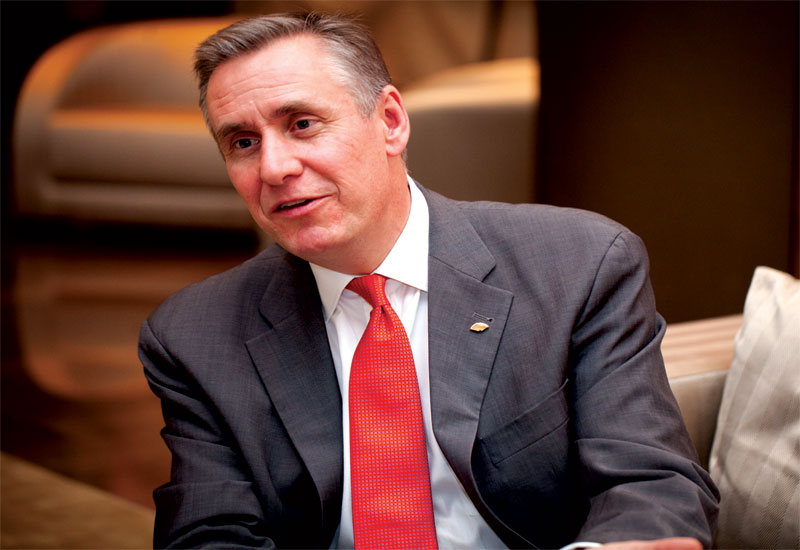
With Mandarin Oriental gearing up for regional expansion, sales and marketing director, Michael Hobson, explains why the hotels are a perfect fit for Middle East guests.
The Middle East has long been seen as a lucrative source market for hotel companies looking to promote properties in Europe or South East Asia, and Mandarin Oriental is no different.
But in addition to attracting Middle Eastern guests to hotels around the world, the company is now planning its regional expansion, with two highly-anticipated properties — the Mandarin Oriental Doha, and the Mandarin Oriental Abu Dhabi, both scheduled to open in 2014.
Underlining its commitment to the region, Mandarin Oriental recently held a number of workshops to promote its hotels and connect with business partners from across the Middle East.
“Obviously this region is very important to us as an outbound market in particular,” explains sales and marketing director Michael Hobson.
“The workshops are a good chance for us to either establish relationships or re-connect with people we are already doing business with. They provide an opportunity for all of these people to get around and spend time in each and every hotel they are doing business with in a very efficient manner. We have found that the formula works very well.”
He adds: “I think that the workshops help us to understand the needs, wants and preferences of our key customers and bookers so we can now respond to that accordingly. We must also consider that this is a business that is very fluid so there are always updates from our side, but also from their side as well. It is all about working together as partners.”
But finding the right partners is crucial for the hotel brand, stresses Hobson, who is on the look out for agents who can deliver the “right” sort of clientele.
“There needs to be a good match between the partners we work with, and the Mandarin Oriental customer — we are really interested in identifying those agencies that can deliver us the right customers and then we can really approach them with incentives to attract that clientele.
“We are always looking to find that match, and when we do find it we are always delighted to host those agents to come and see us and to experience our products and services,” adds Hobson.
Continuing to find partners in the region is an important step for the company, which is on a drive to increase business from the region.
The Middle East currently accounts for “very significant” proportion of the company’s global business which, despite the global economic downturn, is continuing to do well.
“We had a very good 2010 and the business rebounded much faster in 2010 than anybody would have anticipated,” says Hobson.
“The first quarter of this year has been very strong so far. We seem to be on track and on pace. It is marginally ahead of 2010 on a booking pace, not dramatically so, but marginally ahead and I suppose with the events in Japan — if we put those to one side because that is a situation of its own — everything else seems to be going very much according to plan.”
There is no doubt that unanticipated events are also rocking the Middle East hotel industry at the moment, although Hobson anticipates that the regional unrest won’t impact negatively on Mandarin Oriental’s global business.
His stance is that certain destinations will stand to benefit as Middle East travellers flock further afield for their holidays this year.
“We think that it [the unrest] may have a positive impact in certain markets — in the obvious markets of London, Geneva, Munich, Paris, as well as Kuala Lumpur, Singapore and Hong Kong, which are favourites with Middle Eastern travellers. So we feel that there are many destinations which may actually be impacted positively.”
Looking ahead to 2014 and the launch of Mandarin Oriental’s first properties in the Middle East, Hobson says the company is “very excited” by the prospect of having two hotels in the region.
“There was a wonderful opportunity to join the development of Saadiyat Island in Abu Dhabi and we are pleased to have been given that opportunity,” he reveals.
“When we are given any new developments we are always looking at it from a brand standpoint as well as a commercial standpoint and, as any management company would attest, those hotels need to be commercially successful for any owner in order that we can all benefit from it and so that brand standards can be maintained.
“So when we look at a new project it has to fit a number of criteria and all the projects in the region have so far manage to do that.”
The company’s second property in the region will be in Doha, Qatar — the much publicised winner of the World Cup 2022 bid, which Hobson is clearly pleased about.
“I think things like the World Cup and other similar events around the world have a positive impact in showcasing the destination, and obviously business for that particular period usually benefits because of the increased demand,” he says.
“However, it can sometimes be overcooked, and the industry has to be careful that they don’t kill the goose that lays the golden egg — people can often get ahead of themselves and start overpricing for that particular period.
“Obviously, at the end of the day, we are a commercial company and we are responsible to our share holders and like all other hotel companies we are responsible for delivering optimal revenues, but I think as an industry one needs to be careful of not being seen to be gouging the market.
Overall these events highlight the destinations themselves, which then has a much longer-term impact on tourism,” he adds.
And could any further regional expansion be on the cards for the brand?
Hobson hints that Abu Dhabi and Qatar could signal just the beginning for Mandarin Oriental’s presence in the Middle East: “These hotels will be our entry point [in to the Middle East], but there are many cities and countries within the region which would be attractive to us”.
However, Hobson stresses the company will think long and hard before opting to develop any more hotels in the region, as with Mandarin Oriental, its always a case of quality before quantity.
“As you can imagine we are often presented with projects, which perhaps do not meet the criteria where we feel we can provide a quality, luxury experience for the Mandarin Oriental guest,” Hobson explains.
“As a company we are not trying to be the biggest — but we are always trying to be the best.”
Curriculum vitae
Michael Hobson is the sales and marketing director for Mandarin Oriental. He joined the company in 1994 and has more than 30 years of experience in the hospitality industry. Hobson holds an MBA from the University of Leicester.