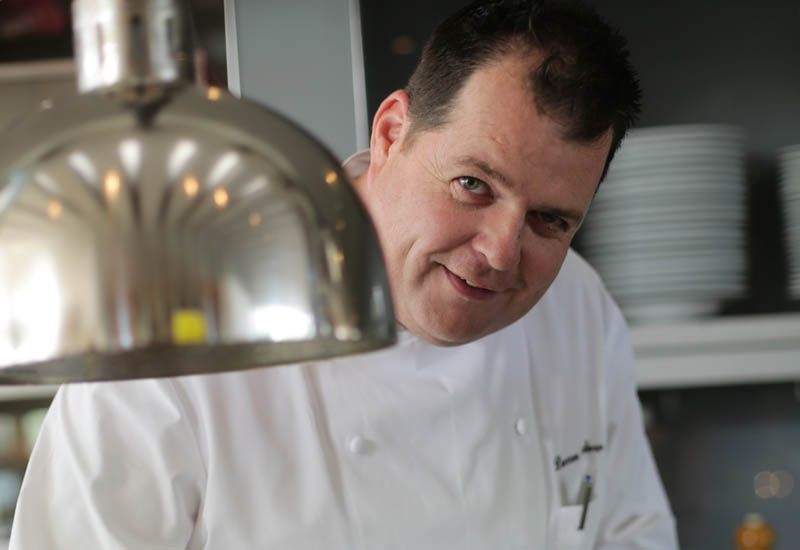
The fourth annual Caterer Middle East Chef & Ingredients Forum 2015 saw a crowd of chefs and F&B operators gather at the Grosvenor House Dubai on October 6.
The usual issues of supply chain and staffing challenges reared their heads, but new discussions this year included restaurant refurbishment and the effect of discount vouchers on operational costs. A further highlight of the day was an on-stage interview with keynote speaker, Michelin-starred chef Jean-Georges Vongerichten.
PANEL 1: 10:05 AM
Local, Organic & Sustainable — keeping up with the supply issue
Chefs discussed on the rise of local produce and the trend towards using of organic ingredients on the panel session moderated by Gates Hospitality CEO Naim Maadad.
“There has been a 275% rise in local farm produce from in and around the UAE. A farm in Sharjah, that is about 2ha in area, has assumed an important position for our group of restaurants as we source a lot of ingredients from there. The family-owned farm use natural methods of growing vegetables and we are happy with the produce,” said Akshay Nayyar, corporate chef — EMEA, Sanjeev Kapoor Restaurants.
In the past, chefs have been wary of using local produce, but many are now keeping an open mind to what’s on offer locally.
“I visited a local market recently at Al Aweer, and was pleasantly surprised with the ingredients on offer there. The price point was very competitive, and I would recommend chefs visit the local markets more often,” said Izu Ani, head chef, La Serre Bistro & Boulangerie.
But Ani said he will not buy local “for the sake of it”, adding: “I will invest to make my customers happy, not the economy.”
Meanwhile, Dirk Haltenhof, resort executive chef — F&B production, Madinat Jumeirah, spoke about what farmers in the UAE should cultivate. “It doesn’t make sense to grow pumpkins, which will require as much water as an entire swimming pool to grow just one.
“At Madinat Jumeirah we have our own little back garden where we cultivate herbs, chillies and baby tomatoes. We educate our guests about it and more often than not we are appreciated for our efforts,” he added.
For much of the produce that the UAE or its neighbouring countries cannot grow, chefs need to be extremely careful from where and how they source.
“They need not get drawn into the organic fad. Mentioning the word ‘organic’ on the menu does not translate into demand from guests,” said Sascha Triemer, vice president, culinary, Atlantis The Palm. Almost all of the chefs unanimously agreed with his sentiment.
“Another aspect we need to consider is whether people are ready to pay the premium for organic dishes. The answer is no; it’s often expensive on account of the cost of ingredients,” said Nayyar.
PANEL 2: 11:00 AM
How to stimulate innovation in the kitchen
Kitchen design is a complex and expensive part of developing a restaurant, but often the last element considered, said panel moderator Edward Harvey, managing director and general manager at Tricon Foodservice Consultants, Dubai.
“Sadly, it’s the last element of the thought process. And regrettably there’s insufficient expertise, time and financial capital involved to facilitate it,” he said. “In a hotel, the challenges of accepting a poorly designed kitchen can include an impact on morale, efficiency and the profitability of the operation.”
St Regis Saadiyat Island Resort, Abu Dhabi executive chef Malcolm Webster agreed and said: “It’s very challenging. It’s important to work with the owners, make them understand the need for investing funds into a kitchen in terms of workflow, processes and equipment.”
He said that chefs often get access to kitchens that aren’t optimally designed, but “at the end of the day, you have to make it work”.
Nicholas James Cuadrado, executive development chef, JRG Dubai, said: “A lot of kitchen design is inherited, so you have to try and work with the kitchen you have, to ease the workflow. That’s how I look at it.”
Luis Pous, executive concept chef, Asia de Cuba Worldwide, remarked: “It’s easier to do it at the beginning rather fix it later. When you develop a kitchen, you need to know the menu first. Sometimes the investors don’t even know what they want, they spend on different equipment and then they start changing the menu, and some of the equipment may not be used.”
The panellists unanimously agreed that the sooner chefs can get involved, the better it is for the investors and their capital investment costs.
CASE STUDY: 12:30PM
Revitalising the Asia de Cuba Brand
Less than a year old, Asia De Cuba Abu Dhabi is part of the brand relaunch of the concept originally created by Jeffery Chodorow. “This is a legendary brand,” said Nick Fielding, director of operations, Asia de Cuba Worldwide.
“Not only has it been featured in popular sitcoms, it is an important milestone in the culinary journey of fusion cuisine.”
Luis Pous, executive concept chef, Asia de Cuba, has been with the brand for nearly two years. “Mixing soy sauce and black beans does not result in fusion food; you have to select the ingredients that work. And, ultimately adapt to the market you cater to,” said Pous.
Asia de Cuba first opened its doors in 1997, and operated initially from single sites in the US and UK. But after 15 years the brand opened its third outlet in Abu Dhabi.
The old mid-town New York outlet made way for a new offering in Downtown New York. And the London branch benefitted from a strip-down and refurbishment.
Success has been hard to gauge so far, as the brand only recently relaunched. But Fielding and Pous are satisfied with the way that Abu Dhabi residents have taken to the brand.
Meanwhile, a few menu changes have taken some getting used to for the London restaurant’s faithful, but Pous believes this is nothing to be alarmed about.
“Following the changes we made to the menu, we did receive a few raised eyebrows. However, it is not something that would make them lose their faith in our restaurant,” Pous concluded.
PANEL 3: 1:00 PM
The Discount Voucher Deal Dilemma
Discount and voucher deals are useful tools to boost off-peak custom to the region’s restaurants, but must be used selectively.
Jason Pettit, brand chef at FoodMark, called discounting a “necessary evil” and explained: “It’s a good way to drive footfall and increase revenues for certain day parts, but don’t cannibalise your sales. Recognise your strengths and the trading patterns of your brand and maximise the opportunity.
“It’s a tool to open you up to a wider audience, but as an everyday offer it becomes damaging.”
The panel, chaired by Nicholas Couvaras, MD of Kroma, warned that restaurant operators who over-use voucher deals will get a reputation for discounting and be frequented by deal chasers, rather than loyal customers. “You won’t see them again until the next discount,” predicted Pettit.
Ryan Waddell, executive chef at Reform Social & Grill, revealed that the Entertainer ‘buy one get one free’ deal brought in AED1m of business to the gastropub in the past year. He said the benefit of that offer is that it can only be used once. “Hopefully they’ll enjoy their meal and come back again.”
There is no discounting at his new venture, the Black Lion. “The alternative [to discounts] is to work your menu – change it every three months to keep it exciting. With quality and consistency, if people love the food and the atmosphere, they will want to return.”
Manoj Aswal, head chef at Bukhara at Kempinski Hotel Ajman, agreed: “The guests who drive your business are the ones who come again and again. Word of mouth is what makes restaurants run forever, not discounts.”
Pettit admitted that — with increased competition and rises in the cost of living — discounting is here to stay. “Consumers are more conscious of where their money goes, so discounts come into play. And busy restaurants are psychologically good — people walk by and see it’s full.” And that makes them want to come in, he added.
Daniel Lewis, senior corporate chef at RMAL Hospitality, said that UAE consumers’ expectations of discounts are increasing. “The days of just offering glass of wine or an aperitif are gone. So it can take a lot out of your earnings,” he said.
The panel agreed that restaurant operators should explore collaborations with suppliers to work together on discounts and promotions, and meet somewhere in the middle on margins and costs.
HOW TO…
The How To sessions returned this year. Madinat Jumeirah resort executive chef — F&B production, Dirk Haltenhof, presented on how to stimulate innovation in the kitchen, and shared insights into how he works with his team of chefs to constantly innovate in a challenging market.
Asia de Cuba Worldwide director of operations Nick Fielding gave a presentation on how to manage the expectations of different generations of hospitality employees and customers, and hosted a discussion on staffing challenges then and now, as well as operational differences.
A chat with… Jean-Georges Vongerichten
OUR FAVOURITE QUOTES FROM THE DAY:
“When I was 16, my parents took me to a three-star Michelin — in 1973. When I saw the ballet of the waiters, the cooking… I turned to my parents and said, ‘this is what I want to to do.’ Ten days later, I was in the kitchen.”
“Lighting is important for a restaurant because people spend 2-3 hours in a space, and the wrong lighting is not flattering for people or the food. The ambiance has to be there as well. A good lighting makes you want to sit there longer, maybe consume more.”
“I’m also working on a vegetarian restaurant. More and more vegetarians are coming to restaurants everyday — globally, in Paris, in Dubai. People want more balance between proteins and vegetables.”
“Rents are more expensive, it takes a lot of money to open a restaurant today. To a young chef, I’d say: start small.”