

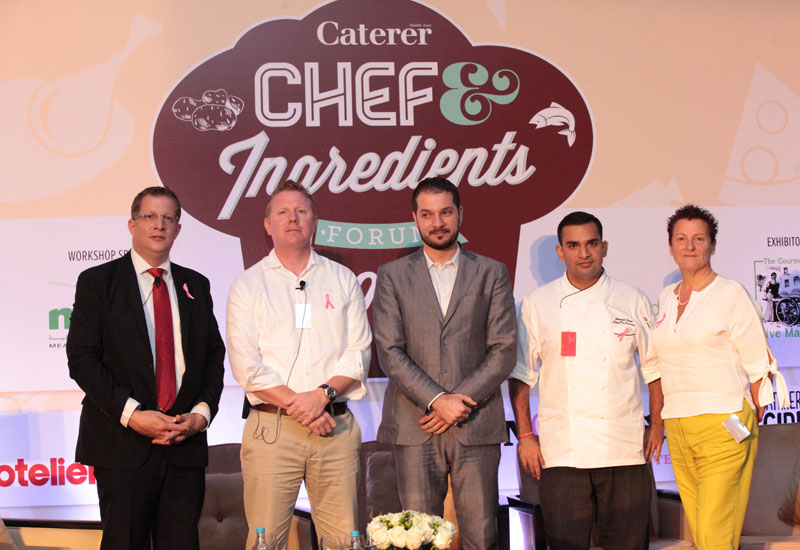
The third annual Caterer Middle East Chef & Ingredients Forum took place on October 8, 2014, at Grosvenor House Dubai; we review what happened on the day
The Caterer Middle East Chef & Ingredients Forum ended on a successful note on October 8, 2014, after jam-packed panel discussions, workshops, and presentations — along with the launch of the first Caterer Middle East Recipe Book. The event was held at the Grosvenor House Dubai, and saw 100 chefs interacting with each other on a variety of issues.
Seasonality Stands
In the first session moderated by Jumeirah Group corporate director culinary Christian Gradnitzer, we discussed how chefs determine what produce is in season.
With customers becoming more knowledgeable, how can the region’s restuarants account for seasonality, and where does the produce come from? Zaya Retreats executive assistant manager, culinary and F&B Carl Stockenstrom said: “We have to be true to the fact that we are living in the desert.
There is a very small market for what is grown here, with a majority of food imported into the country.”
He pointed out that while there is produce all year round locally, it is a very limited selection.
Rang Mahal by Atul Kochhar head chef Amrish Sood said there were various ways in which to let the guest know what produce is in season.
He explained: “Visual impact plays a major role — if I want to talk about a vegetable in season, I display it so it appeals to the guests and it makes them more excited about what’s available in the kitchen. You can also have farmers’ dinners, where you invite farmers, local producers or local buyers in the region to dine with us.”
He added that writing new menus regularly to reflect seasonality is another way of impressing the issue upon consumers. Furthermore, Sood said it was equally important to have the front-of-house team involved in knowing more about ingredients used.
The Palace Boutique Hotel’s Masso executive chef Susy Masseti said she was in a fortunate position to be able to grow her own herbs in a garden. “I also use a lot of local farmers and lot of fresh local seafood, which is seasonal. In this region, seafood is highly seasonal. Customers are very happy for us to propose and give them only what’s good and in season.”
Baker & Spice Dubai operations manager Mohamad El Chehimi said the current situation is much better than five years ago when it was very difficult to source local produce.
“We, as leaders of companies and restaurants, control the production, the consumption and expectations of our customers. There are more than 50 items of fruits, vegetables and herbs, that are available for more than six months in a year. Once we are done with the local production, we look in the region — Saudi Arabia, Iran, India, and the Middle East. We look at things that come by road rather than by plane. We go to the market ourselves to see what is in season. Not more than 5% of imported products are used by us.”
Countering the claim that local and organic items are more expensive, Chehimi said the more chefs choose to buy locally produced organic vegetables, the more farmers will be supported, and the prices will slightly drop.
So why don’t more chefs buy local produce? Chehimi mused: “Maybe because they are lazy to do the research and go out there and speak to farmers and suppliers.”
Massetti, however, countered and said that in a city like Dubai, where most of the chefs belong to big hotels and groups, they don’t have the freedom to talk to the suppliers, or find their own. “And even if they do so on their own, go to the purchasing manager and tell them, it doesn’t go anywhere.”
Chehimi responded by saying that those working in purchasing should be more open-minded — because it does reap benefits.
“My advice to all chefs is to contact their owners, make a plan to try organic and seasonal, and prove it can work. Since we started our business, we have always looked for local, organic, seasonal, and when we have no choice, we import. Since then, our food cost has never exceeded 23%. With beverage, the maximum is 25%.”
The forum continued on this theme with a short presentation by Emirates Hydroponics Farms hydroponics horticulturist and marketing director Rudi Azzato. He said when the firm started in 2006 the market did not understand what hydroponics was. He also revealed the farm saves up to 90% water as it is recycled and filtered.
Azzato said that while the farm is not HACCP-certified, if greenhouses are designed in an efficient manner, hydroponics can be pesticide-free as well. He also revealed the firm is planning to build a new glass greenhouse by the end of 2015, which will be 57,000m2 and “will change the industry”.
The Extinction of the Kitchen Apprentice
The next discussion swiftly moved on to matters of training and how to encourage people to enter the industry and stay there, and was moderated by Radisson Blu Dubai Deira Creek director of kitchens and Emirates Culinary Guild president Uwe Micheel.
He started off the discussion by saying there are many in the F&B industry who can’t afford to attend hospitality schools and therefore enter the workforce with not a lot of knowledge.
The Act Dubai head chef Roberto Segura said the best way at this point was to train staff members themselves. He said: “If we hire a commis, we should spend a two or three hours with them per week and teach them the basics. You need to go back to the basics from school to teach them.” But he admitted this has been difficult.
Bushman’s Restaurant and Bar head chef Natalie Bolt added: “My greatest challenge is not just the training, but that they are coming for a job. As a chef, it is not just a job, it is a passion. We have to inject the passion, then we have to train them. To do this, I believe the government has to get involved.”
Bolt said that because Dubai is relatively new in the culinary and hotel scene, the government needs to support in the education process. “We can’t be doing this as one corporation or one individual restaurant. We need to go as a united front,” she explained.
La Serre Bistro & Boulangerie head chef Izu Ani pointed out that many people who come to the region do so thinking of it as a transition phase. “There’s a very long tradition in Europe to have an apprenticeship … you figure if the people coming into the industry have a heart for it. Either they carry on or they fall by the wayside and do something else.”
He said that if he sees a person with a willingness to learn, he will help, but agreed with Bolt that the industry as a whole needs help from the government to bring the planning tools and provide a structure “so we can easily share our knowledge with those who want to come into the industry”.
Bolt reiterated that culinary school is important to grow as a chef. Ani agreed and said the new generation should be trained properly to take the industry further.
He revealed: “At the moment, I’ve got a connection with a school in France which takes interns for six months. It helps to generate enthusiasm from the new generation.”
Bolt said training is not about filling a form; rather, chefs train every second of the day. Ani agreed and said: “Passion is not something you can instill in people; it’s something you can enhance. You can encourage them and give them more tools. But they have to love it first.”
International Centre for Culinary Arts director and CEO Sunjeh Raja said: “When we see people coming to culinary, they expect a lot more. They have a lot of knowledge but they don’t have the experience.” To counter that, Raja added: “Throughout the whole training programme, we try to expose them to and make them aware of what the industry is. We make them 16-hours ready.”
Micheel however pointed out that a “three-month school cannot replace a three-year apprenticeship. It’s just not possible. The biggest issue is that the expectation of the kids is very different. They think that after three months of school they are Gary Rhodes”.
Increased Competition and Restaurant Rivalry
The final panel discussion was based on the results of this year’s Caterer Middle East Head Chef Survey, which showed many chefs viewed this as a concern. Capital Club Dubai general manager Emma Cullen asked the panel whether menu engineering helped enhance the competitive edge.
Frankie’s Italian Bar & Grill executive chef Fabio Nompleggio said what makes a difference in an area of growing competition is consistency. He said: “Just be yourself and make what you know how to make. Don’t make what you just think is good.”
InterContinental Dubai Marina executive chef Stefan Beer revealed that the infrastructure given by a hotel is much bigger, where there is a dedicated sales and marketing department working to spread the word, whereas in a freestanding restaurant, things are more flexible.
Beer acknowledged the trend of hotels trying to operate restaurants as a free-standing element, and said it was not a controversial topic at all. “You recognise the guest and customer needs, then you operate like a freestanding restaurant. You have to be very careful with your customer base and you have to know what people like and you need chefs who are able to talk to the guest.”
He said: “The time of chefs inside the kitchen are gone. I don’t want the chefs hiding in the kitchen. In Shanghai, when I started my career I had to face the guest and it was very tough for me but after a while I got used to it.”
Bice Mare Dubai executive chef Francesco Guarracino said the problem with Dubai is that everything moves very fast. He added: “A restaurant is open today, and then closed tomorrow because there was a better one [for guests to go to].”
He admitted that the restaurant hosts a lot of events where they invite regular guests to make them feel part of the restuarant. “We try to make customers feel special, even if it’s just remembering their favourite prosecco. We need to make sure they come back. It’s not an easy job, but without customers my job is useless!”
Guarracino also echoed Beer’s comments and said it was definitely necessary for chefs to meet with guests and go front-of-house on occasion. He explained: “I’m very lucky because I have a very strong team and that gives me the chance to touch every single table. The day after, I will search for the customer details and thank them for coming. I tell them I will appreciate them returning, and say that anytime they will be around to let me know. I give them my personal number and we become friends on Facebook. This is how I do it.”
Nompleggio agreed and said 50% of the chef’s job is customer engagement. “Guests want to feel the hospitality, feel like they are extra special.” He proudly revealed that return customers at his outlet account for around 70% of covers.
The Caterer Middle East Chef & Ingredients Forum raised many questions, which we hope to follow up on through the coming months. For any feedback, please contact devina.divecha@itp.com.
The Caterer Middle East Recipe Book
The Chef & Ingredients Forum saw the launch of the inaugural Caterer Middle East Recipe Book. The 296-page book includes recipes, masterclasses, personal thoughts, and tips and tricks from 70 of the UAE’s finest chefs.
On the day, Caterer Middle East editor Devina Divecha launched the book, and spoke to some of the chefs who were a part of the project. These chefs [see photo below] shared their experiences from working on the production of their recipes, getting photographed by ITP’s photographers in their kitchens, and what they enjoyed about it.
Every delegate at the forum walked away with a copy of the book, and sent positive feedback about the quality of the product.
For further enquiries, please email recipe@itp.com.
NOURISH — CHEFS UNITED
Russell Impiazzi, Culinary Director, Food & Beverage, Galeries Lafayette AND Robbie Stokes, Executive Chef, Al Badia Golf Club revealed more information about Nourish — Chefs United Fund and what it hopes to achieve: Impiazzi and Stokes have come together to launch ‘Nourish — Chefs United’ to raise awareness about breast cancer, inspired by the challenges faced by Stokes’ wife Claire. The team held their inaugural ball on October 30, at Fairmont The Palm, Dubai. At the time of going to print, 12 regional chefs were confirmed to be cooking for the event.
Stokes said during the forum: “Tickets have sold out already, before even going online, which shows the support the industry is willing to give. Without all of [the chefs] the event would not be possible. So a big thank you them all.
This is our first event and we hope to do more in the future. You can all help by holding your own events for this cause. And remember that in our industry, where we all work so many hours, we spend more time at work than with our families — we need to show support for each other whenever we can.”
Impiazzi said: “When you hear stories like Robbie and Claire’s, you can’t help but want to get involved. Dubai is a place where there are so many problems and so often we walk past them. But this time what we’ve managed to achieve with the chef jackets tells me the support is definitely there within the chef community.”
The duo said they wanted chefs to support the #ChefsUnited hashtag, and share on all social media forums. Impiazzi added: “That is a message that I think we can share quite easily — real hope and togetherness.” He appealed to the community of chefs in the UAE to start pushing this movement and take the hashtag as far as possible.
“I’m fairly sure we can all get together and do that,” Impiazzi concluded.