

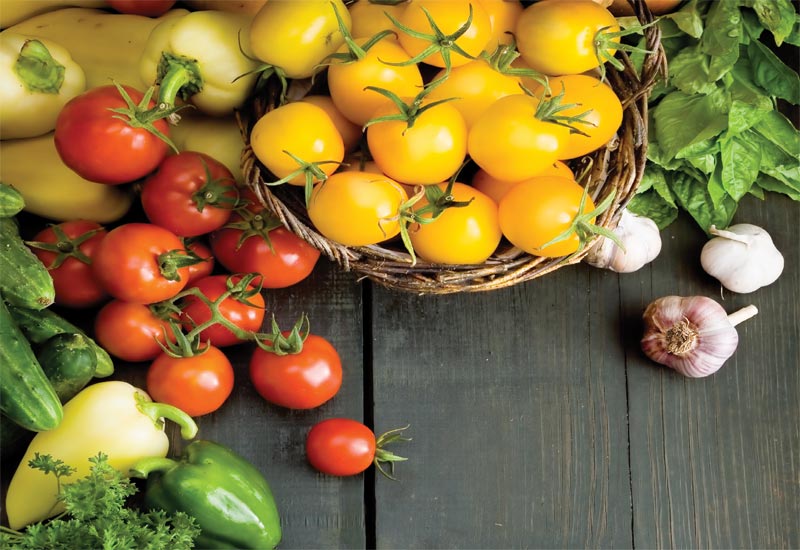
Lee Jamieson takes a close-up look at the fresh produce market and discovers that local sourcing is a snowballing trend
The Middle East’s fresh produce market is currently thriving. A combination of growing consumer demand for fresh ingredients and the need for chefs to increase the quality of their menus in a maturing, more competitive market have created a perfect storm for the region’s suppliers.
Figures from the region’s key import-export hubs demonstrate the sheer scale of the fresh produce market: In Dubai, imports of fresh fruits has reached over 1.1 billion kilograms, valued in excess of AED 4 billion (US $1.09 billion). Imports of fresh vegetables has also reached 590 million kilograms, AED 1.3 billion (US $354 million).
Chefs across the region are now looking to source their ingredients closer to home in an attempt to reduce the time and distance between harvest and cooking.
“It’s all about quality,” explains Mövenpick Hotel Doha executive chef, Ery Irmansjah, “and quality is expressed through taste.
“Going to the market is about much more than bringing back ingredients; it’s about discovery and renewing creativity. Personally, I enjoy going to the market, handpicking the ingredients and then taking them back to my kitchen to transform them into scrumptious meals!” he says.
“Healthy eating trends are changing quite fast as consumers become more knowledgeable about the nutritional value of natural foods. Restaurant customers are now looking for disclosure on everything from calories to local-sourcing practices, and I think there is a growing number of people who are serious about nutrition, labelling, sustainability and community involvement – and they are using this knowledge to make purchasing decisions.”
With consumers more interested than ever before in the quality, source and the nutritional value of ingredients, F&B operators are using their fresh produce to differentiate their outlet from the competition.
This communicates the quality of the food on offer and improves the restaurant’s reputation in a cost-effective way.
“I think the increased demand for fresh produce is linked to the growth in competition among hoteliers and restaurateurs,” explains Arabian Courtyard Hotel Dubai’s Chef Glen Ferdinand. “They are competing to retain their regular customers and also attract new ones.
“So, in this sense, fresh produce is very profitable because it adds to the outlet’s identity and encourages new customers through recommendation.”
Local farms
Although the region is peppered with many very good farms, some chefs are frustrated with the local farming.
“Local farming is not that strong in this region because it is a desert and the climate does not support a lot of cultivation,” explains Bundoo Khan’s chef Ramzan. “Local produce, although cheaper to buy, does not provide the same taste, quality and consistency. However, that said, every region differs in the quality and tastes of its products.”
Some areas are more fertile than others. Jordan Valley, for example, is strong in agriculture and exports fresh produce to other parts of the region.
Similarly, some parts of neighbouring Saudi Arabia are fertile enough to support the local F&B industry, as Al Khobar Hotel, executive sous chef, Gaurav Kakkar confirms: “I would say that local farming in Saudi Arabia is strong; in fact, Saudi Arabia is now completely self-sufficient in a number of foodstuffs. Some of the local produce could definitely be used to replace expensive imported ingredients and prove to be cost effective.
“This gives us chefs the opportunity to spend more money on other ingredients that cannot be sourced locally and add variety to our dishes.”
However, farms located in the Middle East’s more fertile areas still face the logistical challenge of transporting their goods around the region in the hot climate.
The key issue facing the industry is to ensure that the fresh produce supply chain is as short as possible to ensure quality. The regularity and consistency of that supply chain is also vital.
“Fresh meat and fish are moved for short distances as chilled in a vacuum pack and fruit and vegetables are transported in a chilled pipeline at an optimum temperature of 5ºC,” explains Trilogi Logistics Services group general manager, Pieter van Wyk.
“Temperature fluctuations can affect the quality of the produce, so we monitor it throughout the entire process with online real-time temperature reporting.
“You really need to understand the regulatory requirements when moving stock around the Gulf from central warehouses. The GCC policies are not fully supportive, so we do face some challenges and delays at borders which can cause the fresh produce to spoil.”
Closer to source: market day
Farmers’ markets are increasing in popularity across the region and many chefs are going “back to basis” and sourcing fresh, locally grown produce.
The quality of markets can vary throughout the region and the availability and consistency of fresh produce can fluctuate depending on the traders involved – but if a chef can access a good quality market with solid suppliers, then it is possible to significantly reduce ingredient expenditure.
“I personally go to the market in the morning to select fresh meat and fish,” says Ramada Hotel and Suites Ajman executive chef, Rami Al Joubrail. “I also source fruits, vegetables and herbs from my local markets. When we buy fresh products like this on a day-to-day basis I am saving approximately 25-30% on the cost of the materials. Also, I am getting very good feedback from all the customers!”
Similarly, Baker & Spice has attempted to sidestep the global fresh produce business by sourcing as much as possible from local suppliers. Because they are exposed to the seasonality of ingredients, their menus are designed to adapt around the daily availability of produce.
“We work directly with five local UAE organic farms and two wholesale suppliers on a daily basis,” explains brand consultant to Baker & Spice, Yael Mejia. “They alert us to what is available on any given day and we make our choices. We also visit the wholesale produce market regularly to check on what’s new and in season.
“I have found that it is cheaper to buy locally grown produce than to pay for air travel; fresh produce needs to be fresh!”
Baker & Spice’s ethos is on-trend and proving successful, with its third shop and cafe recently opening on Dubai Marina Promenade. The company also runs a weekly farmers’ market, the second of which launched last month.
The first Farmers’ Market, held at Souk al Bahar, proved successful and tapped into the growing consumer trend for buying fresh produce.
“The produce is literally picked fresh and delivered to the market within hours; not days, weeks or months,” continued Mejia. “It tastes good, looks good and is incredibly cheap because there are no middlemen or commission takers – the money paid goes straight back to the farmers.”
Grow your own
Some chefs are going even further and growing their own produce. Sourcing ingredients for the growing organic trend can be costly – but an enterprising chef with green fingers can make significant savings.
“We ran an organic promotion in our Certo Italian restaurant in January and received excellent guest feedback about the food quality, taste and flavour,” says Radisson Blu Hotel Dubai Media City executive chef, Hassan Massood.
“While we now have organic markets in Dubai and more organic products to purchase, I feel that the quantity produced in the UAE is inadequate.
“So, we have started a small production of vegetables including okra, tomatoes and rosemary for use in our Certo Italian Restaurant. We are still in the experimental stages and we are monitoring the outcome from this project. So far, all of the vegetables have been fantastic in taste, texture and flavour.”
Radisson BLU Tala Bay Resort Jordan executive chef, Didier Gusching, has a longstanding passion for home-grown organic produce. Work began in October 2011 on a 40-metre bio garden in the grounds of the hotel.
The garden has become a focal point for the hotel and often operates like a community project inviting local children to visit and learn about sustainability.
“When you talk to people about this, they are always interested,” explains Gusching. “We think of this as a new trend, but it’s actually something that we lost contact with for many years. We now need to get back to the earth and back to the taste.
“Now we have started to grow some crops, we have managed to not purchase vegetables and herbs for around five months. Therefore, the garden has been very financially viable and has made us some substantial savings.”
Another established and successful kitchen garden project can be found at the Iberotel Miramar Al Aqah Beach Resort in Fujairah, under the supervision of executive chef K. A. C. Prasad: “Last year, our vegetable and food garden produced more than 200 kilograms of tomato, the same amount of egg plant, green chilli, Thai basil, rosemary, bitter gourd, bananas, sugar cane and more.
We use them in our cooking and display the fruits and vegetables from our own garden in our buffets to encourage the guests. It’s become very popular!”
“I would encourage chefs who don’t have room for a garden to use areas like rooftops, or even pots inside your restaurants.”
The distance from “source to pan” is becoming increasingly more important for the region’s chefs: logistics are getting faster, chefs are rediscovering local markets, and some are even growing their own fresh produce for a fraction of the purchase price.
A distinct trend is emerging that is already re-invigorating our relationship with food – driven by a growing segment of consumers who are knowledgeable about the ingredients they consume.
