

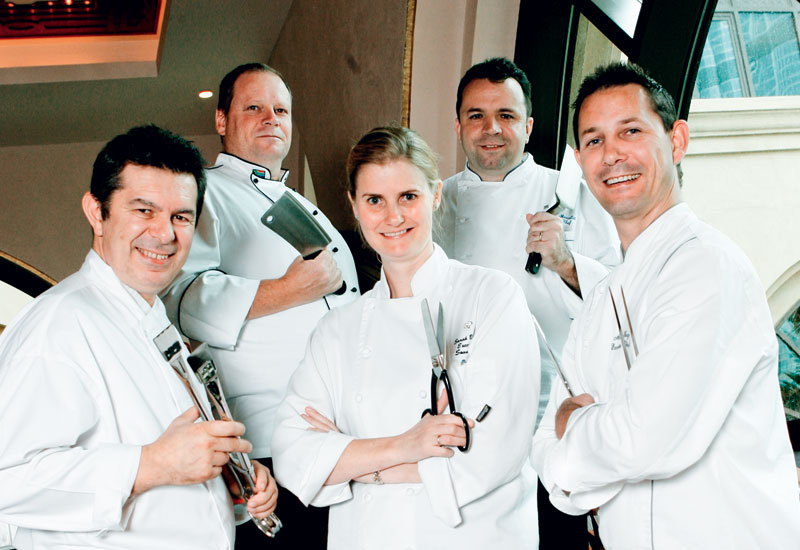
Executive chefs at the region’s five-star hotels reveal their strategies for F&B success.
Beneath the chef’s hats of the region’s five-star hotel executive chefs are cool and calculating business minds. Responsible for numerous outlets offering a variety of cuisines, they have an intriguing juggling act to perform: to provide eye-catching and consistently high quality F&B, while keeping a cautious eye on that bottom line; to nurture the creative exuberance of their staff, while also keeping it in check.
With ancillary revenue from F&B in tighter focus than ever for hotels following the economic downturn, the Middle East’s executive chefs need to use every strategic tool at their disposal to ensure that they whip up healthy profits and maintain a sharp competitive edge.
Caterer Middle East selected five of Dubai’s best hotel executive chefs and brought them together at The Palace – The Old Town hotel to chew over these issues. Joining chef Jean-Luc Morcellet from the host hotel was Sarah Briegal, executive sous chef at Raffles Dubai, Anston Fivaz of Ibn Battuta Gate, Christophe Prud’homme of the Al Bustan Rotana Dubai and Joe Vock, of the Taj Hotel.
What is your approach to shaping the menus of your different outlets and how do you balance creativity with budgetary constraints?
Anston Fivaz: My approach is to provide a taste journey for our guests, ensuring the menus of all the hotel outlets will compliment each other.
Chef de cuisines and sous chefs are hired to be creative, but the budgets are set down by the executive team and head office. It’s up to us as executive chefs to make sure that targets are reached; that the chefs maintain their creativity while remaining within budget.
Christophe Prud’homme: Despite the wider scope that comes with working in a big hotel environment with multiple outlets, it creates its own challenges.
When crafting the menus there is no point in doing something other than Thai food in the Thai restaurant for example. You can fine-tune dishes and you can be creative with the presentation of course, but you still need to focus on the main message.
You also need to make sure there is a balance of high-end products and lower priced offerings, to give a fair average price so that the guests do not feel trapped.
Joe Vock: We find that some element of menu consistency is valued by our guests; it’s part of what keeps them coming back. We put in specials for some variation, but to keep changing menu options can come up against opposition, so we stay fairly consistent.
We also try to be to everybody’s taste in terms of pricing, providing a mixture of upmarket and more mid-range products.
Jean-Luc Morcellet: A lot of our menu change is driven by the feedback we get. We keep a basic level of certain dishes on the menu and then we listen to the comments from the guests, from the chefs and from the other employees. I agree that all in all you don’t want to change too much.
There are so many restaurants in Dubai already so why change what you have already just to try to copy someone else? We do keep a constant eye on the profit-potential of our menus though; if a particular dish isn’t moving then we change it. To control costs we try to keep the ingredients very similar across all of the outlets.
Sarah Briegel: Balancing menu creativity with the budget requires using ingredients cleverly across all of the outlets in your hotel — buying the best quality you can, but using it in a way that means the chef is being creative while also producing less wastage; maybe using other parts of a meat cut for another restaurant in the hotel for instance.
Do hotel brand guidelines have a significant impact on you and to what extent is being part of a hotel restrictive for a chef?
Prud’homme: When you work for a big hotel, certain products need to be unified throughout. Head Office needs to make sure that the food will taste the same way and be of the same standard whether a guest is eating it at the branch in Dubai, Sharm El Sheikh or a different place around the world.
Fivaz: For large corporations like hotels, brand is very important. There need to be certain fundamentals – a certain number of juices at the breakfast buffet, so many cold cuts, so many hot dishes, so many signature dishes for instance. Some hotels have whole manuals on what you are and are not allowed to do. In terms of how restrictive this is?
As chefs we have to work with that as a base, but there is nothing stopping us from going above that base, provided we maintain brand standards.
Morcellet: I think it is necessary; you need to have certain standards for the basic offering. But at the end of the day at The Palace nobody stops me from putting pork on the menu for instance, but I don’t put pork on the menu because I respect the traditional Arabic architecture of the place and the clientele we have as well. You have to adapt yourself to your guests and environment.
Vock: Sometimes brand guidelines take second place to the environment or location of a particular hotel. Being part of an Indian chain, our breakfast offering has to be different to that of our Indian hotels’ as we are reacting to the requirements of our guests. Our chefs use their own imagination, while keeping within the standards which all our hotel branches adhere to.
Have you felt increased pressure to drive ancillary revenue following the downturn?
Morcellet: For me the downturn put everything back into place. Before it we had the luxury of everything being easy and uncomplicated, but now you have to be very creative to make sure you survive and do well in the market. It’s a good challenge.
Briegel: You have to work harder to attract the guests and so you’re thinking of new and different things all the time. There is a lot of competition now and it drives standards higher.
Prud’homme: It also means you have to be prepared yourself. You have to be excited and ready when you wake up everyday. You need to be alert for your staff, your owner, your company; you need to be constantly on your toes because the market is moving so you have to move too, everyone does.
Fivaz: One noticeable difference is that in the old days you’d have your marketing team and they would be the ones coming up with ideas for promotions and you’d run it as the chef. But today the chef is very much involved from the start to the finish of the promotion, and he is also responsible for how successful that promotion is. It’s a tough world out there.
Prud’homme: Yes, the chef has become a marketing tool for the rest of the operation.
Vock: And chefs don’t spend as much time in the kitchen as they used to. The chef is as much involved in administration, marketing and sales, as he is in the kitchen behind the pots.
Briegel: But it is extremely important to try to spend as much time in the kitchen as possible. There are administrative jobs to be done to drive the standards higher and to be sure that you keep within the brand.
But I became a chef because I have a passion for cooking and for food, and for me to teach my team is the most important thing. If I can teach them everything that I know that will only make the team stronger and better.
Are you more a business-orientated or more creativity-orientated?
Morcellet: I think that the business side of things makes you creative. When you’re presented with any kind of slightly strange request it cultivates creativity. It’s a challenge and you have to be very creative to deliver it.
Prud’homme: As in all areas of business, the personal side of the client relationship is key and there is creativity within that.
For example, when faced with a request from banqueting for a particular menu, I will go and see the guest concerned in person and speak to him; you find out there and then what he wants and you can discuss certain flavours and preferences and make a customised menu.
Suddenly the relationship is not the same anymore; you’re not talking hotel to customer, it’s more personal. If you do a good job then afterwards the guest will return to see you specifically, not just to stay at the hotel. This is where your job is very rewarding; you feel yourself playing your role within the company, you feel ownership.
Although you are being a good business man and driving revenue to the hotel, it has the creative satisfaction of a personal relationship.
How do you view standalone outlets in terms of competition to your hotel outlets?
Fivaz: Standalone outlets are as fierce competition as any hotel and that’s a very good thing. As hotel chefs there can be a tendency to get stuck in our hotel world with our fantastic restaurants and fantastic five-star prices.
But in reality there are places like Souk Al Bahar out there: there are many standalone restaurants that are able to offer alcohol and the same standard of food for possibly better prices than ours.
Their overheads aren’t what ours are, their budgets aren’t what our budgets are. So their freedom to explore is a lot greater than ours. With a standalone you don’t need to walk into a hotel and feel stuffy or pretentious, the dress code is more relaxed and the service tends to be more attentive rather than corporate.
Vock: In hotels there are additional complications such as the chains of procedures; everything new has to go through the corporate office. Quite often standalone restaurants do not have that restriction, which enables them to react faster to events.
Prud’homme: But the advantage we have in hotels is the support, the back-up. Without the high volume behind us, without the revenue coming from somewhere within our operation, we wouldn’t be able to offer the products that we do.
Vock: Exactly; if you do a lot of banqueting you can recover what you might lose in your restaurants, but you need a busy banqueting operation. Also you might have people staying with you on full-board or half-board, in which case you know you’re getting some revenue guaranteed for your breakfasts or your dinners.
Morcellet: For a standalone the quality has to be really top, they can’t compromise on anything. In both worlds there are advantages and disadvantages. But in hotels we are more free to experiment.
Prud’homme: In a standalone you work solely for people to be happy so that they come back because the money is not coming from a big operation like banqueting, which can give a hotel restaurant the fuel to be more experimental.
Hotels have more choice: you can either put your price down to bring in a higher volume of customers, or you can run your buffet at 120% cost; everything is possible. For instance, a hot topic in hotels is the seafood night; if you don’t have lobster on your menu, people complain.
My consumption of lobster is 1kg per person for example, which means suddenly the food cost increases a lot and you need to do 90 covers to break even. If you do only 70, you lose, but it doesn’t matter so much in a hotel.
It could be the end for a standalone though as they can’t rely on the cash fuel coming from the buffet downstairs. Hotels are more free to play – you work things out with your team, you play around with costs and revenue, it’s a funny game.
Whose satisfaction is more important: your guests’, your owner’s, your suppliers’, your staff or your own?
Fivaz: They are all very important. You have your shareholders and you are responsible for making them happy and showing you are driving revenue for that outlet.
You’ve got your guest satisfaction and without that you have no business. There’s your employee satisfaction and you need to encourage them, to give them new tools, ideas, concepts. Supplier satisfaction is also very important: when you are asking them for cost cutting or to supply for an event, it’s important to have them next to you. So everyone is a stakeholder in how well the hotel does.
Prud’homme: If you jeopardize any one of those elements then you will end up losing one day.
Morcellet: For me the main ingredient for success is your staff. If they are happy and trained well then they will perform well. This satisfies the guest, which will then satisfy the owner, and of course as a result the supplier, because the more business you do the more business the supplier will get from you.
A beautiful building can be great but if you don’t have the right people inside you have nothing.
Vock: You have to treat your whole team with respect because at the end of the day you can’t do it on your own, it’s the team that does it for you.
Briegel: Everyone’s satisfaction is equally important because it’s a ripple effect: if your guest is happy then your employee is happy; if they are happy they will do a better job, which means selling more, which means making the owner happy and then by extension the supplier.
Meet the chef
Sarah Briegel, Raffles
Originally from Australia, Briegel started off in her native country before moving to London to work at the Oxo Tower and then Smiths of Smithfield. Following a stint at the Mandarin Oriental in Hong Kong, she moved to Dubai to work for Raffles as executive sous chef, where she is responsible for eight outlets.
“I became a chef because I am passionate about cooking and food; despite the administrative duties of being an executive chef I still try to spend as much time in the kitchen as I physically can.”
Anston Fivaz, Ibn Battuta Gate
Having been in the Gulf for 12 years, Fivaz previously worked in Claridges in London and in Michelin-starred restaurants all over the world, from Italy to Poland to his native South Africa.
Today he oversees five signature restaurants at Ibn Battuta and, including the banqueting and poolside dining options, looks after 11 outlets all together.
“When I was growing up I always just had this dream of being a chef, so when the opportunity presented itself, I took it.”
Jean-Luc Morcellet, The Palace-The Old Town
Having been executive chef at The Palace – The Old Town for six years, Morcellet oversees a range of all-day and poolside dining, banqueting, as well as the signature restaurants. He has previously worked across Africa, on cruise liners as well as at the London Dorchester.
“As an executive chef you must be ready for new challenges everyday, otherwise you may as well just stay in bed.”
Christophe Prud’homme, Al Bustan Rotana
Prud’homme started to train to become a chef “late” at the age of 21. Having cut his teeth in his native France, he worked in London for 12 years at the Four Seasons, the Dorchester and the Meridien Picadilly. He then worked at the Marriott in Egypt before moving to Dubai to oversee the F&B outlets at Al Bustan Rotana.
“In every new country you travel to work as a chef you learn something, there are always good points either for yourself, for your career or for your family.”
Joe Vock, Taj Hotel
Originally from South Africa, Vock trained with hotel group Protea Hotels. Since then he has worked on cruise ships and all across Africa, from Nigeria to Tanzania and the Seychelles, implementing new menu systems and standards. Vock has been at the Taj Hotel for eight months, where he oversees four restaurants and the hotel banqueting.
“My employer for my first apprenticeship told me that to be a chef you have to be either mad, or an alcoholic, or both! It is certainly extremely tough; only very few of the people I originally did my training with are still chefs today.”