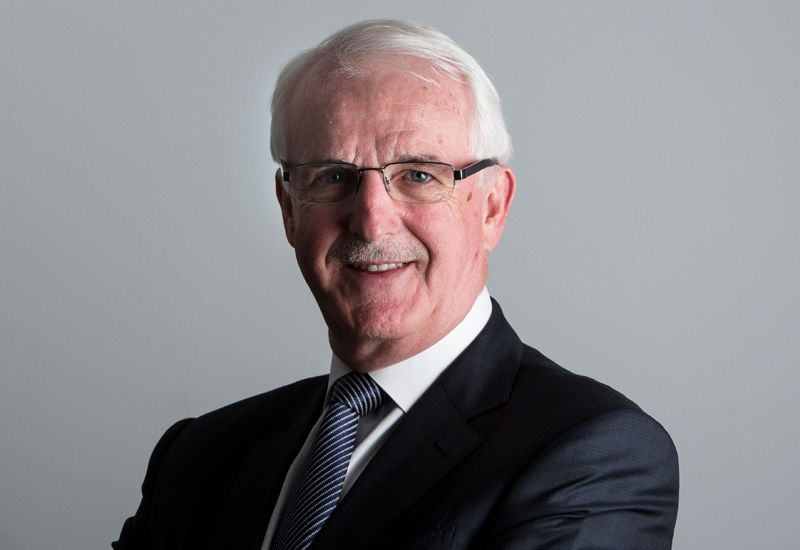
One year ago, Gerald Lawless moved on from his role as president and CEO of the Jumeirah Group, to become the head of tourism and hospitality at Dubai Holding. Following that, in April 2016, he was elected chairman of the World Travel & Tourism Council (WTTC).
And right before the Middlesex University Dubai graduation ceremony in November 2016, where he was awarded an honorary Doctorate of the University (DUniv) in recognition of his contribution to the hospitality industry both in the UAE and globally, Lawless tells Hotelier Middle East: “The WTTC is made up of the leaders of most of the prime travel, tourism and hospitality companies worldwide, and it’s very much regarded as the voice of the industry.
“We also work very closely with the UNWTO and this is a relationship that has been very well established by David Scowsill [the president and CEO] over time to ensure that we are co-ordinating our activities and perceived needs within the industry to make particularly governments aware of the value of travel and tourism to the economy, and to society generally.”
He adds that with the research carried out by the WTTC, the organisation has been able to demonstrate that almost 284 billion jobs worldwide are related directly and indirectly to travel and tourism and hospitality. Lawless says that, based on this research, 10% of the global GDP is attributed to the same industry. Destinations around the world welcomed 956 million international tourists between January and September 2016, according to the latest UNWTO World Tourism Barometer. This is 34 million more than in the same period of 2015, a 4% increase.
“So you can see that we are an important industry. It’s very important for us that governments continue to facilitate travel in a safe and secure manner,” he says.
At the time of his appointment, he said that a global e-visa programme would help boost tourism and related revenues, bearing in mind security issues. It is something he is still keen on. He emphasises the need for a common platform between bodies such as Schengen [the pan-Europe visa programme] or ESTA [the Electronic System for Travel Authorisation programme used by the US], and an ASEAN visa in South East Asia if it goes ahead. “Hopefully it will spread further. We have seen India allow visa waivers to 162 countries, so all of this is very important. Particularly we would say not at the expense or the cost of security because nowadays security is immensely important. We see that it’s not so much anymore about which country a person comes from; it depends on the individual as to whether or not that individual is a safe person to travel.”
Continuing to talk about technology, Lawless says it’s good to try and facilitate travel from the point of view of technology. He explains: “We see the mountain of information that’s now available to the prospective traveller before he or she travels — but this can be further enhanced. So for example if you’re flying from London Heathrow to Dubai, as you check in, the airline will swipe your passport, that gets shared only within the airline. The technology exists so why shouldn’t that be shared with immigration in Dubai, as well as immigration in London so they know you’re leaving?
“Technology could be effectively used to make sure the whole travel experience is as seamless as possible. Dubai is very good at trying to develop technology so it’s great to see the desire, for example, to have more WiFi available on a global basis. Technology in hotels is also moving — Hilton is piloting a robot concierge called Connie and I find that a very exciting and an interesting initiative because people have fun using technology. It’s not depersonalising the experience; it’s all about giving the customer the choice. If I want to check-in in a remote part of the hotel rather than going to the lobby then I should have the choice, but of course if I don’t want to, I should be able to go to reception as well. We’ll find a lot of people will always go along the line of the most convenient way of doing something.”
In addition to being passionate about technology, sustainable tourism is also on the agenda. “I think every country on earth has to be concerned about sustainable tourism, and the United Nations has declared 2017 as the International Year of Sustainable Tourism for Development, and I think it’s a good way of describing it because it’s clearly showing that tourism and travel is a good development, it’s good for the economy, it’s good for people to come together. But it has to be done in a manner that’s sustainable — because the last thing you want to do is to damage the very product that you’re promoting, particularly in leisure tourism,” he says.
Lawless is very happy that the Creek area has applied for a bid to be recognised as a UNESCO World Heritage Site, with the area renamed Khor Dubai for the bid. The area is currently on UNESCO’s ‘tentative lists’ and it is expected that the results of the bid will be revealed in mid-2017. Lawless adds: “That shows already that Dubai fully understands its role in relation to sustainable tourism, particularly when it comes to many environmental issues. Particularly in the Jumeirah Group, each of its hotels have a Green Globe status.
“There have been huge advances over the years. People talk about airlines, but actually fuel consumption on an airline engine has reduced by 50% over the last 30 years. If you look at Emirates for example, flying the A380 is much cheaper than other aircraft in that the fuel consumption per passenger is the lowest.”
Airlines, of course, play a huge role in ramping up Dubai’s status as a travel hotspot, and talking about Dubai’s development, Lawless, with his role at Dubai Holding, is heavily invested in the tourism value to the city, which is consistently showing growth. According to the Dubai Tourism 2016 performance report YTD September 2016, the Emirate has already seen 10.74 million international visitors compared to 10.52 million throughout 2015. Over the last year, many hoteliers have praised the diversification efforts on part of the government, and this is something Lawless echoes. “What Dubai has already achieved, but also its diversification with having a wider variety of tourism products like the theme parks, is absolutely vital for its ongoing development and evolution as one of the world’s great tourism destinations. It’s absolutely essential to continue with that strategy.
“I also believe the achievement with having the World Expo 2020 has given a great focus for the whole industry to make sure that we’re properly prepared to cope with large numbers of visitors coming to Dubai at any one time. Even without the Expo, our target as given by His Highness Sheikh Mohammed bin Rashid Al Maktoum is 20 million visitors by 2020 in any event.
“Yes, we’ve got the beautiful beaches and the lovely, luxury five-star hotels but the way the industry has evolved in the last few years with a whole range of hotels from budget through to luxury I think has been very wise, and also the commitment to the opening of the various theme parks.”