Eight young boys in national dress wielding traditional bent swords or bow and arrows saunter around in a circle, swiping at each other with grins on their faces. They glide in and out of the ring in a rhythm familiar to most Qataris and enchanting to others. When the traditional dance is complete, the boys step aside and a loud smack on a gold symbol turns the attention to two dragons that suddenly pop up to life. The elongated puppets move nimbly, flexing to the sound of multiple musical instruments in a colourful spectacle.
The contrasting performances symbolise the coming together of both Asian and Qatari heritage in the opening of the first Shangri-La hotel in Qatar.
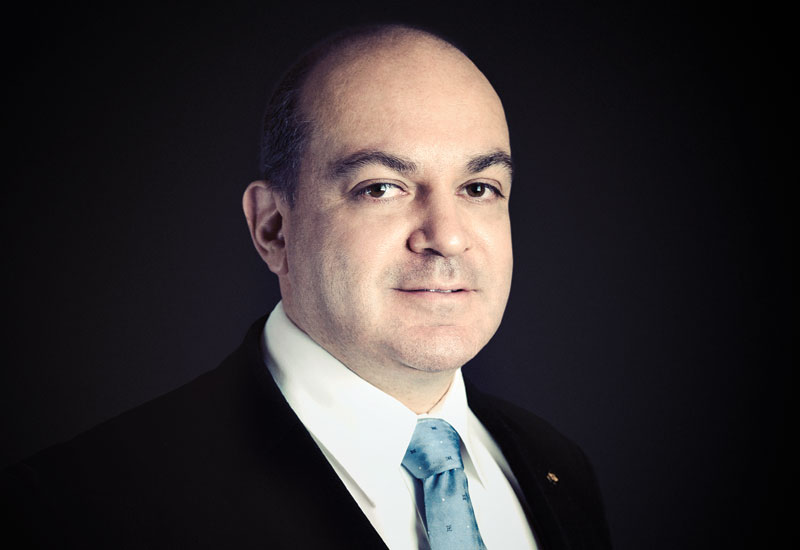
The occasion is sufficiently special to draw the Hong Kong-based hotel group’s global CEO,Greg Dogan. Having worked in the region at various times over more than two decades, he has kept a close eye on its evolution. “We see Doha growing very, very quickly; it’s become a world player,” he says the morning after the hotel’s celebratory launch.
“I’ve been coming here for the last eight years; the city has grown up enormously. The fact that the World Cup will be here in 2022, is an endorsement that the city is on the right path and will be the future for [Qatar] and the Middle East.”
It has taken Dogan all of those eight years to open the gold-plated front doors to the first Shangri-La hotel in Doha. Having found the ideal location in the heart of the city centre, Shangri-La secured a partnership with Sheikh Faisal Bin Qassim Al Thani, a member of the royal family with a reported fortune of more than US $2bn and one of the largest collectors of artefacts in the region.
The Gulf is currently one of Shangri-La’s most important markets, with existing and prospective properties across Saudi Arabia, the UAE, Qatar and Oman, where it has the extremely popular Shangri-La Barr Al Jissah Resort and Spa.
“Definitely the five cities — Jeddah, Riyadh, Abu Dhabi, Dubai and Doha — are really pivotal right now,” Dogan says.
The group is scheduled to open its first hotel in Saudi Arabia is 2018, after signing a management contract with Assila Investments for a 236-room hotel and serviced residences development in Jeddah, Saudi Arabia, with more properties expected to be in the pipeline.
“Saudi Arabia is very important for the hotel industry. Outbound, it’s a bigger population than most of the Gulf region and I see that as a great feeder market for our Malaysian and Philippines properties, and also going into Hong Kong, so it is very important,” he says.
Dogan is also scouting for the ideal resort location in Dubai and is in discussions to open the Gulf’s first four-star Hotel Jen, the youngest of Shangri-La Group’s five brands. Two sites have been identified in Dubai, one existing and one a greenfield.
He also has investigated Ras Al Khaimah in the UAE’s north, but is so far not convinced the emirate is appropriate for Shangri-La. “I’ve travelled to Ras Al Khaimah a couple of times; we will look at any part of this region, but it has to be a win-win situation,” Dogan says.
“We’re always looking for new opportunities. There are discussions going on within the group and with certain developers within the Middle East, particularly in Dubai with Expo 2020 coming up. We definitely see resort opportunities; we’d love to see one in Dubai, we just haven’t been lucky enough to identify a site and location. I’ve been in discussions for two sites on The Palm Jumeirah, which unfortunately didn’t come through, but given the right opportunity, we will definitely look at it.”
Dogan is reluctant to detail why the discussions did not fructify. “It was a number of factors, it wasn’t just one thing. A lot of ingredients have to come together very quickly and in the correct order, and it just didn’t work out.”
The continuing expansion of Dubai — both infill and spreading through the desert east and south — means Dogan has more location opportunities to consider. The man-made canal that will flow through the centre of the emirate from east to the ocean has opened up kilometres of potential new waterfront property, while the six square kilometre revamp of Dubai Creek has attracted immense attention from developers.
Dogan says that as a hotel operator (it also owns some of its managed properties outside the Gulf), Shangri-La regards relationships with the building owner as crucial to success as the location.
“What is also very important for us is that we try to make sure that we go into partnership with partners long lasting and not with developers who just want to turn the asset around and dispose it off. So the relationship is an important one,” he says.
Although his next venture in the UAE is likely to be in the mid-market, Dogan does not believe the country is oversaturated with luxury hotels.
“I’ve been going to Dubai for the last 20 years, I used to work in Dubai, and everybody’s been saying that for the last 25 years,” he says, almost exasperated by the point. “The fact that Dubai Airport now is probably the largest airport in the world, with a second one now operational, will make the city grow until it runs out of space. That’s how I see Dubai going. I don’t see it as a saturated city, no.”
Yet, he does recognise that hotel developers are swivelling towards the mid-market. “If you look at the rates throughout the city, particularly the Deira, Bur Dubai area, the resorts [along Jumeirah], The Palm, you can see that the rates are very high at the five-star level and those rates and occupancies have been very healthy in Dubai,” he says.
“There’s [now] an opportunity for a segment below. To me, it’s obvious, and if you look at some of the other mid-market brands that are in there, they’re running at 90-95% occupancies all-year round, so there’s definitely potential. The mid-market customer has become more affluent and travel has become a lot easier and more cost effective for everybody, so [to meet] the potential for people to stay in these places, you need to have a range of hotels to cater to that need.”
Hotels globally also are gradually placing greater emphasis on their ‘lifestyle’ offering, Dogan says. With more than 90 hotels across Asia Pacific (in which Shangri-La is the largest luxury hotel operator), North America, the Middle East and Europe under his watch, the CEO says much more than accommodation is offered these days. A variety of children’s activities that allow parents to have time to themselves or to go to the gym, an array of restaurants at various price points and even shopping malls within the hotel are increasingly being provided.
“I feel hotels will become a lot more about lifestyle. Now we try to make all our hotels a part of the community and the environment that they operate in,” he says, adding that Shangri-La is renowned for blending its Asian heritage with the local culture at each of its hotels.
“Hotels are becoming a major destination where a family can go and have an array of opportunities and services and spend money in [one] place.”
Food and beverage options are particularly important to Shangri-La’s revenues, with the majority of customers, especially in the Middle East, coming from outside the hotel. “For Shangri-La, it’s definitely something we’ve intentionally marketed to make sure we’re part of the community, allowing everybody, from family to businessmen, to go to the hotel,” Dogan says.
Hotels are also, of course, becoming increasingly digitalised. Whether via third party booking websites, so-called disruptor online accommodation booking sites, such as Airbnb.com, or each hotel’s smart systems, the internet is penetrating the industry globally.
Dogan says Shangri-La has created entire new teams to adapt to the 21st-century change. “As a company, we are investing very heavily in this area because we do see this as the future. We’re looking at the websites and at how to utilise smartphone technology. We have brought in specialists to teach us the best ways to go forward and what is the future,” he says.
“I think it’s affecting the world; which is moving quicker and quicker in this direction. You can literally arrive at an airport, search six or seven hotels within the city and book immediately.”
However, Dogan says while it is difficult to measure or quantify the impact on sites such as Airbnb.com, he does not believe they have affected the Shangri-La Group. “Where we operate our hotels, throughout the world, we don’t see that effect; I’m not sure what it’s like in the Americas and in the western world. The hotels that we have in Europe and those regions are very small, so there hasn’t been that much of an impact,” he says.
“Guests will always want security and something they feel comfortable with. When you go into an Airbnb [property], you go into an unknown scenario where there isn’t a fall back on anybody. It is a different model, and it’s good for some people, but at the end of the day, the reliability of having an established brand, management team, security and guaranteed services are very important, and that’s what people look for when they come to a hotel.”
Similarly, he dismisses any impact from third-party booking sites: “It hasn’t affected us in anyway. That model was always there with traditional travel agents of the past, so it’s just changed from one form to another. The segments have not changed, neither has the speed, and the booking pace is a lot faster.” Such sites typically provide a platform for guests to review a hotel, a potentially risky scenario for some hoteliers but one that Dogan embraces.
“We’ve embraced it because it is important for guests and transparency to make sure that we do our best. I think it’s helped the industry, because hotels have become much more focused on giving good service, so I think in general it’s been a good thing throughout,” he says.
Shangri-La has sought feedback, which it has implemented in its own initiative called ‘Your Service’, which allows guests to provide direct comments — complaints or praise — at various points in the hotel, including rooms and restaurants. This allows staff to immediately address any problems and potentially prevent the grievance from reaching the public realm online. A quick scan of popular hotel review websites, however, reveals that guests are still quite inclined to pass on their opinions — positive and negative — to potential travellers. Reading the reviews, one cannot help but notice the repetition of praise for the Shangri-La Hotel Doha staff. The response works well with the group’s new brand campaign, ‘It’s in our nature’.
“To me that epitomises who we are as a brand and what Shangri-La is all about: treating a stranger as well-known,” Dogan says. Such hospitality is likely to fit in well in the Gulf.