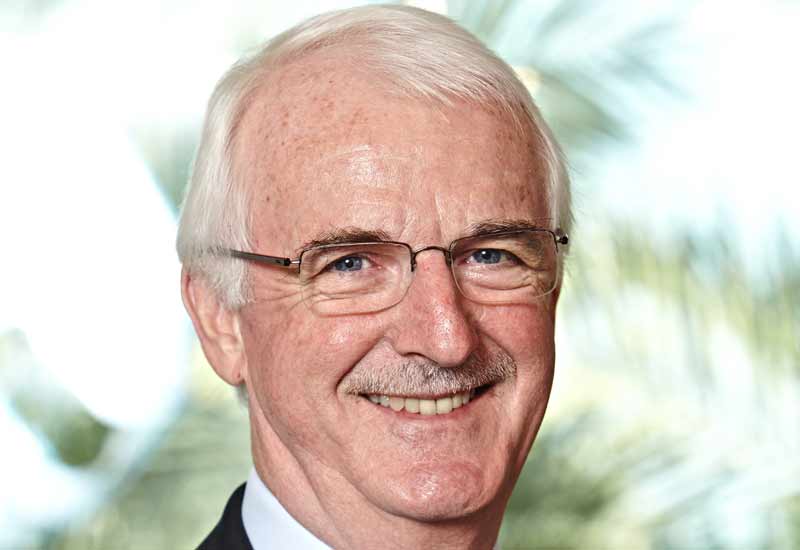
The whispers had begun long before the announcement was made. Hotelier Middle East’s sources were telling us as early as November 2015 that Jumeirah Group president and CEO Gerald Lawless was due to move on. By mid-January, Dubai Holding confirmed that Lawless was joining its corporate office to be responsible for tourism and hospitality after serving for 18 years at the helm of Jumeirah Group.
Lawless first came to Dubai in 1978 and after a 23-year career with Forte Hotels, joined Jumeirah Group in 1997 and has since become synonymous with the brand.
His achievements are many, but as he leaves Jumeirah Group, its portfolio now includes 23 hotels in 12 destinations, stretching from London to Shanghai, with a robust pipeline of new openings planned. Jumeirah Group operates more 100 restaurants, Jumeirah Restaurant Group Dubai, the Wild Wadi Waterpark and the Emirates Academy of Hospitality Management, where Lawless will remain Chancellor. The firm has also launched Venu, its contemporary lifestyle hotel brand.
Sitting in his large office overlooking Al Qasr and the Burj Al Arab in December 2015, Lawless, in his confident and quiet manner, reveals more about the years gone by, and what’s to come.
“Part of the Jumeirah strategy is to continue on our global expansion of the luxury brand which we call ‘Jumeirah — Stay Different’, and indeed having introduced our contemporary lifestyle brand Venu, we’re also looking to develop that in a way where we want to be really selective for both brands — but particularly for the ‘Jumeirah — Stay Different’ brand in terms of locations where we go,” says Lawless.
He says what is more important for the company is quality locations over number of hotels, and this includes the right locations with “really good investors and owners”.
In the last few years, Jumeirah Group has been quite active with signings and openings. From China to India, Turkey and Malaysia, the wheel has been constantly in motion.
Lawless says the strategy for the group is to have a presence in key locations; China is currently a high-prospect market, with about eight properties in the pipeline. Saying the brand is already in important cities, he ticks off Beijing and Hong Kong as being of interest to the company.
However, he adds: “Our overall strategy for the development of the Jumeirah brand is that we’re concentrating in the Middle East, Asia and Africa. And then we look opportunistically at possibilities in places like Europe; we’re getting a lot of enquiries from there.”
With the Middle East focus, November 2015 marked the news that a memorandum of understanding was signed by Shuaa Capital Saudi Arabia.
This MoU will herald investment opportunities for developing hospitality projects in the Kingdom of Saudi Arabia, to be operated by Jumeirah Group.
Lawless tells Hotelier: “We’re particularly keen now to develop our presence through the MoU we signed with Shuaa Capital to get funds together so we can develop in Saudi Arabia. We really are excited about getting into Saudi and we hope we’ll have a few announcements in the early New Year.
“We hope 2016 will be extremely active for Shuaa coming to fruition on a number of potential projects.” At the time of going to print, no new announcements had been made, but Lawless hinted at the time that hotel sites were already selected.
He mentions the projects in Muscat and Abu Dhabi, and adds: “We think the time is ripe now for Jumeirah having established its international credentials — we come now into our own region to really push hard at developing within this area.”
One of the major development projects, of course, is Jumeirah Al Naseem — the fourth phase of development at Madinat Jumeirah. Those driving by might complain that the construction blocks the grand view of the Burj Al Arab; however, that will be more than compensated for.
Lawless says: “It’s going to be a beautiful hotel… Actually coming into the lobby, it’s a three-storey window that will frame the Burj Al Arab. You can imagine the sense of arrival that we will have there.”
The hotel, which is slated to have 430 rooms, will showcase innovations in terms of its design and architecture, says Lawless.
As of now, 35% of the balconies have the possibility to be enclosed, thereby giving guests the option of outdoor living, with views looking out to the Burj Al Arab and the Arabian Gulf.
“The layout of the rooms is quite different and unique. It will be a big winner in the market,” adds Lawless, and says the project is on schedule to open in the summer of 2016.
He will only hint about the F&B at the hotel, saying between four to six units will be leased out to third-party companies, although he says the company is “not in a position to disclose who we would have there yet”.
One year ago, Jumeirah Group signed a management agreement with Meraas Holding to open Venu Bluewaters Island Hotel, together with adjoining serviced residences, which will be operated under the Venu Living brand. The Venu properties are expected to open in 2017 and will offer close to 300 hotel rooms and 119 serviced apartments.
Lawless, however, doesn’t give away much about this property. He does talk about the brand identity, and re-asserts previous reports that the hotels will be aimed at the millennial mind-set. Investors would be attracted to this proposition, he says, because of the minimum room size of 30-32m2 compared to Jumeirah’s minimum of 55m2. “There will be differences in terms of cost of development which is important for investors; at the same time with clever design, 32m2 rooms are still a good size.”
He reiterates that the company’s strategy is always geared towards being recognised as one of the top luxury hotel brands worldwide, and Venu as one of the best contemporary lifestyle brands on a global level.
“We’re reluctant to say how many hotels we want because we think it’s more important for the brand to have the right place for the hotel, the right project… the right product is more important than the numbers.”
When Lawless’ move to Dubai Holdings was announced, Hotelier Middle East reached out to him yet again for his comments. He tells Hotelier: “Jumeirah is already recognised as one of the leading hotel brands. My hope for Jumeirah is that it will continue on this path and will achieve its potential to be the best luxury hotel brand globally.”
He adds: “My advice to my successor, Stefan Leser, is to recognise that the strength of the brand is based not only on our beautiful properties but on the unique levels of service that are offered to our customers through our amazing colleagues who work so diligently, with such great loyalty and passion for Jumeirah. I wish Stefan every success and assure him of my full support for the future.”
Lawless’ focus on tourism and hospitality on a broader level was signalled to the industry when he was appointed as chairman of the World Travel and Tourism Council, as position in which he will serve for a two-year period from April this year.
He says: “Tourism and travel is very important for Dubai’s economy and particularly with the World Expo 2020.
“A lot of people talk about how tourism is doing now, but in terms of our beach hotels, we’re nearly at the end of the year, we’re running at over 82% occupancy year-round, which I think really says an awful lot about the resilience of Dubai and how Dubai continues to be a huge attraction, which is great.
“Therefore I would be very confident that the target of 20 million visitors by 2020 before the Expo is actually achievable, especially when you look at the new suppliers that come [on board]. Plus the theme parks are being built now in Dubai, it really says a lot for how Dubai is going.”
He admits 2015 was a challenging year, but explains: “There was very little growth over 2014, which was actually a superb year. To be thereabouts with 2014 is very satisfying for us and especially with the kind of occupancy rates we’re still enjoying.”
Could the number of new rooms going live in the market be a challenge? Lawless says: “We always have competition, and the hotel business is a very competitive business. In Dubai, with all the new hotel rooms coming here over the next five years, that’s going to be competition. But if we can’t stand up to competition, then we shouldn’t be doing the job.
“At the moment, we have about 90,000 rooms and we’re looking to grow to 20 million visitors. Consider that at the moment the average length of stay is about 3.7 days. We need to extend that and that’s why I think these parks will help a lot. It’s all about trying to extend the tourist stake, which I think will help an awful lot on occupancy.
“The market balances itself ultimately. If you don’t have the hotels, you can’t attract the people to come here. You need to have the hotel rooms to make sure that you continue to bring people in. Yes, we’ll have to work hard to fill our hotels, but then we always have.”
And certainly, Lawless will be doing a lot more on a higher level to ensure the visitors come. He says: “I very much look forward to continue to be part of the Dubai success story, working with Dubai Holding and to my two-year tenure as chairman of the World Travel and Tourism Council. This will allow me to give something back to the travel, tourism and hospitality industry which has given me such wonderful opportunities throughout my career.” We absolutely cannot wait to see what he does next — and different.