

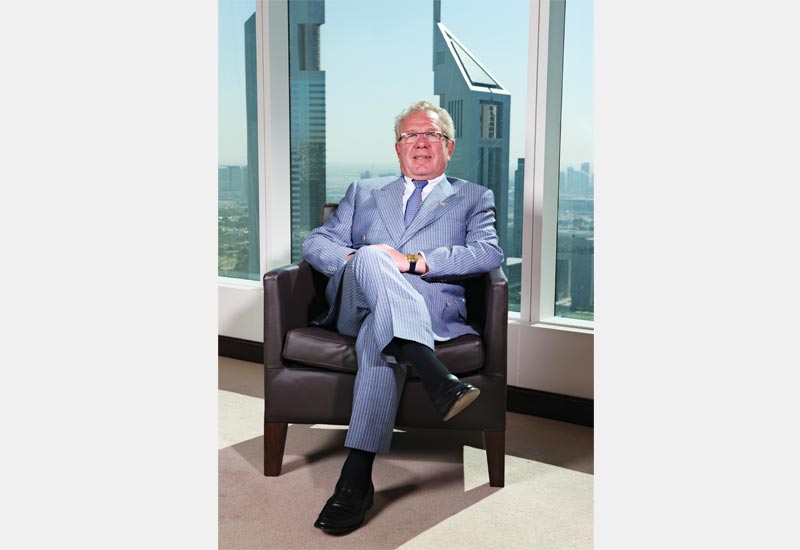
Having spent more than three decades in the industry, Rezidor CEO Kurt Ritter is used to tackling the big issues, whether it’s the Arab Spring, takeovers, entering new markets or even clashes with military dictators. Shane McGinley reports
Size matters,” says Kurt Ritter, the ever jovial president and CEO of Belgian hotelier The Rezidor Hotel Group. As we sit in the Radisson Royal Hotel in Dubai ahead of the start of a lavish party to celebrate the opening of his latest property, his words seem even more ironic as the Burj Khalifa – the world’s tallest building – hovers in the horizon over his shoulder.
Having just celebrated 35 years in the hotel business, Ritter is, of course, talking about his career and developing Rezidor into one of the most respected hotel groups in the world.
While many people have asked him why he has done the same job for so long, he corrects them by saying the scale of the company has changed so dramatically since he became CEO of the Brussels-based firm 22 years ago that it is no longer the same job.
“The biggest single difference is size,” he says. “It is the most difficult part of the change.” When Ritter first took over the reins of the group he inherited 18 properties, while now he is responsible for more than 320 hotels in operation and 100 in development.
“In the old days if they wanted to paint the kitchen I knew about it and I signed the purchase order for the bucket of paint. You can do that if you have 18 hotels,” he recalls.
Ritter is quick to add, however, that his role has not changed following the strategic partnership announced between Rezidor and Carlson in January of this year.
The partnership – which Ritter is keen to explain is not a merger or fusion — has resulted in the creation of The Carlson Rezidor Hotel Group banner, encompassing a total of 1300 hotels across 80 countries.
“The legal status of both companies remains: Rezidor is a publicly listed company at Stockholm Stock Exchange, Carlson a privately-owned enterprise.
We are talking about two separate entities — my role and responsibilities have therefore not changed,” states Ritter, although he adds that he is now also co-chair of Carlson Rezidor’s Global Hotel Steering Committee alongside Carlson president and CEO Hubert Joly.
“Carlson Rezidor aims to be the number one hotel group to work for; offering truly international careers- and development opportunities to our 80,000 employees. The strategic partnership does not impact payroll, compensation and benefits — Rezidor employees are still Rezidor employees, Carlson employees still Carlson employees,” he adds, to emphasise the point.
The impact of the Carlson Rezidor alignment will instead be felt in the form of global branding activities and global revenue-generating activities — essential considering Rezidor’s 100-hotel pipeline.
Most recently, in the Middle East, Rezidor has taken over hotels in Dubai, Fujairah and Doha, marking its debut in Qatar, as well as announcing the signing of Hotel Missoni Doha, due to open in 2015.
Ritter is one of the few hoteliers who does not believe Dubai’s hotel market is saturated and he envisions opening even more hotels in the city.
“I don’t think it has reached saturation point. Dubai started as a holiday destination in the 70s where people thought they were crazy to have a resort in the desert, but people came. Today, with the banking, education and medical, there are more reasons why people come here. If they are creative then the sky’s the limit,” he says.
The back story to the opening to the Royal Radisson Hotel, located just off Dubai’s Sheikh Zayed Road, is quite dramatic and one which Ritter believes will become increasingly common as the Dubai market matures.
The Brussels-based hotel group announced last July it had taken over management of the 471-room JAL Tower and the 257-room Hotel JAL Fujairah Resort & Spa and both would be rebranded as Radisson properties.
It was never fully disclosed why JAL was relieved of duties by the owners but Ritter says the Dubai market was likely to see the takeovers becoming a bigger factor of life in the Dubai hotel sector in the years to come, especially as contracts come up for renewal.
He believes this will mean competition among operators will increase and hotels will change brands a lot quicker, a trend he says is already commonplace in the US.
“If you look at the US it has become crazy. Every time I go there are new names on the buildings; they change brands like you change shirts.”
High profit expectations among owners are also likely to prompt changes in management, as the city’s rising number of hotels squeezes average room rates.
“You promise [owners] the blue from the sky and then at the end of the year you blame the market or oversupply or whatever… you’re failing to reach that level and you are history,” said Ritter. “It has become much more strict and competitive.”
Hotel contracts in the Middle East have typically spanned 10 to 20 years, but Ritter says deals are increasingly shorter to allow owners to exit the contract if profits fail to match expectations. “There are also non-performance clauses, which you never had before,” he adds.
As a demonstration of this, Ritter says Rezidor took just two months to sign and take over the two JAL properties. “The owner asked us if we were interested to manage the property. There was no hesitation from our side and it happened very quickly within one-and-a-half to two months, which is very short.”
The maturing of the Dubai hotel market has seen its pipeline of new properties and rooms decrease, but even so, as of January 2012 the latest data from STR Global shows that the emirate has a total of 13,349 rooms in the pipeline.
Ritter says Rezidor’s next focus in Dubai is to open or take over a resort hotel in the city. “From a strategic point of view if we had the luxury of choosing we would like to have a resort hotel… something on the beachside,” he says.
Growth beyond Dubai
Moving down the coast to Abu Dhabi, Ritter is less confident and believes the slowdown in construction and the delay of key tourism projects will impact demand in the UAE capital. “Definitely there will be a demand/supply issue with not enough demand and too much supply,” he says bluntly.
Last year, Abu Dhabi, holder of seven percent of the world’s oil reserves, announced it would delay the completion of the Zayed National Museum, the Louvre Abu Dhabi and the Guggenheim Abu Dhabi.
Ritter says while his portfolio of hotels on Yas Island are enjoying 80% occupancy and saw a 20% surge in bookings as a result of the Formula 1 Grand Prix, he thinks it is unlikely he will pursue any more properties in the capital. “We had one in the pipeline which is not ours anymore… but not under these circumstances”.
He also believes the ongoing success of the Dubai market will also cast a shadow over the issues currently facing Abu Dhabi. “Dubai had been first, they have been very clever to diversify the market and I don’t know whether the new cities like Abu Dhabi and Doha can just come and copy and paste… probably not.”
In spite of his reservations about Abu Dhabi, Rezidor’s latest financial report for the first nine months of 2011 showed like-for-like RevPAR was up 17.8% in the UAE and the emirates was one of the best performing countries in the MENA region, beaten only by Saudi Arabia with 18.7%
On the whole, RevPAR in the MENA region declined 12.8% between January and September 2011, with the report attributing this to Arab Spring-related conflicts in many markets such as Egypt, Tunisia and Libya. The figures show RevPAR in Egypt was down 38.6% and Tunisia slumped 31.9%.
Looking at the Libyan conflict, Ritter says the company ran into some conflict with former ruler Colonel Muammer Gaddafi when they tried to close their hotel in Tripoli.
“We had to leave our hotel, not because we wanted to but because when the embargo came from the UN… We had a few incidents as when we closed the hotel Gaddafi came in and said ‘no, the hotel has to be open’. So [Gaddafi’s forces] opened the hotel, but they did not take the Radisson sign down.
“So journalists went there and they were restricted and mistreated. So it was detrimental to us in many ways,” he says.
However, Ritter also looks on the bright side as there were many media who ran out of money who were offered refuge in the Radisson — smiling he says they have now “earned a few loyal journalists.”
With the new temporary government now in place, Ritter is confident the operations in Libya can get back to normal as soon as possible.
The Radisson Blu team moved back into the property as of January 1, with many former staff being rehired (see page 12).
With Egypt he is confident the market will also recover and in Bahrain he says occupancy rates are now back to around 35%, compared to reports in spring 2011 which claimed they had fallen to as low as five percent in some areas.
New markets
When we met Ritter back in 2010, he claimed he wanted to open five hotels a year in the Middle East and, despite the Arab Spring and the economic environment he seems to have managed to stick to that. “In 2011 we have opened five hotels… We think it will continue like that.”
One of the new markets Ritter will debut in this year will be Qatar, where the company will take over the Ramada Plaza Doha and rebrand it as a Radisson Blu, following an $18 million revamp by its owners.
He plans to convert the existing 583-room Ramada Plaza Doha to the Radisson Blu brand in the third quarter of 2012, bringing the chain’s total properties under operation or development in the Middle East to 40.
With Doha pledging to spend some $88 billion on infrastructure and hotels over the next decade as it gears up to hold the world’s most-watched sporting event, Rezidor is aiming to take advantage of this.
“The economic conditions are excellent in Qatar, the country is a rising star. A presence with our core brand Radisson Blu will strengthen our brand profile and image,” he says.
Another brand in Rezidor’s portfolio is Hotel Missoni, a luxury bespoke brand in association with the iconic Italian fashion house. With properties already open in Edinburgh and Kuwait, and four more to open in Turkey, Oman, Mauritius and Brazil, Ritter also revealed Qatar will be a location for Hotel Missoni.
“Our fashionable lifestyle brand Hotel Missoni will be a perfect fit for Qatar. As almost everywhere in the Middle East, people in this country are very receptive towards this kind of new and unique luxury,” he says.
Looking towards 2012 and his 36th year in the industry, Ritter is cautious. “It is always very difficult. I feel a lot for our GMs… If I had to produce a budget I would be sweating.”
Luckily, with more than 400 hotels now on his plate, Ritter no longer has to sign individual purchase orders and can look at the bigger picture and taking on his big-name rivals like Hilton, Marriott and Sheraton.

