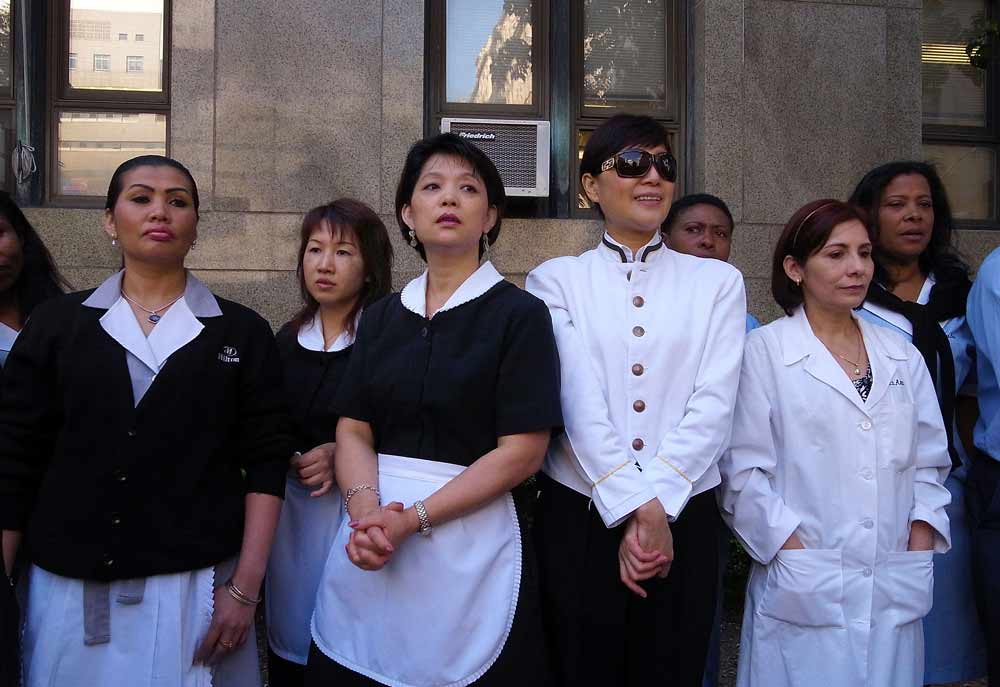
With their roles covering so many different aspects, executive housekeepers see the strengths and weaknesses of their hotels. James Clarey finds out what the main issues and challenges are for these hotel professionals — and discovers how to overcome them
There is no two ways about it – housekeeping is often seen as a poor relation in the hotel family. It is renowned for its low wages and high staff turnover. However, without its pivotal role, a hotel couldn’t function.
It is the backbone that keeps the property standing, clean and efficient — some of the most important aspects for both staff and guests.
Over the last few years, expectations on the role of the housekeeping department have grown, with a huge emphasis now put on environmental issues and staff wellbeing. Behind the entire operation is one person keeping the ball rolling on these issues and fighting for a better experience for their guests — the executive housekeeper.
As Annette Damz, executive housekeeper at Grand Millennium Al Wahda Abu Dhabi, says, a lot of issues housekeepers have are dismissed, but when others in the hotel have problems, they are always the department called upon. “We are the bones of every hotel,” she claims.
Staffing
One main issue in the industry is staff poaching, propagated by low wages where even small increments are enough to tease certain staff members to rival hotels. Executive housekeepers say that the main way to counteract this is not to add clauses to contracts, but to instead make staff want to stay, to give them a sense of loyalty and make them happy in their positions.
“All it takes is being part of your team, showing interest in their day-to-day work and developing the stars among them,” says Damz. Rudy Evangelista, executive housekeeper at Al Diar Siji Hotel & Siji Hotel Apartments, concurs, adding that “there will always be a higher paying job somewhere else, but one way of keeping staff is by treating them well and providing a pleasant work environment, which is as important as higher pay”.
Akhtar Shahid, executive housekeeper at Ramada Ajman, says that poaching will never be stopped, as “the staff came here for the money and want to grow and mature themselves.”
However, at his hotel, he has seen a staggering 75% reduction in his staff turnover in the past year, simply because of the measures that he and new management have taken to make all his staff happy.
He says that practical things, such as an in-house tandoor oven in the cafeteria to make fresh bread for his predominantly-Indian staff to take home for their families has improved staff wellbeing exponentially.
Raji Kumar S. Pillai, assistant executive housekeeper at Salalah Marriott Resort, brings up a different issue — it is not keeping staff from being poached, but keeping them from leaving the “remote area” of some resorts in the region.
“It is a challenge to keep the young generation especially, as they do not perceive the countryside to be as attractive as the capital Muscat, or Dubai,” he says. “Therefore, the company is interested to provide a lot of support, so that people can bring their families, assist with visas, housing and schooling of the children if required. We also like to provide entertainment, such as staff parties, volleyball tournaments and movie nights.”
When hiring staff, Shahid says he prefers to hire from in the UAE, as he likes being able to give staff a one-hour trial, to see how they work alongside colleagues. Prabhat Shukla, executive housekeeper at Holiday Inn Downtown Kuwait agrees that hiring from overseas is sometimes a problem, but mainly because of “long legal formalities and the time consuming visa process”.
He says that Nepal has become a new market for him, as there is now a Nepalese embassy, and he no longer has to work through Dubai or Abu Dhabi. Evangelista, however, thinks that the effort of going through the overseas channels and dealing with the visa process is worth it, as these staff tend to stay longer with the hotel and are more loyal.
One thing is for certain with all employees, however — a permanent staff member is favoured over agency staff. But sometimes outsourced work is a necessary evil to keep down costs during low periods. The main problem with this is a constant rotation of different staff.
“You can’t guarantee that you will get the same person on a daily basis. It’s very painful to see that person who you had trained has left the company,” says Shukla. Damz agrees, adding that the language barrier is often a problem, too.
This obstacle can also be an issue with in-house staff. To counteract this, Joseph Thomas, executive housekeeper at Crowne Plaza Abu Dhabi has set up regular language classes, meaning his staff, mainly from the Indian subcontinent, can “easily fit in” within two months.
Not only are language courses on the table, but many other training schemes for staff to improve and develop their skills in other areas. Thomas says that six team members have moved to different areas in the past year alone, after completing interdepartmental training.
The same is seen across the board, with Mamdouh Salem, executive housekeeper at Raffles Dubai, explaining that while six members transferred to other departments, seven supervisors, one assistant manager and one manager were also promoted, as well as one team member transferring internationally.
At Six Senses Zighy Bay, executive assistant manager Guillaume de Lasteyrie explains that they insist on nine hours of training a month, but “at the end of the day, a warm smile and recognition on a daily basis when goals are achieved serves as the best reward”.
GREEN ISSUES
At Zighy Bay, one of de Lasteyrie’s main focuses is on environmentally-friendly solutions. He says that while these methods “require extra consideration”, “the key is to perpetually consider and reduce our pyramid of conservation — waste, water and energy consumption”.
Instead of vacuuming dust and sand, he mops the floors with water mineralised on site and infused with lemongrass from its organic garden. After mopping, the water is then used for irrigation.
Sreedhar Suresh, director of housekeeping at Shangri-La Barr Al Jissah in Oman, agrees that being environmentally friendly is becoming one of the biggest factors in his job.
His hotel is ISO 14000 certified, and has changed suppliers recently due to their lack of onus on green issues and initiatives. However, de Lasteyrie explains that many hotels that give guests the option for daily linen changes are simply “greenwashing”, and at Zighy Bay, the standard is to only wash bath towels and bed linen every three days unless asked.
“After we explain ourselves most guests understand and accept our methods,” but “most guests are already sustainably-minded”.
Tatjana Ahmed, executive housekeeper at the Grand Hyatt Dubai, adds that while the hotel does so much to try to increase environmental sustainability, such as using new product Toucan Eco, which allows the hotel to produce its own disinfectant by mixing water, salt and electricity, guests largely undo their efforts.
“It is very sad to see that many efforts of the hotel are in vain, as our guests seem to enjoy beds which are made daily with fresh linens. As far as I know, this practice works very well in Europe but has still not taken off in the Middle East. In this part of the world it is still perceived as if something is being taken away from their comfort.”
INTERACTION
It is new products like the Toucan Eco, as well as tips and ideas, which are increasingly being talked about by the housekeeping community and spreading through hotels.
“Most housekeepers are looking for better chemicals and technology that allows us to do our job better,” says Sharon Buenaventura, executive housekeeper at Park Regis Kris Kin Hotel in Dubai.
“What’s really helped in recent times is the interaction among housekeepers worldwide on social media networks. For example, I am on LinkedIn and it has housekeeping professionals interacting with each other, sharing tips, seeking advice and learning about latest developments in our field. This is fantastic, as we learn a lot this way and are able to know about new ideas and products.”
Another way the internet is helping housekeepers is through guest feedback submitted online. “I am monitoring all guest comments daily and discuss them with my team in our morning briefings,” says Nader Adib, executive housekeeper at Hilton Ras Al Khaimah Resort & Spa. He keeps track of Trip Advisor to “monitor the satisfaction of our guests and the condition and cleaning of the hotel”.
While most housekeepers prefer traditional methods to garner guest feedback and check on the proficiency of their team — daily checks of all areas and comment forms, some are going one step further. “Our employee survey is conducted through an independent company which is done twice a year,” says Shukla.
“Guest satisfaction is also measured by an independent company which provides us with guest feedback on a monthly basis.”
PANIC BUTTONS
Recently, one hot topic in the housekeeping industry that has had a lot of coverage online is the use of panic buttons for maids, as introduced in New York hotels. Most housekeepers in this region dismiss the idea, saying their hotels are safe enough.
“Panic buttons can be a nuisance,” says Buenaventura. “As long as the team has been briefed on the dos and don’ts, security is not such an issue in the UAE. It is a very safe environment,” but she adds that the hotel still has 24-hour surveillance.
Suresh agrees that training to equip staff with “knowledge and skills on how to handle security issues” is the key, but adds that at Shangri-La Barr Al Jissah there are still panic buttons. “The staff do not take telephones on the floors and therefore the panic buttons are useful and user friendly.”
Shahid has a different approach; while he says he “really loves” the idea of panic buttons, his approach is to always send a male staff member to hotel areas with women.
DESIGN
One of the biggest issues for housekeepers is with hotel designs, many being built with guests and front of house staff in mind.
“Normally designers think from the guest perspective and focus on front offices areas, rather than back areas and service areas,” explains Salem.
“Therefore, storages and pantries are probably the most challenging part for the daily operation.”
Buenaventura agrees, saying that getting rid of housekeeping trolleys in corridors is “something most of the housekeepers dream of”, but in order for this to happen, “housekeepers should be involved in the design of the hotel to provide operational information and facts regarding storage areas, traffic and other concerns pertaining to the general function of housekeeping to the designer.”
However, at Zighy Bay, design constraints aren’t such an issue, with de Lasteyrie saying that “Six Senses abandoned housekeeping trolleys since our first hotel opening in 1995.
In Zighy Bay we use tricycles with baskets to service the villas.” He adds: “Not only is this method aesthetically pleasing and mechanically conducive, it also helps to keep our hosts healthy.”
Whichever ways they service the rooms and no matter how their hotels are designed, housekeepers agree that their roles are increasingly challenging. Pillai concludes: “We have to be very flexible and react to many things; we have to be administrator, engineer, cleaner and guest relations manager all at the same time.”
Your green initiatives
Half-used shampoos from the rooms are used to clean our windows, and give them the best shine and smell.
Annette Damz, Grand Millennium Al Wahda Abu Dhabi
We recycle old towels as wiping dusters and recycle half-used toilet rolls in
colleagues’ accommodation.
Prabhat Shukla, Holiday Inn Downtown Dubai
Our linen is organic and unbleached, including fabric used throughout the resort for pillow and daybed covers.
Guillaume de Lasteyrie, Six Senses Zighy Bay, Oman
We have stopped using plastic bags in our bins and instead we prefer to use paper underliners.
Sreedhar Suresh, Shangri-La Barr Al Jissah Resort and Spa, Oman
We have a dedicated team member to segregate recyclable items, but we are also planning to introduce waste bin containers for plastic, paper, can and solid waste in guest rooms to make it easier.
Joseph Tomas, Crowne Plaza Abu Dhabi
What is your approach to floristry?
Sharon Buenaventura, Park Regis Kris Kin Dubai: We spend an average of AED 200,000 (US $54,450) on flowers and plants in a year. We try to minimise cut plants and have more live plants in our endeavour to help reduce carbon footprint in the daily delivery and transportation.
Joseph Thomas, Crowne Plaza Abu Dhabi: We have a dedicated florist taking care of this. On special occasions like Valentine’s Day, Christmas and New Year we do things differently.Mamdouh Salem, Raffles Dubai: We only purchase exquisite flowers like orchids and phalaenopsis to decorate the hotel. Last October the head florist and myself went to the Netherlands for Hortfair to get new ideas.
Guillaume de Lasteyrie, Six Senses Zighy Bay: We do not promote or place cut flowers in our villas. This is due to the high amount of water and space used in greenhouses. Often harmful pesticides are also used that are toxic to workers. If we have a request for a romantic turndown, we have a bougainvillea plant from which we collect the fallen flowers.
Prabhat Shukla, Holiday Inn Downtown Kuwait: We have an outsourced flower company which takes care of flowers, but we roughly spend around 7500KWD (US $26,886) annually. We try to use green plants rather than flowers.