

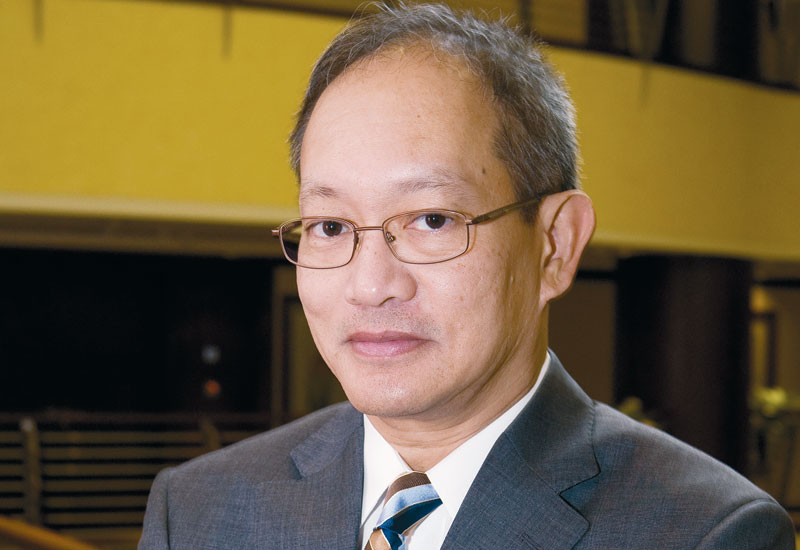
As only the second CEO in Dusit International’s 62-year history, Chanin Donavanik outlines how he plans to follow in his founder mother’s footprints by prioritising carefully chosen hotel projects overseas alongside one of the largest industry education programmes in Asia
You took over the management of Dusit International following your mother Thanpuying Chanut Piyaoui’s retirement aged 84. What are your plans now you are at the head of the company?
The company was founded by my mother 62 years ago and since then we have not changed much. For her, she wanted to bring something Thai overseas because she believed very strongly in what the Thai people or the Thai culture could do to the hotel and hospitality field and for 62 years we have been trying to do that.
Just recently we have been expanding overseas and when we do that we want to bring something with a little bit of Thai passion to every place that we go into.
I have been working with the company now for 32 years; we have been around for 62 years and I’m the second CEO. My mother retired four years ago when she turned 84. I don’t think I’m going to work until I’m 84!
Outside of Asia, Dusit already has hotels in Dubai and Egypt. What is your approach to overseas expansion?
We have been trying to go overseas for 17/18 years now. We bought or we invested in the first hotel in the early 90s overseas. At one time we bought a European hotel company, which we sold because of the Asian financial crisis. As a company we are still very conservative, we don’t like to have debt so we have been very selective of what we have been doing.
I think with Dubai we were a little bit lucky. I had the opportunity to meet someone here who gave us the first opportunity to come here seven or eight years ago. He had a vision that he would like to bring something from Asia to Dubai, so we were the first Asian hotel company in Dubai.
You said the company was very conservative; has that assisted you in seeing through the tough times of 2009?
Yes I think so. It helped us so well that now we are actually starting to look for new investment. I think that before 2009 we had four or five years of booming time for the hotel industry worldwide so a lot of hotel pricing and a lot of hotel investment had been too high. I think now is a good time to look and see what we can do – it is the best time to invest in the hotel business worldwide, maybe more so in the North American market because prices here have come down the most.
Would you expand further?
Yes. There are a few cities in Europe and a few in North America. We are not a big company and the idea is not to be everywhere. The idea is to be in strategic cities and locations that we can be long-term. In the last 62 years there has only been two CEOs in my company and we want a lot of relationships, we want consistency, we want stability. We are not buying a hotel today to sell in five years.
We have not looked at investing in Asia as much because the prices in Asia did not drop as much in 2009 and in some countries they have gone up. If you want to invest in a hotel in China today, it costs 30% more than last year. So in some countries it’s not worthwhile [for us to invest].
Right now we have almost 10 projects in the Middle East, we have seven in India, we have our first project in China — we want to do more, we have just opened a development office in China. We also recently opened an office in Berlin and have offices in Dubai and New Delhi.
Following the opening of Dusit Princess Dubai at the end of December, you now have three of your five brands in Dubai. Tell us a little more about them?
Dusit Thani has been around for a long time and is usually a more traditional hotel or classic hotel in terms of Thai style. And they are big properties with 500-600 rooms. We have Dusit Residence Dubai, which is a serviced apartment and our first branded product in the serviced apartment business.
Last year, we opened the Dusit Princess — actually the Princess is my mother’s original hotel name; the name dates back 62 years. The reason why we call it Princess was because the first hotel was opened by the elder sister of the King of Thailand. It is a very first class hotel, not a luxury hotel but it’s still comfortable and I think there’s going to be a lot of demand in the Middle Eastern market to have this kind of hotel.
We are trying our first here in Dubai and we are very confident that it is going to be a success, then hopefully we can grow the Dusit Princess brand throughout the Middle East.
Why did you launch the Residence brand in Dubai rather than Thailand?
We have been looking at this business for a long time — in Thailand we have apartment buildings but we have not really done it in a way that it is linked to the hotel brand. We had an opportunity here and again we have been very lucky because the developer and owner were interested in working with us in their serviced apartment building, so we jumped at that. So I think we have been very lucky so far, the Dusit Residence is doing very well. Right now we are trying to grow the serviced apartments in this part of the world.
Can you describe your new brands?
We have two other brands we have not brought in, the Dusit Devarana, which is a deluxe type of operation and we have started building that in a few parts of Asia. The first one will be in New Delhi in India in May 2010. Then we have two to four coming up in five years. We don’t have one in Dubai.
We have also been doing quite well with our lifestyle brand, which is a smaller, more boutique style of hotel brand called dusitD2. And we have a few opening now in Thailand; we want to grow that brand outside also.
We have many brands not because we try to be creative like some of the big boys; we need that because we want to grow and we want to capture different markets and we want to capture it in a way that it is clearly defined. We don’t want to put our name to lots of different hotels so the customer is confused, we try to create different sub brands so that the customer will understand what they are looking at.
Will Dubai have all five brands?
I would love to, I do not know when but I would love to. We always see Dubai as a centre for this part of the world. We made this our headquarters for our operation in the Middle East — it would be nice to have a product that we can show to people.
How are you progressing Dusit’s education programme?
For a hotel company, at least in Asia, we are doing more than anyone else there in terms of hospitality education. Our Dusit Thani College, which offers a bachelor degree programme and has just started a masters degree programme, has been around for almost 15 years.
Right now we have 2200 students studying full-time so every year we graduate with a bachelor degree about 400 to 500 students.
We also are the only partner of Le Cordon Bleu cooking school from Paris — every year we have almost 1000 students going to our programme. We try to grow our education programmes, which was my mother’s decision 20 years back to see what we can do to prepare Asian new generations for the hotel industry. So, we have been in the Philippines for a year; we have a programme that we joined with one of the top universities in the Philippines. In the first year we had almost 5000 students. This programme will have about 15,000 students when it has stabilised for the four year bachelor degree programme, so we will be graduating maybe 3000 to 4000 people from the Philippines programme.
We are now discussing with people for India. We would like to bring our education programme to India and we are talking to someone in China. So it should be quite active in this area and it is something that people in Asia need.
We are not a large university, but this year we are going to have about 8000 people studying with us full time and as I said, the number is going to be close to 15,000 in a few years. But the most important thing is it is going to develop and train people so that as Asia is growing very fast in terms of hospitality and travel, these people are going to be helping the economy to grow as well.
And why are we so popular — because most of our graduates don’t have a problem in looking for work.
How would you sum up future growth?
There are 8000 people in the company; I think within two or three years it’s going to be 15,000.
We have about 14 hotels opening in the next two years. We are going to be opening six, seven, eight hotels a year from now. That is not easy for a small company. It’s a lot of work. I think this is going to be good for our people; there are a lot of opportunities for us to grow.
DUSIT IN THE MIDDLE EAST
Dusit International currently operates four properties in Dubai and two in Egypt, including the new Dusit Thani Lakeview Cairo, which opened in the first week of January this year.
Of Cairo, Donavanik says: “I think the market is quite strong and I think we also have a very good partner there. I think our hotel should be one of the top two, top three, top four in the whole of Cairo. It’s a top luxury hotel. It’s going to be better than many of the traditional major chain hotels”. Later this year, a Dusit Thani will open in Abu Dhabi comprising 400 hotel rooms and 100 serviced apartments.
There are also Dusit Thani hotels scheduled for Jeddah and Bahrain, both due to open at the end of 2012.
In terms of other Middle Eastern markets, Donavanik adds: “We like Oman. We have been looking at a few projects there. Hopefully, in the next three months we can finalise something there. We would like to find something in Qatar and that would cover most of the Gulf states. In North Africa, we like Morocco”.