

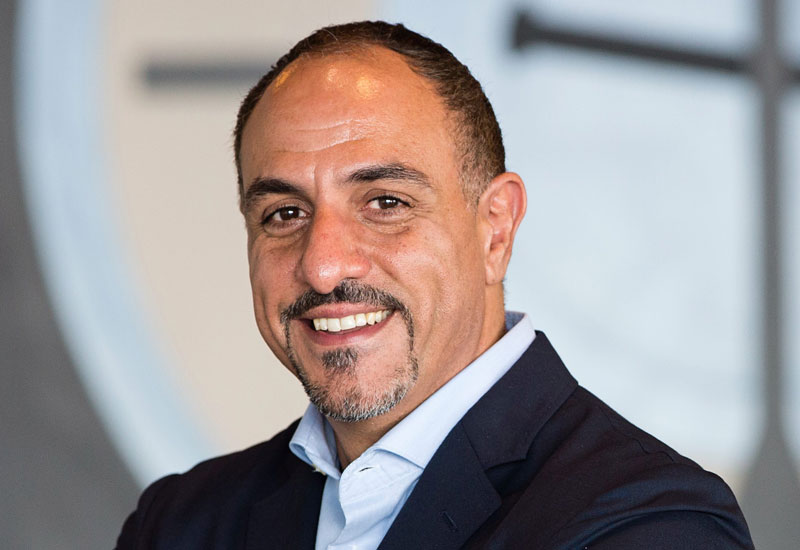
Dubai-founded AWJ Investments portfolio of concepts in the UAE comprises Operation Falafel, Awani, Bahria, Filicori Zecchini, Smoky Beach, Surf Bite, and the yet-to-open Lulu & Murjan — and this is only the tip of the iceberg, as Caterer Middle East found out during a recent interview with the company’s CEO and co-founder Manhal Naser.
Meeting at Bahria In Jumeirah Beach Residences last month, Naser revealed that AWJ will be adding another five units to its tally by July — bringing the total number of units it operates to 14 — while developing new concepts, some of which he reamins tight-lipped about.
One of the concepts that AWJ has already announced is Lulu & Murjan, which has been under development for the past 15 months and is set to open in December in Dubai.
Discussing this new venture, Naser says: “It’s a creative all-day dining restaurant — Levantine with an international taste — and it is going to be in Jumeirah on the beach. I am expecting this concept to be one of our most successful. Always, when I think about a concept I like to break away from the norm and come up with something totally different.”
Naser’s flagship restaurant is Operation Falafel, which he describes as the company’s “winning horse that everyone is betting on”. It serves up Arabic street food, including falafel, shawarma and mana’eesh, and the first outlet opened within The Beach retail and dining development, along Jumeirah Beach Residence’s The Walk in March 2014. Since then, four more have followed, with the latest opening just last month.
Speaking about AWJ’s primary brand, Naser says: “Operation Falafel is a scalable concept. Franchising is an important area that we are focusing on in 2016 and we paved the way for this since creating the concept; we have finished our own operational manuals so we are prepared [for franchising] and we exercise the supply chain to ensure consistently in different locations.”
While not revealing too many details about the franchising plans, he tells Caterer: “We are about to sign a strong regional deal with one of the biggest players in the market, who would represent us in the region. After this, we are going to Europe and the US; our plan is to exceed 400 units in a couple of years across the world.”
The fact that AWJ is at this stage just two years after Operation Falafel’s inception shows that the company is ”committed to the franchise”, Naser asserts.
“It is an aggressive plan and we will make every effort to make Operation Falafel a world-renowned brand. My dream is to see it everywhere I go,” he continues, adding that he wants Operation Falafel to be as ubiquitous as McDonald’s.
“This is what I am striving to do and I think we can do it because as a concept it has many elements that gel together to make it successful all around the world. hummus and falafel is popular around the world, not just in the Middle East.”
The businessman expects to be operating a total of nine Operation Falafels in Dubai alone by the end of 2016. Besides this, AWJ’s Dubai-based Arwani concept will expand to Abu Dhabi and Saud Arabia, and Naser mentions he is “cooking up” a further two concepts — but maintains that he is keeping these ideas under wraps for now.
Reflecting on all of this development and the evolution of his company, he remarks: “For us, 2015 was a year of stabilisation and sorting internal matters in the group. In 2016 [so far] we are setting strong foundations to expanding regionally and globally in the second half of 2016. And in 2017, we will see the earnings for all shareholders increase and we will prepare to enter the stock market.
“It took us a while to set the real foundations and come up with concepts that are in high demand. Today, I can say that all our concepts have a niche. We are not copying anyone in the market as we coming with our own flavours.
“Operation Falafel may seem simple for some people because it is just shawarma and falafel but they don’t know that our mix has its own DNA, and this is not easy to obtain — it has to be done though consistency, intensive research and a great deal of work by a big team.”
Citing another example of his aversion to replicating existing concepts — a point he makes several times — Naser says Arwani it is not just a typical Levantine restaurant “that you see all around Dubai”.
“Every dish is created by a chef who knows how to create. It is very difficult nowadays to find the creators, rather than the imitators. I’d say that 80% of what you eat in Arwani cannot be found somewhere else, which is why people come back to us. Customers say that they have tried many restaurant, and yet they come back to us because we have many dishes that are totally different,” he reasons.
Naser also believes in adapting to suit the market, over time, sharing that he is working with Bahria at the moment, “making tactical and strategical changes”, to make it more of a casual dining destination, in line with the global industry trend away from more fine-dining experiences.
Naser has always had a keen eye for trends and what consumers want, having worked in various industries and studied away from home in the US. While he initially joined the family business in Jordan, it wasn’t long before Naser wanted to break away to start his own legacy.
“My father started a construction business and then launched other businesses in retail, and fashion and garment. When I started in the family business I started off by helping my brothers in the retail side. I had to start at the bottom of the ladder — my dad told me I had to start from the floor and not go straight into an office — so he put me in the warehouse. After this, I moved to the outlets, where I started to deal with people as a salesperson, then I became floor manager, and then I was handling cash. It took me a year or two to do all of this — and then I was moved into an office where I became more involved in the financial side,” he says.
It was this experience that “ignited a feeling” in him to become a businessman in his own right and “be in a place” where he could handle different projects.
This interest was reflected in his studies in economics, finance and marketing in the US. Then when he returned to the Middle East after competing his Master’s in 1997, he thought about how he was going to establish something on my own.
“I had this stubborn mentality and I wanted to do it my way. My dad was not happy about me leaving the family business — he said that he had done all he had in order for us to carry on and develop it further, rather than we start something new. But I am pretty sure he was proud of me because he wanted to see me be successful. I had a strong passion towards food and ever since I was little I had a problem accepting just any type of food.”
From being a picky eater as a child, Naser started young in learning about the different elements involved in creating dishes. He tells Caterer: “I used to be able to taste something and tell my mother the ingredients, or if it lacks salt. Even now, the chefs come to me and ask me to try things. I try and start to segregate it in my head — perhaps it needs more cinnamon, reduce the spices a little, add this, add that. Our executive chefs do not release a dish without me tasting it — when I say it is okay, they will release it.
“I try to taste with every taste bud. I imagine how a European will taste it, how an Arab will taste it, how a child will taste it, and so forth.”
He says he recognises that food can be made truly authentic or it can be palatable to the masses. “In Operation Falafel, I cannot make the hummus very traditional. It has to be more neutral. I look at the balance. For example, when I go to Arwani, some dishes are very traditional and they are meant to be pure Levantine, home-style cooking, with lots of spices. Each place has its own mechanisms and tastes; you need to know your niche and not deviate. Many people find their niche and then one year later they deviate and lose their purpose,” he remarks, as we discuss the success of his restaurants.
Asking what considerations he thinks have come into play, in this respect, he says: “There are so many factors to being successful, if I am indeed successful. People tell me how well I have done but for me, it means nothing because I still have things to do — every day I wake up and want to achieve something. I get so sad when I finish something because I think ‘well, what now?’ The hunger is always there.
“My hobby is business. I like to do business. I am the kind of person who does not sleep. I never stop. I like to always look for something new and research business concepts, and also look at how I can enhance what I have. There is no limit to development — this is who I am as a person.”
Reflecting on where this drive comes from, Naser shares that his role model is his father, who taught him that “even if you have money and businesses, one day you might lose it, so you have to be prepared to know how to start again”.
Besides instilling this in the entrepreneur since he was a child, Naser says that his father always stressed the importance of education, studying hard, getting a degree, and then starting from the bottom of the career ladder.
Given his current position as CEO of growing F&B empire has seemingly been decades in the making, it is unsurprising to hear AWJ described as “his baby”.
“It is something I dreamt of. Three years ago it was on paper and today it is tangible. Lots of companies around the world want to work with us, and it gives me a sense of pride. I love my team a lot and they are very responsible; I am not a kind of person who likes things to be centred on him — instead, I like to create leaders in every area and deploy these leaders, so they can reap, and get some good yield. I give empowerment to different people and each one thinks differently, but I work closely with them and direct them.”
As part of this management approach, Naser describes how he takes pleasure in developing his 600 employees’ potential.
“I have many people who have started in junior positions and become senior in two years, growing their self-confidence as well. I respect that they stay with me and they are grateful to the company. Retention is high and I am proud of this.”
He says that, with recruitment, passion is more important to him than the right experience, adding: “You can work on many things [in a person], apart from morals and a lack of desire for the job. If you have a person who has a problem with their ethics, it’s difficult to correct this, and everyone needs to work to live, but if a person has desire, passion and stamina, they stand out. I don’t want average people who just want to work — I look for a person who is really striving to develop themselves and learn. I can then put effort into helping them. I don’t mind what they know or don’t know. When I see that hunger, I will spend time with that person to develop their strengths.”
Asked about how his approach to running his businesses has changed over the past two decades, he reveals: “There are lots of variables. The economy has been different ever since we started. Mentally, I am more developed and more rational [than when I started]. I used to take decisions based more on my emotions, compared with how I work now. I have seen myself evolving on a personal level. I can also make judgements in a shorter period of time now as well, rather than taking two or three days, because I have much more experience now. The market evolved and I evolved, as a person.”
Elaborating on how the economy has impacted — and is currently impacting — the company, he continues: “I heard from many people that the economy is not doing well, with lots of fluctuations. I was sceptical because when I looked at our numbers and talked to my finance people, I saw that in Q1 we had 50% growth versus 2015, therefore I cannot complain. People are still spending and people’s disposable income is still high. Going out is a part of the daily routine now; in Europe or the States, maybe people go out once a week or once every two weeks, but families here with a typical income go out every day. It is a habit. Being in this industry and having a restaurant, we are benefiting from such habits; this year so far is going well and I am almost on budget. I have growth versus last year and we are looking at accomplishing lucrative numbers by year end. The only thing that will stop me from achieving will be if there are delays in developments. I have plans to open a couple of more outlets by year-end, and if I can’t then the income will be deferred to the year after.”
Having worked in several countries, he pinpoints the UAE, “honestly speaking” as the best place to launch a business, referring to the country as a safe haven. He says this is partly becasue the country allows entrepreneurs to establish a company quickly and partly because the UAE is a very attractive country “for all people”.
Explaining what he means, he says: “Look at how many nationalities live in the UAE. If you were in a mono-populated country, 90% of the people you would be serving [at your restaurant] would be the same race. Here, we have a wider population segment that we can reach and if you are popular in the UAE, you can be popular all around the world; I get calls from people who want to franchise my concepts in Germany, Mexico, Canada, the US and all around the GCC, solely after they saw them in Dubai. So the UAE has given me a faster environment to grow my concepts; if I did what I’m doing in another market, it could have taken five times as long [to expand the business].”
He also makes that point that while “Dubai is small in comparison to London, New York or Paris”, as it is a fashionable city, it draws investors who are interested in developing concepts.”
Looking to the future, he adds: “Being in this business, I have some insider information about the beautiful projects still to come in Dubai because we have to be part of it. We love to be here and develop here, so I don’t see us [developing concepts] outside of this country. We are here to stay and we will always try to come up with something new for the market.”
Manhal Naser pinpoints 2016’s culinary trends
The complete dining experience
“When diners decide they want to eat out, they are looking for a complete dining experience. In the culinary world, this is all about the ambience, entertainment and décor offered by the restaurateur. From creative décor of handcrafted ceramics to live entertainment, diners seek an experience that will be remembered long after the last morsel food is gone. This is where those stylistic creative flourishes come into play.”
Diverse and cultural connections
“Consumers are no longer tied down to their local restaurant, but are willing to explore and try new places which offer the cultural cuisine coupled with the perfect ambience.”
The fusion revolution
“Diners are always on a culinary quest for the next interesting taste that will enrich their palates. With the advent of the internet, consumers are more knowledgeable and curious about the different foods available and are more than willing to taste the next fusion creation. While some may see this as a loss of authenticity, others have embraced ethnic ingredients like soy sauce, jalapeños, chilli and hummus. These ingredients have even become household staples, facilitating fusion cuisine’s popularity with diners.”
Digital technology drives food preferences
“Unsurprisingly, technology has infiltrated the dining scene. The increased smartphone penetration in the Middle East has made it possible for restaurants to build delivery fleets at a fraction of the cost incurred previously. With technology enabling consumers to track food deliveries by the minute, this additional option will soon be a norm. In addition to tracking food deliveries, consumers have come to expect certain connectivity attached to their dining experiences, be it the ability to order restaurant delivery with a smartphone app, check in online on social media, or review menus and make reservations online.”
The popularity of smart casual dining
“Smart casual dining is a concept that has been gaining popularity every year. These restaurants offer the quality of fine dining combined with the speed of fast food at affordable prices. The simplicity, taste and affordability will make smart casual dining more popular this year for consumers.”
Food trucks on the rise
“Food trucks are no longer just a fancy idea and are a trend that is catching on in the region. Most food trucks started out serving just sandwiches and burgers for consumers on the move. Today, more sophisticated foods are being added. Gourmet food trucks are starting to appear as part of the evolution of the new culinary trend.”
Scrambling for clean menus
“A greater awareness of healthy eating is changing the eating habits of consumers in the Middle East. A greater awareness of healthy eating is changing the shopping habits of consumers in the UAE and Saudi Arabia. They say they are now more health-conscious when they buy, taking more care to read nutrition labels and seeking out products with health benefits, according to a new survey. They also want food labelling to be much clearer. There is a constant need for balance between selecting food that is fresh and healthy versus food that is tempting and exciting. With more and more consumers gravitating towards health claims of natural, organic, whole-wheat and gluten-free, healthy dining will be a key driver for people wanting to dine out. The vegetable side dishes will be the hero of the plate for 2016.”


