

Hotel design came under the spotlight at the International Furniture Fair Singapore 2012, with a new conference tackling the all important questions of how hospitality design and furniture converge
Design took the focus more than ever before at Singapore’s trilogy of furniture and interiors shows this year, with a variety of new exhibits, a debut education programme and a big focus on hotel design specifically.
For the first time, the organisers of International Furniture Fair Singapore 2012/29th ASEAN Furniture Show (IFFS/AFS 2012), Deco Asia 2012 and The Hospitality Show 2012, introduced the Hospitality Design Furniture Converge Asia 2012 Conference, which featured 30 speakers across a two-day programme.
As the name suggested, the focus of the conference was on the relationship between design, interiors and hospitality, with the aim being to establish better working practices between the architects, designers, furniture manufacturers and hospitality operators and highlight trends and opportunities for all to capitalise on.
“The focus on design has been the strength of our show, and we will continue to build upon that,” commented Tony Pang, chairman of the Show Advisory Panel of the decision to add the conference to the show programme.
“To maintain our prominence in the market, we aspire to get even better at looking after our exhibitors’ needs, as well as keeping things fresh for visitors to our show.”
In the keynote address, ‘Rethinking Hospitality and Design’, James Dilley, associate director of hospitality and leisure design specialists Jestico + Whiles — designers of The Yas Viceroy Hotel in Abu Dhabi — weighed up the issue of what comes first — design or furniture.
“The furniture has to come with the design.You’re not designing just an environment, you’re designing an experience. It’s not just about the choice of the furniture, it’s about how it’s placed and what it’s placed with, how it’s mixed up,” said Dilley.
Dilley presented the audience with examples of independent hotels and bars that had taken the relationship between design and furniture one step further, actually integrating the two.
He cited projects from Philippe Starck and Zaha Hadid, where “the environment becomes the furniture”. These examples used very little loose furniture and the traditional image of where architecture stops and interiors starts was blurred.
“Architecture and furniture can be inseparable,” commented Dilley, referencing the bar at Q Hotel Berlin, designed by owner Wolfgang Lock with architecture studio Graft, in which the seats are part of the walls.
However, Dilley added the importance of furniture to “empower the space and create zoning”, from using cushions on a beach to alter the natural into the luxurious, to using loose furniture in a lobby to draw people in.
“Furniture works on a very simple level – sometimes all people need in hotels or airports is something to pin them down to a place and to stop them moving around, a space they can claim as their own — it can be a floor finish, a big chandelier that makes you feel comfortable as you sit underneath it,” observed Dilley.
His advice to hoteliers was to carefully consider what their furniture, and use of it, was communicating about their product and brand.
“The definition of hospitality is that it’s about serving the guests and you can do this in many ways — you can make a very functional interior or you can make things which are very frivolous and make this experience of coming into a room truly different and truly unique.”
Dilley urged hoteliers to think about offering something relevant to their location and advised against traditional perceptions of luxury.
“Sometimes simplicity is luxury, there’s nothing invading your space. It doesn’t need to be cluttered with furniture. Luxury isn’t defined by how many pillows you have on a bed, which is really how it’s been defined by some hotels in the past 10 years,” asserted Dilley.
Case study: The Yas Viceroy
To illustrate his emphasis on zoning and locality, Dilley referenced The Yas Viceroy Hotel in Abu Dhabi.
“The first thing I’d say is the outside should respect the inside, the inside should respect the outside, and in this space, because of the veil that runs across the building, there isn’t clear definition between inside and outside, so they have to be continuous,” said Dilley.
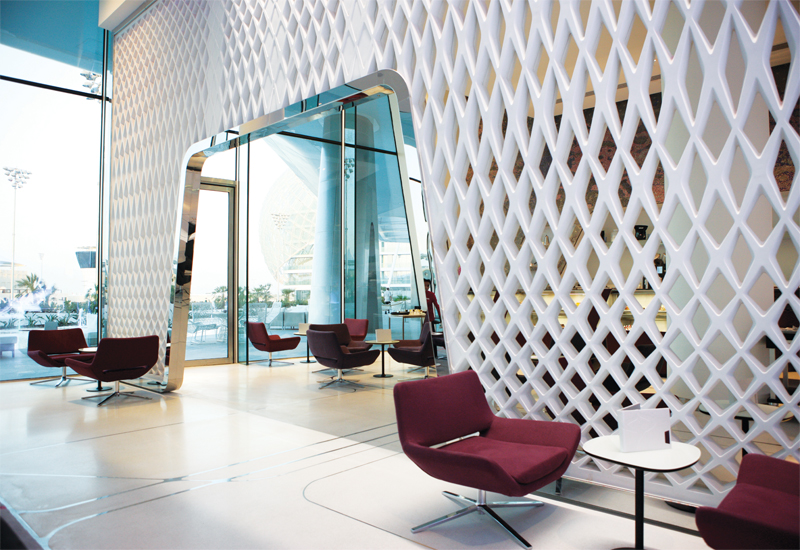
The “string bag” in the lobby is a perfect example of this: it’s a screen designed to reference the Arabic mashrabiya, that separates different areas of the lobby without actually closing anything off entirely.
“We created a string bag, a wall that holds all these functions in. The lightweight concrete screen holds the zones in but you still have visual permeability,” says Dilley.
“The interior design is based on three prompts. One is the Arabic culture, so the screen is as close as we get to mimicking that; two, the formula one track runs though the hotel so we brought the speed lines in from the pit stops to the terrazzo floor, and thirdly, it’s on the marina where there’s a thriving coastline so we used a lot of biological references for the art work and the colour scheme is based on squid ink, so these are very subtle references to environment, but the narrative is strong and you can hang everything on that — it gives you a very coherent interior,” said Dilley.
“Furniture is less important than the overall composition, everything is tackled together,” emphasised Dilley. “Furniture is part of the interior, you don’t know quite where the interior design stops and the furniture begins — it doesn’t have to be a separate discipline where you populate the space after the design has been finished.
“Even artwork is considered as part of interior design – it’s not something you come in and hang on the wall, it was built in, part of the whole environment,” he added.
When it comes to guest rooms, Dilley urged against making the TV “an icon in the room like we see in many hotels”, and recommended the finest quality fabrics that will wear with time and bathrooms that offer the flexibility to be open or closed giving the choice back to the customer.
“People always say the devil is in the detail. Well, really, the angels can be in the detail,” said Dilley. “Furniture is not just about the things that you need, what you sit on or sleep on, it’s about the extra things that are thrown into the room and about care and how people treat their guests and what they think of them.”
Another speaker at the conference, Henry Steed, principal design director at ICN Design International, took it a step further to emphasise the need to focus primarily on guest comfort.
“The hotel manager is the last person who should have an opinion of how something should be if that’s just his personal opinion. I’m more interested in 5000 room guests who are going to sit at each lounger or dining table and thinking ‘are they sitting at something that’s really comfortable and are they sitting at something that looks really good?’.
Of course aesthetics come into it, but function is highly important, Steed said. Taking a different approach from Dilley, he said the “bedrock” on which a hotel’s design was built should be underpinned by function.
“You can’t put the wallpaper on unless you have a wall. Don’t spend the time designing the wallpaper first, get the wall sorted out and then you can work out what wallpaper you need.” What approach do you believe is best? Send your thoughts to louise.oakley@itp.com
Showfloor highlights
D’Space
This design-focused area took the spotlight on the show floor, featuring some of the most intriguing exhibits. In addition, it housed the design and green seminars which attracted over 200 participants. D’Space also illustrated young designers’ talents by collaborating with design schools and institutions on projects, including 30 Chairs Lifestories and the Young Designer Showcase.
SingaPlural
The inaugural Singapore Furniture Design Week took place alongside the exhibition in the streets of Singapore city. A special shuttle service brought visitors from the Singapore Expo to *SCAPE, Park Mall, Plaza Singapura and SPACE at Bencoolen Street, to view and experience the satellite exhibitions downtown.
New product launches
Many exhibitors from the ASEAN/Asian contingent have also chosen to launch new collections at IFFS/AFS, including companies such as: Accentuate Home (Singapore); Admira (Singapore); Indigo Living (Hong Kong); Odelic Trading Co.,Ltd (Japan); and Planet Furniture (Thailand).
First-time exhibitors
Of the total 512 exhibitors, 30% were first-time exhibitors, consisting local, regional and international manufacturers, such as: Sunpan Modern Home and Westbrook Living Lifestyles (Canada); Kannoa and PolArt (America); Resol Group (Spain) and Vendone Design & Starbay Europe (France).
About IFFS/AFS
The International Furniture Fair Singapore, held in conjunction with the ASEAN Furniture Show (IFFS/AFS), Deco Asia and The Hospitality Show, is regarded by industry experts as Asia’s premier sourcing platform and design-led exhibition.
With nearly three decades of experience since its inaugural event in 1981, IFFS/AFS remains the most distinctive channel for regional and international companies to penetrate the global market.
The event is organised by International Furniture Fair Singapore Pte Ltd (IFFS Pte Ltd, which is partly owned by the Singapore Furniture Industries Council (SFIC) and MP International Pte Ltd.
For more information about the fair, visit:
www.iffs.com.sg | www.DecoAsia.com.sg | www.TheHospitalityShow.com.sg

