

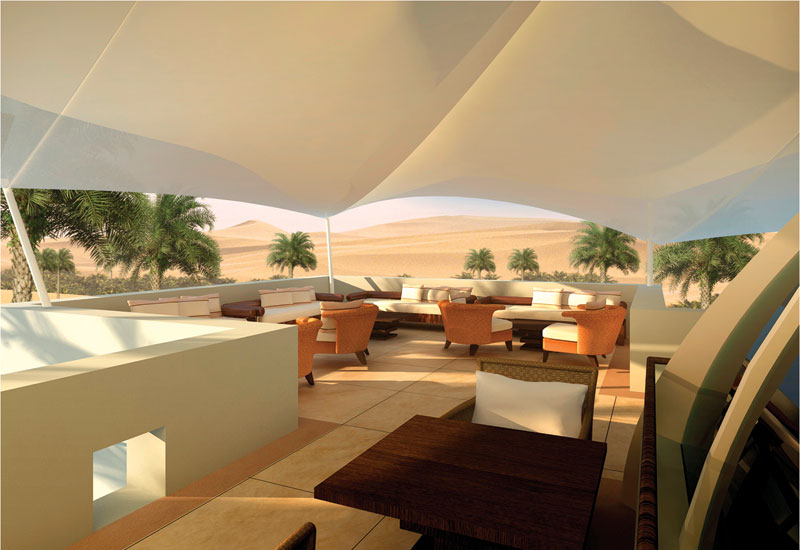
Banyan Tree Al Wadi general manager Pascal Eppink explains why this new desert resort, which is set to open in Ras Al Khaimah in September, will encourage guests to stay longer than you might think
For several years, Emirates Hotels & Resorts’ famous Al Maha property was the UAE’s only desert resort. While this has established a loyal following and a reputation for exceptional luxury, Arabian Travel Market (ATM) revealed that some like-minded hoteliers are also preparing to set up home on the dunes.
Desert Islands has already opened off the coast of Abu Dhabi (see page 59) and Anantara is preparing to launch a second property, its flagship in the region, in the Empty Quarter.
Banyan Tree Hotels & Resorts is also looking to make its name in the Emirates, with the September launch of Banyan Tree Al Wadi in Ras Al Khaimah (RAK), the company’s first Banyan Tree branded property in the UAE following the opening of sister brand Angsana on Sheikh Zayed Road in Dubai at the end of last year.
While Anantara is still keeping details of its Qasr Al Sarab property under wraps, the imminent opening of Banyan Tree Al Wadi just after the summer means that its general manager Pascal Eppink is raring to go. And having been on site since the early part of 2008, he has real experience of why the property will offer more than a typical desert resort.
“This will be the first desert resort with its own private beach, nature reserve, hydrotherapy spa and golf course,” reveals Eppink, speaking exclusively to Hotelier at ATM.
The low level resort, which comprises 101 villas, each with their own private swimming pool, has been designed in keeping with the traditional architecture of RAK.
“The colours of the buildings are as similar to the sand as possible, so the resort blends into the desert as if it has been there forever,” says Eppink.
In keeping with the theme, there is a Bedouin camp in the nature reserve, a falconry centre at which guests can take a course and leave as a trained falconer and even a snake pit.
Guests will be greeted by a member of staff and a camel upon arrival and those staying in luxury villas will be granted a camel for the duration of their stay “so they can give the camel a name and use the camel at any time,” says Eppink.
Animal specialists have been hired to look after the animals in the nature reserve, which will have its own rehabilitation programme, with visiting experts also coming to the resort as a result of tie-ups with universities in the area.
“We will have a falcon exhibition centre. When guests come in, they will see the history of falconry, we will display where the birds come from and how they live, we will offer daily educational tours in a purpose-built classroom and have professors coming in to talk about the different subjects of flora and fauna native to RAK,” says Eppink.
With such a multi-faceted property to manage, Banyan Tree has partnered with several other experts and existing facilities in order to offer guests the best service. Dubai-based adventure activity company Desert Rangers is setting up a base in Ras Al Khaimah specifically to run activities for Banyan Tree Al Wadi.
“They will deploy a number of people to RAK who work only for Banyan Tree, so that makes our services flexible in the sense that if a guest wants to sleep in and wants to start a tour at 11am instead of 9am, we can do it,” says Eppink.
The golf course, meanwhile, will be operated by Banyan Tree, but the facility itself already exists: the Peter Harradine-designed Al Hamra Golf Course. Banyan Tree Al Wadi will therefore open with 325 staff, but the full golf course and restaurant team will take the tally up to 400.
Deserted beach
One area in which Banyan Tree does not need to partner with outside experts is in the field of spa, for which therapists will be recruited from its very own training academy in Phuket, Thailand.
Eppink says: “Banyan Tree is quite known for its spa facilities so we will have a large hydrotherapy facility and of course we have 10 different types of spa treatment rooms as well — deluxe up to what we call royal treatment rooms with their own experience showers etc.
“We will also have four spa treatment rooms in the sea on a private island; that’s next to our beach club.”
The beach club is 15 minutes away from the main desert resort, alongside the golf course, explains Eppink, but it is a private facility exclusively for guests of Al Wadi, with transport provided by the hotel.
Future plans include expanding this facility in order to offer guests the chance to stay both in the desert and by the sea, adds Eppink.
“A year from now, we will be building another 20 villas on the beach,” he reveals.
It is the wide variety of facilities and activities on offer at Al Wadi that cause Eppink to predict that people will stay at the property “longer than the average desert resort”.
“Most desert resorts have a two to three night [average length of stay] but because of the variety of activities available people can be active for a few days, relax for a few days on the beach, play golf and use the spa, so I think four to five nights will be the average at Al Wadi.
“Europeans can probably stay easily for a week, but of course there will also be people from the Middle East who come only for the weekend, so that takes the average down because most weekend business is two nights,” says Eppink.
“Western Europe will be a key market for us, the GCC as well of course and to a lesser extent India, Japan and China, which are traditional markets for our company, so we have a well-established brand name,” he adds.
And finally, with the option for people to use Banyan Tree Al Wadi for a week-long holiday, Eppink says it is also important to keep them feeling connected.
With that in mind, everywhere, except for in the nature reserve, will offer wireless internet connection.
“It’s a company standard; people expect it from us,” he says.
“We didn’t offer internet in some of our hotels in Thailand and Indonesia for a long time — we didn’t put it there on purpose.
“We want our guests to come and escape from work pressures, but by the time the average length of stay gets a bit longer, there are very few people that can live a week or more without looking at their emails,” concludes Eppink.
BIOGRAPHY: PASCAL EPPINK
Pascal Eppink took up the role of general manager at Banyan Tree Al Wadi in the first quarter of 2008 and has been responsible for co-ordinating the operational aspects of the development as well as hiring and training the pre-opening team.
Well-versed in the Banyan Tree philosophy, Eppink was previously resident manager at Banyan Tree Phuket in Thailand, the group’s flagship property, at which he was in charge of rooms, F&B, HR and engineering during his two and a half years at the resort.
Other notable experiences in the industry include roles as rooms and hotel manager at the Ritz-Carlton Bahrain Hotel & Spa, director of rooms at Grand Hyatt Muscat, in Oman, and at Hyatt Regency in Riyadh, Saudi Arabia, and resident manager at Orchard Hotel Singapore.
Eppink holds a bachelor degree in hotel management from the Hoge Hotelschool Maastricht in the Netherlands and is fluent in Dutch, English, French and German.