

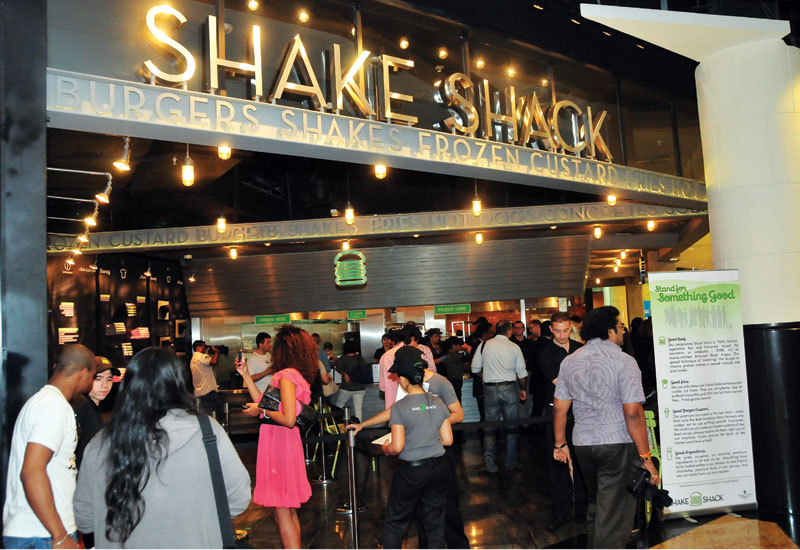
COO of Shake Shack, Randy Garruti, explains why the cult New York burger chain has decided to partner with Alshaya and make its Middle Eastern debut
Fast food brands are living up to their name and filling the GCC’s malls quicker than you can shake a stick at them. New York burger concept, Shake Shack, is right on board, hoping to feel some of the love in the GCC’s relationship with fast food in its first Middle Eastern outlet, now open in Mall of the Emirates.
The brainchild of American restaurateur and entrepreneur, Danny Meyer — who also owns New York restaurant brands Union Square Café and Eleven Madison Park — Shake Shack has a cult following in the United States.
Since the first outlet opened in New York’s Upper West Side, the chain has expanded via a series of concession stands and standalone outlets at sports and entertainment venues that foster passionate followings: from the home of the New York Mets baseball team in New York, via Nationals Park, home of the Washington Nationals baseball team in Washington DC, to the popular Mall of the Emirates in Dubai.
Clearly, iconic venues are part of the Shake Shack strategy. But COO of Shake Shack, Randy Garruti, explains that it was the personal relationship with its Middle Eastern partner, Alshaya, that convinced the American company to take the plunge and lease its franchise in the region.
“We were very fortunate to meet Mohammed Alshaya three years ago and he expressed interest in Shake Shack,” says Garruti.
“After a few trips to the Middle East to understand the business climate, we were amazed with how well the Alshaya Company was able to operate Western brands and we jumped at the opportunity to form a partnership.”
Garruti says that Dubai is a natural venue for the Shake Shack concept: “It reminds us of New York in so many ways — its vibrancy, its drive to be great, and most importantly, its blending of cultures from all over the world.”
In order to ensure seamless brand transition across continents Garruti says the Alshaya team lived in New York to experience and work at Shake Shack, and vice versa.
But, in a climate of rising concerns about health and obesity, where does a concept based on deep-fried foods and ice cream fit in? “We believe that people worldwide will always love to eat burgers,” says Garruti.
“Our goal is to be sure when people say ‘I want to eat a burger and some ice cream’ that we are their choice.”
Despite the numerous fast food rivals in the Middle Eastern market, Garruti is adamant that discount promotions are not the way to entice diners for Shake Shack: “We have never done a group-buying discount and we generally are just against discounting our products. Shake Shack has been very fortunate to be able to rely on a passionate fan base that has done the marketing for us.”
Competing on price is not Shake Shack’s aim, according to Garruti: “There are no shortcuts to quality,” he says. “We either do it right or don’t do it at all. Sometimes that makes a product more expensive for us, or our guests. But our guests have told us time and time again that they want quality.”
With plans for a new outlet in Kuwait, it will be interesting to see how
the Shake Shack strategy of integration with iconic venues will pan out in its new Middle Eastern territories.