

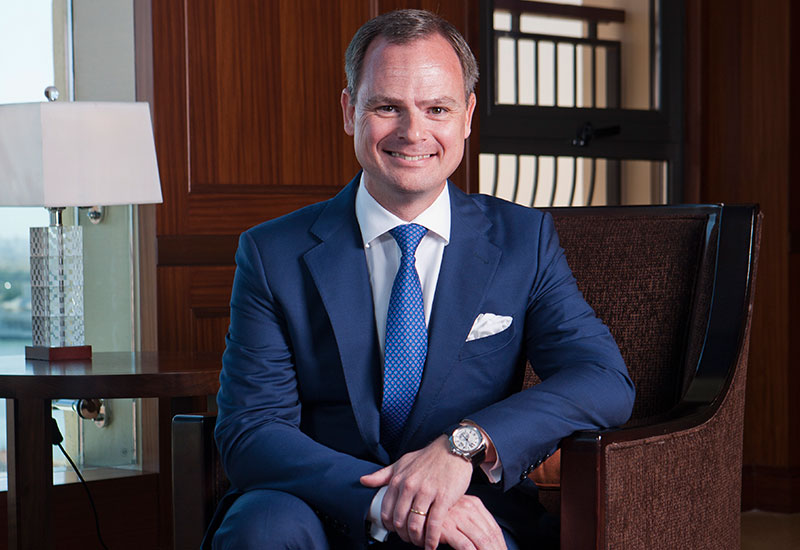
As the company’s Venetian Village continues to take shape in the UAE capital, Abu Dhabi National Hotels CEO Ignace Bauwens discusses future growth strategies and how he is looking to establish the business as a major player in the F&B world
Following Richard Riley’s departure from hotel, tourism, transport, and catering group, Abu Dhabi National Hotels (ADNH), Belgian national Ignace Bauwens transferred from his role as vice president of operations UAE, Near East & Africa at InterContinental Hotels Group (IHG) to take the reins of the company on September 1, 2014.
Four months into his role, Bauwens is preparing to complete Abu Dhabi dining destination, Venetian Village, with three more restaurant openings. Spanning 20,000m2 on the grounds of the Ritz-Carlton Abu Dhabi Grand Canal, the complex includes the hotel’s spa and 52 rooms.
“In this new development we thought, let’s develop an F&B destination, Venetian Village, and we will manage this directly through ADNH,” comments Ignace Bauwens during an interview with Hotelier Middle East at the recently launched Japanese restaurant Inakaya — the third for the brand in the world, with the other two located in New York and Tokyo. The restaurant specialises in robatayaki, a Japanese grilling art that is as much a performance as it is a way of cooking.
In addition to Inakaya, Venetian Village features Al Fanar Restaurant & Café and Brasserie Flo, a classic French restaurant, which opened in December. This year Olives, by American celebrity chef Todd English, and Barfly, from the creators of Buddha Bar, are to be added to the waterfront setting, in addition to just-announced concept, Punjab Grill, a fine dining Indian restaurant.
The restaurant division was introduced in 2008 by Riley, who wanted to lure new F&B brands to the city through master franchise agreements, and today it continues to occupy a significant chunk of Bawens’ focus as he settles into his role and firms up his strategy for the future of the company.
This will be in line with Abu Dhabi’s Vision 2030, which aims to build a sustainable and diversified, value-added that provides more opportunities for all citizens and residents in the emirate.
“ADNH is the oldest hospitality company in Abu Dhabi, established in the mid-1970s,” Bauwens explains.
“Given the heritage ADNH has, it’s also playing a pivotal role in the government’s creation of Abu Dhabi’s Vision 2030, and I’m committed to being a key entity along with the government and other entities in the market.
“ADNH started through H.H Mohammed bin Zayed bin Sultan Al Nahyan, so we cannot forget that cultural link, and we also have the link to our shareholders today — we are on the stock exchange, while still having our anchor strongly as part of the heritage of Abu Dhabi.”
The company owns a number of hotels in Abu Dhabi and Al Ain, including Le Méridien Abu Dhabi, Hilton Al Ain, Ritz-Carlton Grand Canal, and Sofitel JBR — the group’s only hotel outside of Abu Dhabi and Al Ain. It also manages its portfolio of eight properties within Al Diar Hotels, a semi-government investment company under the umbrella of ADNH.
In addition to hotels, ADNH has taxis, limo services, tour operator Sunshine Tours, and a joint venture with contract foodservice provider Compass. The food division is currently not core to the company, although Bauwens explains that this may change as further F&B outlets take shape within the hotel portfolio; for example Sofitel JBR will introduce two third-party outlets this year, with more details to follow.
Bauwens believes this is important since “the F&B part is very dominant in hotels if you look at it from a revenue perspective”, and this is even more pronounced in the UAE where alcohol licensing laws often restrict F&B outlets to hotels.
“Moving forward we have partners where we rent out, so we have some outlets we are working on with others — in Hilton Abu Dhabi and Le Méridien Abu Dhabi. We are looking again at some of our properties and will evaluate the best options for guests, operators and owners.”
Aside from outlets within the company’s hotel portfolio, ADNH also has plans to further develop its standalone outlets under the F&B division; however, this is still in the evaluation phase.
“I think there’s potential to be a big player in the restaurant and F&B world, but we’re going to do signature restaurants like in Venetian village,” comments Bauwens.
“We need the right brand for the right guest experience but at the same time we also need to ensure that it’s the right investment for the owners so we need to find that combination and it’s possible.
“We will look at this Venetian Village as our first big one and then moving forward we’re looking at a few other options with nothing finalised at this stage.
“We’re looking at what could be the best option for future F&B.”
One thing that Bauwens makes clear however, is that ADNH will not be focusing on creating its own F&B concepts since this “demands a lot of time, expertise and money”.
“Now our focus is looking at opportunities to work with internationally renowned brands and making a win-win situation. So it needs to add value for guests and shareholders — that is where we see the opportunity.”
Neither will the company be looking to penetrate Dubai right away with restaurant destinations. Bauwens claims that the flourishing F&B scene in Dubai, with venues such as Madinat Jumeirah, DIFC, and Meraas’ Jumeirah Beach, as well as JBR Walk, mean that another one is not needed at the moment.
“Dubai has a lot of destinations so to create another one is not a priority for us. Going for an ad-hoc opportunity, yes.
“What would be successful in Abu Dhabi might not be successful in Al Ain or might have a different market position in Dubai. So you need to understand the capture audience.
“It’s important that the right brand fits the location. If you understand the brand and the location and you do your homework and there’s a fit, then it’s almost a guaranteed success.”
The company will however look to Dubai for future hotel developments, with the aim to “spread the risk”, both in terms of targeted segments, and location. This will most likely be done through acquisitions.
“I think the most obvious [route of expansion] would be organic, through acquiring assets,” claims the CEO.
Having recently restructured its loan, ADNH is now in a more “financially sound situation” and Bauwens says it is almost time for the company to start looking to the future.
“I solidly believe that everything that’s a financially right investment would be worth looking at. I believe ADNH should focus on the four pillars of business, and hotels is the biggest one.”
From an operational perspective however, Bauwens is clear that he wants to “park” any discussion on expansion of the Al Diar brand for the moment, until he has had a chance to study the situation and firm up a strategy.
In terms of the F&B division, Bauwens regards Venetian Village as “the first real baby” and he is keen to evaluate the success of the current restaurant portfolio before steadily advancing.
“Next year at this time everything should be up and running and buzzing. At the moment let’s finish this, let’s show Abu Dhabi what the Venetian Village is and what people can experience.
“Let’s learn from the feedback of our guests. From there we will take the next steps. We’re looking at other options but it’s too early.
“I really want this to finish first and be a destination where people love going in Abu Dhabi,” he concludes.
The Venetian Village
Restaurants open:
Al Fanar Restaurant & Café: A home-grown concept, Al Fanar serves Emirati cuisine such as seafood, meat and salads and features mud brick rooms and a mini souq.
Inakaya: Specialises in robatayaki, a Japanese grilling art that is as much a performance as it is a way of cooking. Staff members wear kimonos and happi coat-style uniforms, and guests will have culinary choices served on 1.2 metre-long paddles by the yakikata (grill-masters). Staff perform the Sanbonjime, a rhythmic clapping ‘thanking’ ceremony and every night the traditional New Year tradition, a mochi pounding ceremony, takes place.
Brasserie Flo: Classic French concept, Brasserie Flo, was brought to life by young Alsatian chef, Jean Paul Bucher in 1968. Since then, Brasserie Flo has expanded throughout Paris and other parts of Europe and made its regional debut in Venetian Village at the end of 2014.
To open in 2015:
Olives: US celebrity chef Todd English will be serving his Mediterranean cuisine at Olives, an eatery that first made its debut in the USA in 1989. Olives currently has locations in New York City, Las Vegas, Mexico City and the Bahamas.
Barfly: Two-storey restaurant and lounge, Barfly is the brainchild of Raymond Visan, the founder of George V Eatertainment and the nightlife visionary behind the legendary Buddha Bar. Barfly at Venetian Village will revive the buzz of its original celebrity hangouts in Los Angeles and Paris.
Punjab Grill: a fine dining Indian restaurant with locations in Singapore, Bangkok, Mumbai, New Delhi, Bangalore and Pune.
