Almost a year on from the launch of the Qatar National Tourism Sector Strategy 2030, hoteliers in Qatar gathered at the fourth edition of the Hotelier Middle East Qatar Hospitality Summit to discuss the challenges they face as supply floods the market, and visa restrictions and staffing issues remain complex
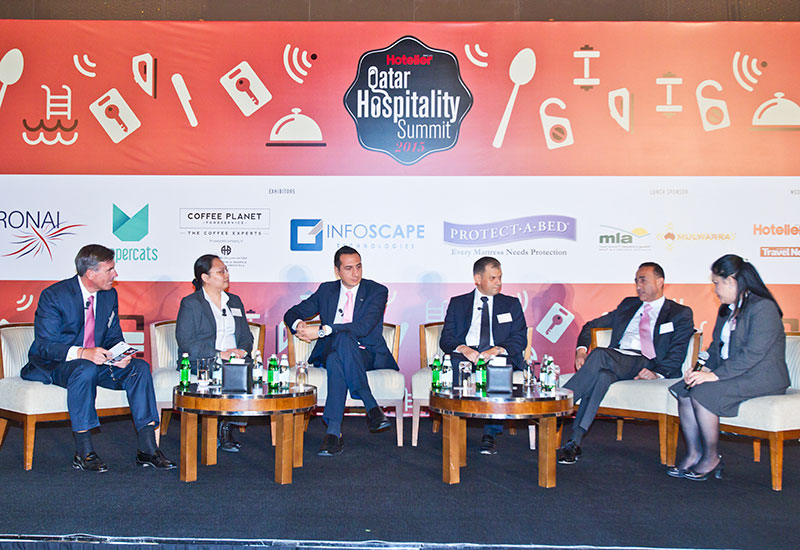
The Hotelier Middle East: Qatar Hospitality Summit 2015, which took place on April 22, 2015 at Grand Hyatt Doha, brought together 157 general managers, corporate hoteliers and heads of department from Qatar’s hotels and resorts.
The fourth edition of the event featured a strong line-up of Qatar’s hospitality leaders who discussed the most pressing issues facing the industry almost a year on from the launch of the Qatar National Tourism Sector Strategy 2030.
09.05 am: Presentation
Qatar Business Confidence Survey Results
Christopher Hewett, associate director, TRI Consulting
The event opened with an exclusive presentation by Chris Hewett of TRI Consulting, on Qatar business confidence, during which 2014 performance was discussed:
09.25 am: PANEL DISCUSSION: DESTINATION QATAR
Moderator: Christopher Hewett, associate director, TRI Consulting
The opening panel discussion of the day examined the opportunities that the QTA’s sector strategy has opened up for the market, how the industry could support the QTA and its partners to help the sector flourish, and the challenges that were still being faced, such as visa restrictions for emerging markets. The panellists agreed that visa restrictions must change to accommodate growing numbers of visitors from emerging markets in particular.
Zeinab Hammoud, director of sales & marketing, Governor West Bay Suites & Residences commented: “From China there are a lot of people that want to come, and Brazil is really growing, but visas are not easy to get.”
Dr. Alexander G. Grit, research lecturer — School of Tourism, Stenden University of Applied Science, also highlighted South America as an emerging inbound market for Qatar, along with Germany and Spain.
Christoph K. Franzen, general manager Grand Hyatt Doha said that he would “go after the Chinese market” if it weren’t for the challenges, while he hinted that India is a potential target.
Safak Guvenc, area manager Qatar/ general manager W Doha & Residences also identified China and India as key target markets. “Take India, China — think of the populations of these countries. They are moving from poverty into middle class — millions of people — where are they going to travel? Their closest destination of course!” he said.
One way to soften barriers to entry, according to Guvenc, would be “separating” visas. “For visa restrictions I think we have to separate them into working, residence and tourist,” he claimed.
“Imagine the negative effect it would have for people, not getting a visa,” Franzen warned, while Hammoud added “they’ll have this idea they can’t come back”.
10.10am: PANEL DISCUSSION: IS INCREASED COMPETITION HEALTHY COMPETITION?
Moderator: Rabih Feghali, director of business development, Ròya International
Gaining an edge over the competition is one of the things that keeps everyone from GMs to marketing, sales, housekeeping and HR staff striving for the best. But in a small destinations such as Qatar, a flooded market means less revenue for everyone and the smallest margin is vital. Has Doha reached that point yet, or is there still room for more?
Tareq Derbas, GM of St. Regis Doha, said: “I strongly believe ‘the more the merrier’. Some are afraid of competition, but the more competition we get, the more it increases Doha as a destination where the best brands are.”
What are the areas that hotels are focusing on the most to increase their competitive edge? The clear answers were service and training.
Julian Crane, director of marketing, Four Seasons said: “We are focusing on more training, coaching and development — this is needed for our staff to create the loyalty that develops them into brand ambassadors.”
Another way to get ahead of the game from a brand perspective, as agreed by all of the panellists, is by filling a huge gap in the market — that of three- and four-star properties.
Pascal Eggerstedt, general manager, InterContinental Doha The City, said: “Too many properties that are three- and four-star in Doha want to band themselves as luxury properties, when they’re not. It just confuses customers.
“And the thing is, there is a huge market in Doha for three- and four-star properties. We need affordable accommodation for families, those visiting their relatives who work here, for millennials — even customers who simply can’t afford the price tag that often comes with five-star properties in our market.”
11.30:PANEL DISCUSSION: SOCIAL MEDIA — A GOLDEN OPPORTUNITY
Moderator: Martin Baeuerle, hospitality consultant, MB Hospitality Consulting
Social media experts say that user-generated content (UGC) is the next big thing and can be a marketing gold mine for hospitality businesses. A panel discussion on the opportunities that social media presents addressed this issue and asked how hoteliers can make self-promotion work for them.
Reydan Ulusan, marketing & ecommerce manager Best Western Plus Doha commented: “Research shows that 50% of people come through peers rather than advertising, so this is why it’s really important for people to give their opinions.”
Noha Belhaj, marketing communications manager, Grand Hyatt Doha said that it’s a case of “getting them to talk, to respond”.
“For example, ask, ‘what’s your favourite thing to do on a Friday morning?’ — it’s not easy to measure revenue, but you can measure engagement.”
Fellow panellist, Katie Roberts, PR & marketing communications manager, Doha Marriott Hotel, said that hoteliers need to give followers “the tools and hashtags”.
“You need to make sure people know you’re there, so I think that’s also really important. If someone is in a restaurant and taking a photo of a dish, let’s build on that in our restaurants and our outlets.
“It’s about how quickly we respond to that and encourage them to post content on our behalf.”
Belhaj added that it’s important to engage with influencers, which Joelle Lahlough, cluster PR & marketing manager at Wyndham Grand Regency Doha & Ramada Encore Doha agreed with.
“People blog about your services, it’s growing, and people are seeing a lot of positive feedback from that,” said Lahlough.
Both Roberts and Lahlough commented that knowing how often to post is crucial.
“I think there’s a misconception that it’s an easy thing to do but it’s not,” said Roberts. “It’s very time-consuming and thoughtful; it’s a lifestyle. We do around two to three posts per day on Facebook; for Instagram it’s the same, for Twitter it’s four times. Also we want to use video content more with YouTube.”
Lahlough added: “If we post something on Facebook or Instagram, we can’t post too many so we need to know when and what to post. People need a reason to relate to your product or service — post something that will get people to relate to your restaurant.”
12.45:PANEL DISCUSSION: DEVELOPING A WORLD-CLASS TEAM
Moderator: Rupprecht Queitsch, chief executive officer & senior partner, INHOCO Group – International Hospitality Consulting Group
Attracting the best in the world to Qatar isn’t an issue for those in sectors such as engineering and healthcare. But in hospitality, staff are often attracted by what they consider exotic locations. Some of the issues faced by the HR and recruitment teams in Qatar properties are shared with other GCC countries. But a few things are particular to Qatar.
Strict visa rules were cited as one of the biggest barriers to recruiting the best talent. with mention given to the Kafala laws and NOCs as well as only allowing a certain number of recruits from certain countries.
Many workers in the hospitality industry from countries with less expensive labour, may have never lived away from home, which is another challenge the panellists referred to.
“When we recruit candidates, we’re looking for a high level of adaptability, particularly as many in the hospitality industry have never lived overseas,” said Lynne Inciong, HR manager at Crowne Plaza Doha — The Business Park.
All of our panellists said that they work hard to make sure their people feel as at home as possible in Doha — from their living accommodation to leisure activities organised within the hotel group.
Adham El Sebaey, general manager of Hilton Hotel, Doha, said, “Everyone in Doha is an expat and is away from their home country so our goal as human resources, recruiters and managers, is to create a home-away-from-home environment.
Basel Jabri, HR manager of Grand Hyatt, echoes this, saying: “Once the staff are here in Doha, we work hard to provide them with the right environment so that they’re happy. Taking care of them and fulfilling recruitment promises is important.”
Looking after staff once they are on board is one thing, but how do Doha hoteliers source good talent?
Sebaey said: “Hilton is a big name globally in our industry, so it’s easy to attract talent generally. However, Doha can be a harder sell as people aren’t sure what to expect. We’ve been successful, even when competing with Dubai or Abu Dhabi, which people have heard of more often.
Fostering brand loyalty is also key in competitive market like Doha, so how is this done? “We look for people who are passionate about hospitality, not just looking for any job; people who are keen to stay and grow their entire career, whether that’s starting from an entry-level position or someone who has studied hospitality,” said Hassan Hassan, director of HR for Mövenpick Hotel West Bay.