

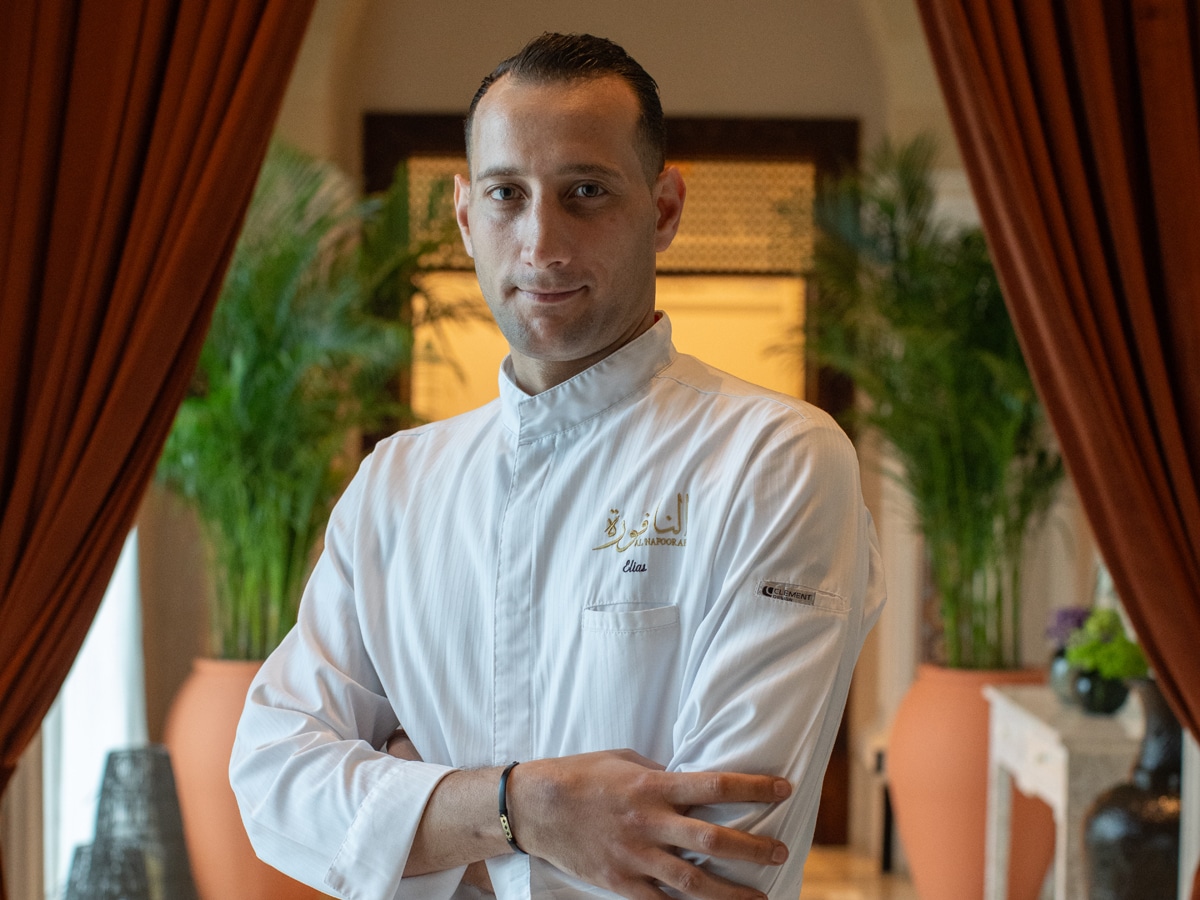
Chef Elias Samaan has spent over a decade refining the art of Lebanese cuisine. As the driving force behind Jumeirah Al Qasr’s Al Nafoorah, he is known for while embracing modern techniques that enhance traditional flavours.
Growing up in Lebanon, food was central to his upbringing — an integral part of family, culture, and storytelling. Inspired by his mother and grandmother, he developed a deep respect for the craft, eventually turning his passion into a career that celebrates the richness of Levantine gastronomy. From perfecting the simplest mezze to reinventing dishes like sayadieh with a contemporary twist, Samaan continues to push boundaries while preserving the soul of Lebanese cooking.
Here, he tackles our rapid-fire round, revealing the strangest dish he’s ever cooked, his ultimate guilty pleasure, and the one chef he’d invite to dinner. He also discusses the challenges of maintaining consistency in a fast-paced kitchen, his love for ingredients like sumac and olive oil, and why Beirut remains his favourite food city.
1. What did you want to be growing up?
Growing up, I was always captivated by food and the kitchen, although I didn’t initially view it as a potential career. I loved how flavours intertwined, how food had the power to bring people together, and how every dish told its own story. While I explored various paths at first, I consistently found myself drawn back to the kitchen, experimenting with ingredients and perfecting traditional Lebanese recipes. Over time, I came to realise that being a chef wasn’t merely a job for me; it was my passion and a means of preserving and sharing our culinary heritage. Becoming a chef de cuisine in Lebanese cuisine feels like a natural extension of who I am.
2. What inspired you to become a chef?
Growing up in the north of Lebanon, food was always at the heart of our home. I was deeply inspired by the rich traditions of Lebanese and Levantine cuisine, where even the simplest dish could bring people together, tell a story, and evoke profound emotions. My greatest influence came from my family—watching my mother and grandmother cook with such passion and precision ignited my love for the craft. Over time, that passion naturally evolved into a career, where I strive to preserve authenticity while adding my own creative flair. Being a chef isn’t just about cooking; it encompasses culture, history, and the art of creating unforgettable experiences.
3. What is the biggest challenge about being a chef?
Maintaining consistency is one of the greatest challenges, especially in Lebanese cuisine. Every dish has to meet the same high standard, whether it’s the first plate of the night or the hundredth. Another challenge is balancing tradition with innovation. Lebanese cuisine has deep roots, and while I respect the authenticity of classic dishes, I also look for ways to refine and elevate them without losing their essence. Then there’s the fast-paced nature of the kitchen—the long hours, the intensity, and leading a team in high-pressure environments. Despite these challenges, the passion for the craft and the satisfaction of seeing people enjoy my food make it all worthwhile.
4. What is the weirdest thing you have ever eaten or cooked?
In Lebanese cuisine, we have a profound respect for utilising every part of an ingredient, which has led me to work with some rather unique dishes. One of the most unusual things I’ve eaten is kibbeh nayyeh made with sheep brain—a variation of the traditional raw kibbeh, where finely minced lamb is combined with raw brain for an exceptionally creamy texture. It’s not something you encounter every day, but it certainly has its devoted fans.
As for cooking, one of the more unexpected dishes I’ve created was a fusion of Lebanese flavours with molecular gastronomy techniques—deconstructing a classic fattoush into tiny, flavour-packed spheres. It was a challenge, but also an exhilarating way to push the boundaries of tradition.
5. What’s your favourite cooking gadget?
The mortar and pestle (Jurn wa Modaqqa) is an essential tool in Lebanese cuisine. Grinding spices, garlic, and herbs by hand releases oils and aromas in a way that no machine can replicate. It connects me to the roots of Lebanese cooking. On the modern side, I love using a sous vide machine—it allows for precise temperature control, which is particularly beneficial when I’m experimenting with contemporary interpretations of Lebanese dishes.
6. What is your ultimate ingredient?
Olive oil is the heart of Lebanese cooking. It’s used in everything—from drizzling over hummus to mixing into a fattoush dressing and preserving labneh. A high-quality extra virgin olive oil adds depth, richness, and a deep connection to our land and traditions.
Another essential ingredient for me is sumac. Its tangy, citrusy flavour enhances a multitude of Lebanese dishes, from salads to grilled meats, bringing a unique brightness that no other spice can replicate. Lebanese cuisine is all about balance, and these two ingredients play a crucial role in creating that perfect harmony of flavours.
7. What’s the most unconventional ingredient you’ve ever worked with?
Camel meat. Although it’s not commonly used in Lebanese cooking, I was curious to explore how its rich, slightly gamey flavour could be adapted into a traditional dish. I created a slow-cooked camel maqlooba, layering it with rice, eggplant, and aromatic spices—it turned out surprisingly delicious. I also experimented with black garlic in mezze, adding its deep, balsamic-like sweetness to hummus and baba ghanoush for an extra layer of umami.
8. If you could only eat one type of cuisine for the rest of your life, what would it be?
Without a doubt, Lebanese cuisine. It’s not just food—it embodies history, culture, and a way of life. The balance of flavours, fresh ingredients, and variety make it impossible to get bored. Mezze like tabbouleh and fattoush, rich slow-cooked dishes like kibbeh bil saniyeh or sayadiyah—there’s something for every mood and occasion. Lebanese food is also one of the healthiest in the world, relying on olive oil, fresh herbs, grains, and lean proteins.
9. What’s your guilty pleasure food?
Sfiha—Lebanese meat pies—loaded with extra lamb fat. The rich, juicy filling wrapped in crispy dough is completely irresistible, especially with a squeeze of lemon and a cold drink. Knefeh is another indulgence, but not just any knefeh—the kind soaked in extra sugar syrup and stuffed into sesame kaak bread. It’s heavy, sweet, and impossible to stop at just one bite.
10. What’s the strangest food combination you’ve ever tried?
Labneh with truffle and honey. At first, it seemed unusual—mixing the tangy creaminess of labneh with the earthy aroma of truffle and the sweetness of honey—but it worked. Another surprising combination was makdous (pickled stuffed eggplants) with dark chocolate. The nuttiness of walnuts, the saltiness of the eggplant, and the bitterness of chocolate made for an interesting balance of flavours.
11. What is your favourite city for food?
Beirut. The culinary scene there is a perfect blend of tradition and innovation—classic street food like manakish and foul, fresh seafood by the coast, and modern takes on Lebanese cuisine in high-end restaurants. Outside Lebanon, I love Istanbul for its rich mix of Middle Eastern, Mediterranean, and Central Asian influences.
12. If you had to create a dish that represents your personality, what would it be like?
If I had to create a dish that truly represents my personality, it would be a reinvented Sayadiyah—the beloved Lebanese fish and rice dish. Sayadiyah embodies balance, depth, and tradition, which mirrors my own approach to cooking. To give it a contemporary twist, I’d use charcoal-smoked seabass for a bolder flavour, paired with saffron-infused rice that adds a touch of elegance. Instead of the traditional caramelised onion sauce, I’d opt for a velvety tahini-sumac sauce, introducing a delightful layer of richness and acidity. To finish it off, I’d sprinkle crispy turmeric onions and pine nuts on top for that perfect crunch. Every dish—just like every chef—should celebrate contrast, harmony, and a signature flair.
13. If you were hosting a dinner party and could invite three famous people, dead or alive, who would they be and why?
First, Anthony Bourdain. His passion for global cuisine and deep respect for food cultures would make for incredible conversation. I’d love to hear his insights on Lebanese cuisine and share a meal that tells a story. Second, Fayrouz. Her voice is the soundtrack of Lebanon, and having her at the table would create a truly magical atmosphere. I can envision her enjoying a warm plate of kibbeh nayyeh while classic Arabic music plays softly in the background. Lastly, Otto Frederick Rohwedder, the inventor of sliced bread—just to serve him manakish and demonstrate that Lebanese bread culture has been thriving for centuries.
14. What’s your signature dish for friends and family?
When cooking for friends and family, I always return to dishes that evoke comfort, nostalgia, and the essence of Lebanese hospitality. My signature dish is Kibbeh bil Saniyeh, the baked kibbeh layered with spiced minced meat, onions, and pine nuts. It represents home for me—it’s simple yet deeply flavourful, and when prepared correctly, the crispy golden crust with the juicy filling inside is unbeatable. Another favourite is Sayadiyah, the Lebanese spiced fish and rice dish. I prepare it with perfectly seasoned fish, caramelised onions, and fragrant rice, all topped with fried almonds and pine nuts. Cooking for loved ones is about sharing tradition with a personal touch, ensuring that every meal feels special.
15. Which chef do you respect the most?
There are many chefs I admire, but if I had to choose one, it would be Anissa Helou. She has dedicated her career to documenting and preserving Middle Eastern and Mediterranean cuisines, ensuring that traditional techniques and flavours are not lost over time. Her deep knowledge of Levantine food, from street dishes to historical recipes, is something I truly respect. On a more global level, I have great admiration for Anthony Bourdain—not just for his cooking, but for the way he approached food as a gateway to culture, history, and human connection. Ultimately, I respect any chef who stays true to their roots while pushing the boundaries of their cuisine, keeping tradition alive in a modern world.
16. Have you ever had a food-related dream or nightmare?
Yes, I’ve had my fair share of food-related dreams—and a few nightmares too. One of the funniest dreams I experienced involved being surrounded by a massive Lebanese mezze spread, where everything was floating around me—hummus, tabbouleh, kibbeh, and manakish. It was like I was inside a giant souk filled with endless food, tasting dishes that never ran out. On the nightmare side, I once dreamed that I was preparing a huge dinner service, and everything kept going wrong—the kibbeh wouldn’t hold its shape, the grill wouldn’t light, and the orders kept piling up. The worst part? When I looked down, instead of my chef’s knife, I was holding a spoon. It was the ultimate kitchen disaster.
17. Is there a specific ingredient or flavour that you can’t stand?
As a chef, I appreciate almost every ingredient because each one has its place in the right dish. However, if I had to choose a flavour that I personally can’t stand, it would be excessive artificial sweetness in savoury dishes. For instance, overly sweet sauces or dishes where sugar overpowers the natural flavours of the ingredients are not to my taste. Another ingredient I don’t particularly enjoy working with is liquorice or anise in heavy amounts. While these flavours are common in some Levantine dishes and drinks like arak, I prefer more balanced, subtle tastes rather than anything overwhelmingly strong. That said, part of being a chef is learning how to work with every ingredient, even those you don’t love, and finding ways to make them shine.
18. Do you have a secret talent?
Most people know me for my skills in the kitchen, but one of my secret talents is carving and plating presentation. I love taking simple ingredients and transforming them into artistic, visually striking dishes. Whether it’s shaping vegetables into intricate designs or arranging a mezze spread that resembles a piece of art, I believe that presentation is just as important as taste. Another hidden talent of mine is having a sharp memory for flavours—I can taste a dish once and break down its ingredients almost precisely. This ability helps me recreate and refine recipes, especially when experimenting with new twists on traditional Lebanese cuisine.
19. What is your happy place outside of the kitchen?
As much as I love the kitchen, my happy place outside of it is being in nature, particularly by the sea. There’s something incredibly soothing about the sound of the waves, the fresh air, and the overall peacefulness that helps me reset and find inspiration for new dishes. I also love exploring local markets, wandering through the stalls, inhaling the aromas of fresh spices, and chatting with vendors about their ingredients. Additionally, spending time with family and friends over a good meal—without the pressure of service—is something I truly cherish.
20. If you could time travel, what advice would you give yourself on your first day in a professional kitchen?
If I could time travel back to my first day in a professional kitchen, I’d tell myself: Stay patient, stay humble, and never stop learning. The kitchen is intense, and at first, it feels overwhelming—long hours, high pressure, and constant challenges. However, every tough moment is a lesson that will ultimately make you a better chef. I’d also remind myself that perfection takes time. Mastering Lebanese cuisine—or any cuisine—is not just about following recipes; it’s about understanding flavours, respecting ingredients, and embracing tradition while developing your own style. And finally, I’d say: Take care of your hands and your feet. After years in the kitchen, you come to realise just how valuable they are.