


Many new hotels are being constructed every day, which can have a significant impact on the environment. Adaptive reuse, however, is gaining traction around the world – where underused or abandoned buildings are transformed and given new life and purpose in the community.
For The Ned, this has always been a common theme with its properties. In London, The Ned occupies the former Midland Bank headquarters, a Grade I listed building designed by Sir Edwin ‘Ned’ Lutyens in 1924. Its second property, The Ned NoMad, is situated in the 1903 The Johnston Building, originally a store and office. Initially crafted by Lebanese architect William Sednaoui in the 1970s, The Ned’s third hotel in Doha, Qatar resides in the former Ministry of Interior.
David Chipperfield Architects refurbished and adapted the building between 2016 – 2022, transforming it into the luxury hotel we know today. The hotel recently celebrated its two-year anniversary. Boasting 1970s glamour, the hotel inspires a sense of connection with the local environment and has now become a cultural icon in the city.
David Chipperfield Architects, established by Sir David Chipperfield in 1985, has grown globally since. With an impressive portfolio of diverse projects, including workplace, retail, residential, education and hospitality and more, David Chipperfield Architects was well-positioned to take on the challenge of refurbishing the Ministry of Interior, preserving its historical significance while serving as a modern, boutique hotel.
Since completing this project, Sir David Chipperfield went on to win the Pritzker Architecture Prize in 2023, considered to be the most prestigious award in architecture.
In conversation with Hotelier, Chipperfield takes us behind the scenes of the transformation of one of Doha’s oldest buildings.
Adaptive reuse
A hotel’s design and architecture can play an integral role in impacting the guest experience. From the moment they arrive at your destination, the visual aesthetics are the first thing visitors see when they arrive. As this lays the groundwork for their first impressions, it’s not something to be underestimated.
A well-designed hotel is often one that draws thoughtfully on its location and the cultural context surrounding it, responding to the region’s identity in form, layout and materiality. The Ned Doha is the epitome of this, preserving a part of the capital’s heritage while also designing the future of tourism in the city.
A captivating blend of the old and the new, Doha’s architecture landscape tells the story of Qatar’s journey from a small pearl-diving hub to a modern global city. Occupying the former Ministry of Interior building, The Ned Doha’s striking, geometric design reflects a unique part of that history,
“By reusing the building’s shell, we significantly reduced embodied carbon and the need for new materials,” explains Chipperfield. “Beyond this, we incorporated a range of passive design strategies tailored to the Gulf climate. For instance, the new horizontal brise soleil canopy effectively shades the outdoor spaces and promotes air circulation. Lush vegetation and water basins improve the microclimate, enhancing the quality of stay in the outdoor areas despite the extreme heat. Meanwhile, recessed glazing in the upper floors, combined with the vertical louvres of the façade, reduce solar gains and minimise the energy demand for cooling.”
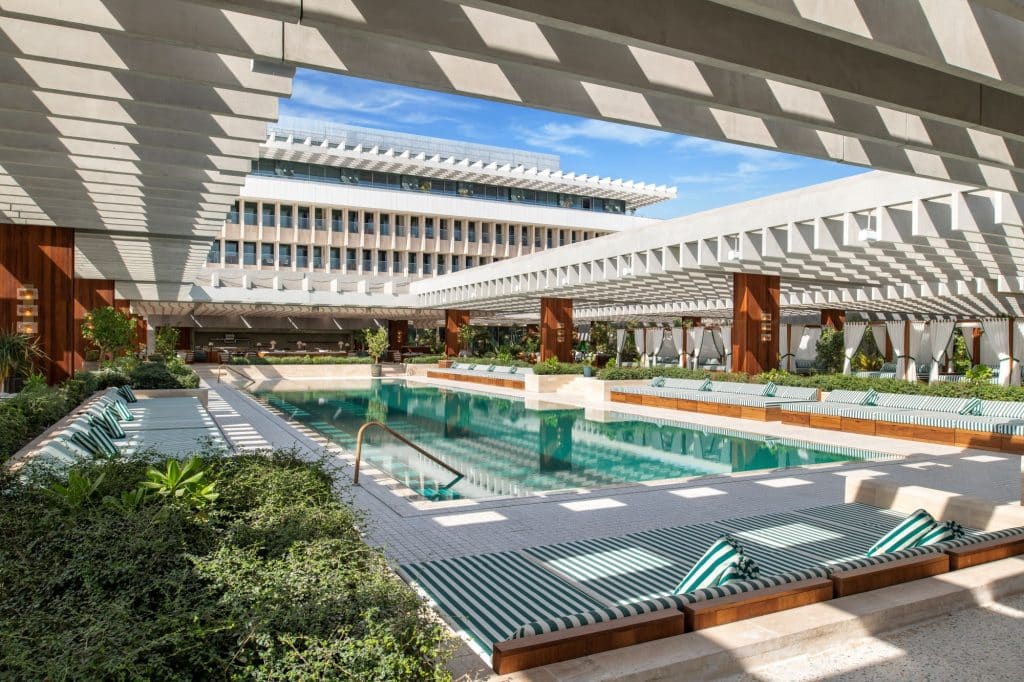
Reusing existing structures rather than demolishing and/or building new ones not only reduces carbon emissions but also preserves historic architecture. It’s an important strategy to preserve the past and bring new life to the pillars of a city that represent history, culture and community. “What I enjoyed most about The Ned Doha was the opportunity to engage with a building of such architectural and historical significance. The former Ministry of Interior represents a unique moment in Doha’s urban development,” shares Chipperfield.
“The collaborative process with everyone involved was also particularly rewarding, as it required a sensitive balance of expertise in heritage conservation, adaptive reuse, and contemporary hospitality design,” explains Chipperfield.
He continues: “Seeing the transformation take shape – from the restoration of the façade to the creation of inviting public spaces – was a testament to the potential of adaptive reuse to honour the past while creating something vibrant and relevant for our time.”
Preserving history
Doha boasts a rich architectural history that features traditional materials like barasti, mud-rendered walls, wood, stone, and gypsum as well as more modern styles such as art deco, classicism, and brutalism. Each building reflects a unique story, adding to the city’s charm and appeal for visitors. Preserving that cultural and architectural history of Doha was a priority for Chipperfield, who expresses how it creates a meaningful dialogue between the past and the future.
“In a region undergoing rapid development, historical buildings serve as tangible connections to the city’s identity and evolution. Projects like The Ned Doha help to anchor this identity by celebrating the richness of the city’s heritage. It ensures that development is not at the expense of cultural continuity. By adapting and reimagining historical structures, we create layered urban environments that resonate with both locals and visitors,” says Chipperfield.

From its humble beginnings as a fishing village to its rise as a global cultural and economic hub, the city’s structures weave traditional elements with contemporary design styles, creating a skyline that honours its past while embracing its future. The Ned Doha’s reimagined infrastructure does all of that in one structure.
“What stands out about our approach to The Ned Doha is the careful balance between respect for the existing building, and the demands of its new programme as a boutique hotel. The Brutalist character of the original Ministry of Interior building — with its rhythmically articulated façade and sculptural silhouette — guided many of our design decisions,” says Chipperfield.
Many hotels in the GCC region have been experiencing a rise in guests seeking more cultural, authentic experiences in recent years. With this growing demand, it’s important for hotels to reflect traditional elements in their guest offerings, from the hospitality provided to the design of the exterior, interior and furnishings. The Ned Doha combines retro glamour with contemporary comfort, a fusion of styles that helps to connect guests with the past while experience modern luxuries.
Chipperfield shares: “Rather than impose a new aesthetic, we allowed the building’s inherent qualities to shape its transformation. We focused on celebrating existing elements, while introducing contemporary features that harmonise with the original design. For instance, the brise soleil canopy, a new addition, not only references the building’s linear geometry but also provides shading and comfort, addressing the Gulf climate in a thoughtful, integrated way. This sensitivity to context and materiality defined the project’s character.”
Hotels that reflect the local culture in their designs allow tourists to connect with the city’s heritage and also help maintain harmony within the local community.

Design with integrity
Chipperfield reveals how architects and designer are always under pressure to give form to ideas. The 71-year-says: “As I get older, I am more convinced that the integrity of the design process protects the development and resolution of an idea.”
“This means working closely with clients and collaborators, conducting rigorous research, having a clear understanding of the project’s programme and context from the outset. Just as important is building a strong and diverse team that brings together local insight and international experience.”
As a designer who has worked on projects across the globe, Chipperfield has a diverse portfolio of work and a wealth of experience. Yet, he still approaches each project with humility and respect for the surrounding environment.
He shares: “I remind myself that it is a privilege to work in a different region. We architects have no real right to work in someone else’s city, someone else’s culture, and so it is crucial to approach foreign projects from a position of humility, rather than one of entitlement.”
“These projects must be seen as cultural responsibilities, as occasions for dialogue with traditions, cultures, societies that may be different from our own. Only by engaging deeply with local culture, environment and society, and by drawing on the insights of local collaborators, can we produce buildings that make a meaningful contribution to their place,” Chipperfield concludes.