

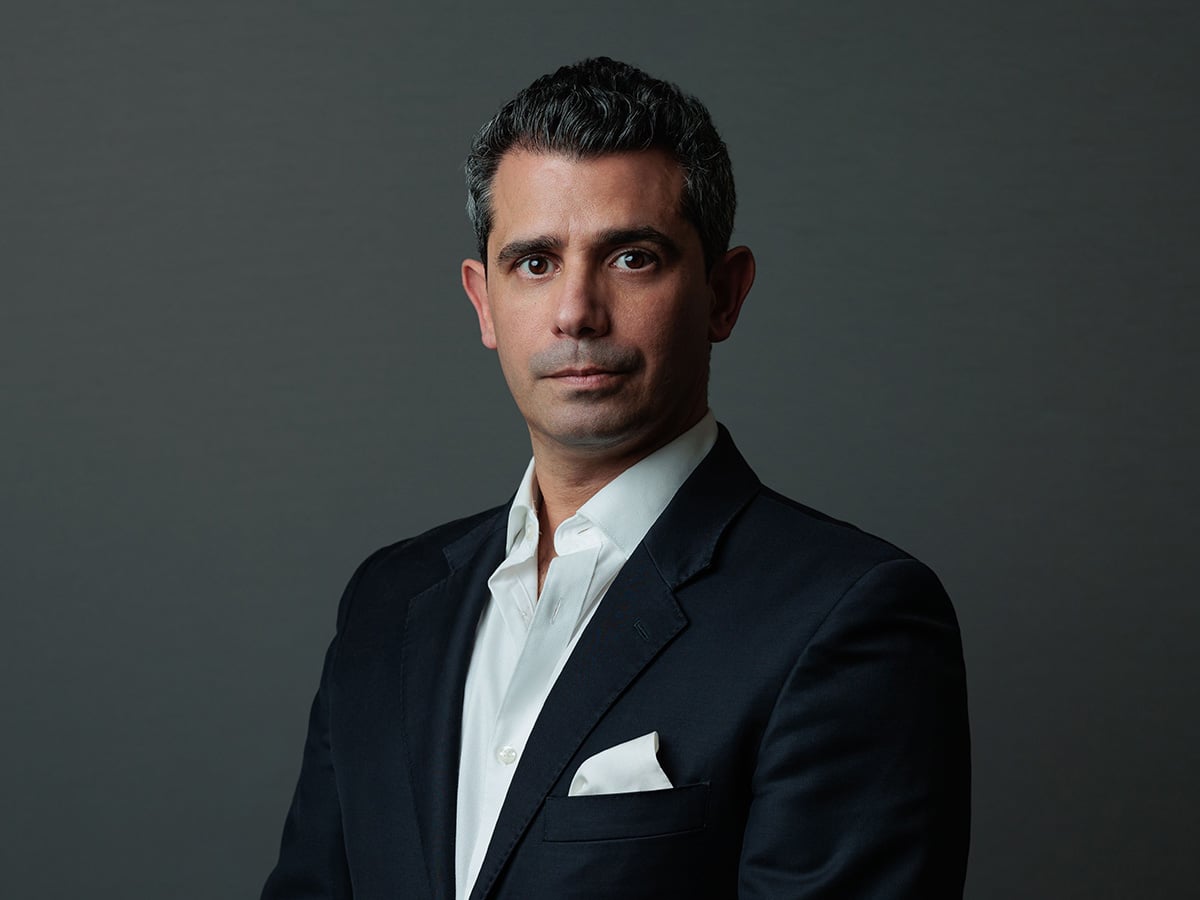
Riyan Itani is the director and founder of Global Branded Residences (GBR). For the past 20 years, he has specialised in providing branded and luxury residential development consultancy around the world.
His experience covers brand and operator selection and contract negotiation, strategic development advice, feasibility studies, and brand premium studies.
Over the years, he has worked on more than 100 branded residential schemes across the globe. Dubai is now the leading city, globally for the development of branded residences, with the number of standalone projects (developments without a hotel component) set to rise to 54 percent of the market, accounting for 78 percent of new projects over the next four years, against a global projection of 41 percent.
Over the past 10 years (from 2014 to end of 2024) the branded residences sector in Dubai will have grown by 410 percent, rising from ten projects in 2014 to 51 today. In the past five years alone, the growth in the sector has been 122 percent rising from 23.
The research was conducted by Itani and his team at GBR and revealed in Dubai during his The Future of Branded Residences event.
Hotelier Middle East caught up with him before the event, where he delved into what inspired him to specialise in this niche sector, the current trends in the global branded residences market and what factors to consider when advising on brand/operator selection and contract negotiation.
He said: “I’ve been very lucky to have been researching the market for many years and what became clear is that it was a sector that was small and growing very fast. During that time, I’ve specialised in providing consultancy and brand selection services for developers and investors all around the world.
“Globally speaking, as well as in Dubai, there has been a huge amount of growth in the number of projects that have been opened and operating globally. Dubai is a great example of that in the region, as there is a 137 percent growth forecast over the next five to seven years.”
The trend is exploding around the world, too, he added and there’s increasingly a market for branded residences that aren’t attached to a hotel, but have a hotel’s brand attached.
Itani said: “In Dubai alone, about 78 percent of the pipeline going forward is going to be standalone developments, which compares to about 41 percent of the global market. This is an incarnation of branded residences that is pure, it doesn’t have a hotel element to it, it is a purely residential property, and that’s a trend that we’re seeing.
“There’s also a slight reduction in the number of luxury developments which are being replaced with upper upscale developments. In certain markets around the world, a proposition that is sub-luxurious is actually what the market’s looking for or what can sustain in terms of pricing.”
What to consider when choosing the brand
Itani said there are many facets to operator selection and contract negotiation for branded residential projects, such as whether it includes a hole element, the location and the market for buying the units.
He added: “There are also the aspirations of the developer or the investor. What are they trying to achieve: a high rate of sale or a high price of sale? When you put all of those factors together, it’s like a decision-making tree and you end up with a particular range of brands that would be appropriate for that development.”
Meeting the needs of developers
Itani thinks it’s key to understand which brands are available for the type of property you’re developing, too. He added: “For example, there are hotel brands that don’t have an interest in standalone properties. Other brands will only do a standalone property in a market if they already have a hotel there.
“Some are very interested in doing standalone properties at an opportunistic level. You then layer on top that non-hotel brands such as luxury goods, automotive companies and fashion design have no interest in doing a hotel or managing the residences. For them, it’s about design, look and feel, furniture packages and brand licensing.
“Some of the big challenges come when there is a misalignment of expectations. For example, you may have a developer who’s developing in a secondary location who wants an ultra-luxury brand, and that probably isn’t going to work. Or you have a project that is driven towards investment purchases but they want brand that isn’t driven towards investment. For example, they don’t run a rental program.
“When you have that misalignment that’s when it goes wrong because the buyer isn’t getting what they want, the developer is frustrated and not able to get the brand they want and eventually the model doesn’t work as efficiently.
“This means you’ll find developers who are trying to sell units far too expensively to represent the brand where the market has a threshold, a capacity for that. We analyse the market and the profile of purchasers to make sure the product is tailored towards that market expectation. Then we layer the branding proposition on top of that.”
The rise of standalone projects
Itani outlined that, globally speaking, there are more residential buildings than there are hotel buildings, but tapping into the cache of a brand is seen as a way to increase the interest of residential properties.
He said: “It means more buildings will be branded in the future. In places like Europe, buildings are much smaller and that’s something brands in particular have to reconcile because they often need a certain volume of residential units to make it efficient to manage.
“Hotel brands are now asking how they adapt to this new typology, which is without a hotel. Often that’s in cases much smaller than what they would usually do because they understand they are competing now against, for example, non-hotel brands who are very happy to do a scheme of 25 units in Madrid, for example, compared to 250 in Dubai.”
With the reduction in the number of hotel brands in the pipeline of developments, Itani explained how GBR navigates the changing dynamics of brand partnerships.
He said: “ In many markets in the world, the residential sector is performing extremely well, so there is a wish to get to the market as quickly as possible.
“We have to spend a lot of time talking with operators and brands to really understand where they are looking to be, what type of proxy they are looking to do and what type of management and deal structures they are interested in, so that we can very quickly marry them to our developer and clients as efficiently as possible.”