


Dubai’s hospitality industry has never been one to turn down an opportunity. Maud Bailly, the new CEO of Accor brands Sofitel, Sofitel Legends, MGallery and Emblems, is also well aware of the opportunities that are on offer here.
The conversion brands MGallery and Emblems are now classed as ‘collectable brands’, enabling a faster expansion in the region.
Bailly started the role in January 2023, and spoke to Hotelier Middle East on a trip to Dubai.
She believes these two flags have immense potential to be further planted in the Middle East.
“A boutique hotel in the Middle East is absolutely possible,” said Bailly during an interview at Sofitel Dubai The Obelisk. Previously Accor’s CEO for Southern Europe’s 1,900 hotels, Bailly is currently on a world tour, meeting GMs, owners and potential owners to grow her set of collectable brands.

Sofitel CEO on creating MGallery hotels
Despite the flagship Sofitel the Obelisk having 600 keys and offering the opposite experience to a boutique hotel, Bailly said the expansion of offshoot brand MGallery and Emblems into the region would pave the way for smaller, more intimate properties, some of which Accor can create.
She said: “We’d design it from scratch ourselves. There are MGallery properties around the world built from scratch, not only converted. That would be the idea for the Middle East. We need great owners who are passionate about the world of boutique hospitality.”
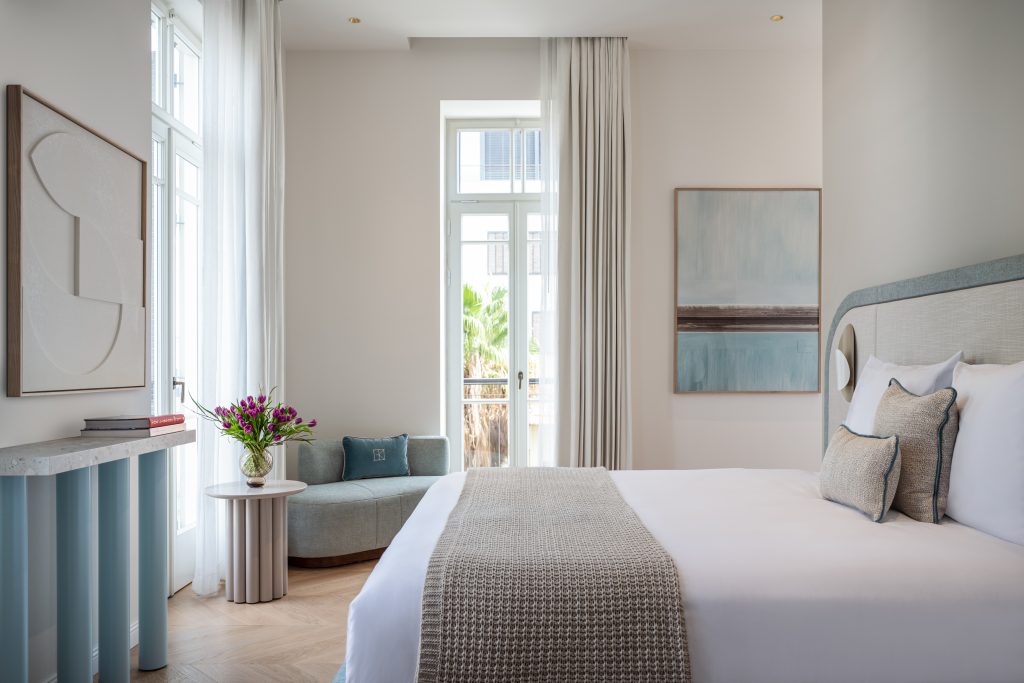
Showcasing the culture of the Middle East
Bringing the collectable brands to the region would fill what Bailly sees as a huge gap into the market: Cultural hotels. MGallery in particular is described as the brand for “hotels with a story.”
She explained: “You can’t have a hotel without a vibrant neighbourhood and, to me, a hotel should be the beating heart of that neighbourhood. Hotels work thanks to their local residents.
“The beauty of hospitality is to feel where you are staying. Personally, I don’t want to stay in a standardised room where I am. I want to stay somewhere different, somewhere I feel is connected to the local culture. I’m not a fan of copy-paste strategies.
“There are so many local cultures in the Middle East that we value and we want to showcase.”
Design-led properties and providing retreats
Emblems has one of the smallest pipelines across the Accor’s portfolio, planning 60 hotels by 2030. The brand has three kinds of hotels: Historic properties, design-led properties or retreats.
Bailly said: “In the Middle East, I’m not sure there are many historical buildings to convert, but the design-led and retreat-led Emblems have real potential. I know a lot of architects who are fans of Dubai, and I could easily see them create the most amazing building imaginable and have that be an Emblems.
“Retreats, too… There’s so much potential in this region. This is the future and people are going to start choosing sustainable hotels over others very soon. It’s a powerful signal, Emblems would prove just how commuted to environmentalism this part of the world is.”
Sustainability in hotels
Bailly’s focus on retreats forms part of a wider vision of hers: To shine a light on the good hospitality can do for the planet.
She said: “Emblems is a place which is really connected to the local environment and actually benefits that environment. Hospitality isn’t just take, take, take. Emblems shows how the industry can give back.
“Many see hospitality as a predatory industry. They see hotels go to a location, take its resources and destroy the environment. Now more than ever, Accor is looking to prove hospitality can be respectful.
“A big part of why I travel to all our locations is to share that passion for preserving local culture. I don’t want to dilute the brands by accepting every single opportunity. Today, I say no more than yes and that’s okay.”
Creating collectors
Creating a new set of sustainable, local and retreat-led hotels will future-proof Accor, the CEO said.
She explained: “The plan for these brands isn’t about creating a network, it’s about creating a community. We want to turn our guests into ‘collectors’. This means a guest should be passionate and curious to stay in each different MGallery or Emblems.
“Each hotel has to give a different promise, that’s how you create collectors. We want guests to be excited, we want them to be impatient almost to want to try the next.”
