


With an increased global focus on the hospitality industry in the Middle East, owing to the growing number of international events and world-renowned guides and awards coming to the region, the importance of having well-trained professionals has never been higher.
No longer can service across hotels and the hospitality industry at large be merely good or ‘good for the region’, it now needs to be comparable to the experience well-travelled tourists and gourmands are used to in the world’s historic culinary and hospitality destinations.
Hiring top qualified people and growing them into leaders is more important than ever, which is where the likes of SHL Schweizerische Hotelfachschule Luzern comes in. Founded in 1909, SHL is one of the two original hotel management schools in Switzerland and offers one of only two Bachelor of Science in Hospitality Management degrees in the country accredited by the Swiss federal government and in compliance with the Bologna Declaration.
The school also offers the Swiss Diploma Hoteliere-Gastronomin / Hotelier-Gastronom HF, as well as various customised education and training programmes and advisory services to the industry and educational institutes.

Maria Ramstad Kristiansen, head of marketing and student recruitment at SHL, spoke to Hotelier Middle East about the benefits of formal hospitality training.
She said: “Switzerland’s hospitality industry is a great example of the benefits of a high-quality education system. Our industry benefits from a permanent inflow of young talents from a wide range of various universities, higher education schools, as well as vocational and professional training institutions.
“The hospitality industry in Switzerland also has a strong sense of commitment to education and training, which are always the top priority for us. We see skilled employees as a vital asset, not only in delivering superior service standards and in supporting the overall image and reputation, but also in having a measurable impact on business results. All stakeholders need to contribute to raising standards and, from my point of view, the most powerful aspect of it is that we appreciate education as an investment in the industry’s future, not a cost we have to incur.
“We also perceive employee education and continuous learning and development to be of the same importance as executive education. The long history of the Swiss education system is the best proof of the fact that we as an industry and our entire society benefit from ongoing training and education on all levels. I believe this investment could even be understood as one of the highest forms of corporate responsibility.”
Proper training equals successful businesses
The increasing focus on the region, with high-profile openings such as Atlantis The Royal in Dubai, means the standard is ever higher in hotels and resorts in the Middle East. Ramstad Kristiansen likens it to competing in the highest-level sporting tournaments. If you want to play with the best, you need to know ‘how to bend it like Beckham’.
She explained: “It’s like playing in the Champions League, all levels of training and education are key ingredients in the recipe for success. A strong industry commitment to backing and supporting education on all levels and for all employees is crucial. There are numerous studies, research and data that prove the direct impact of a skilled workforce on service quality and performance and, eventually, on economic and financial successes.”
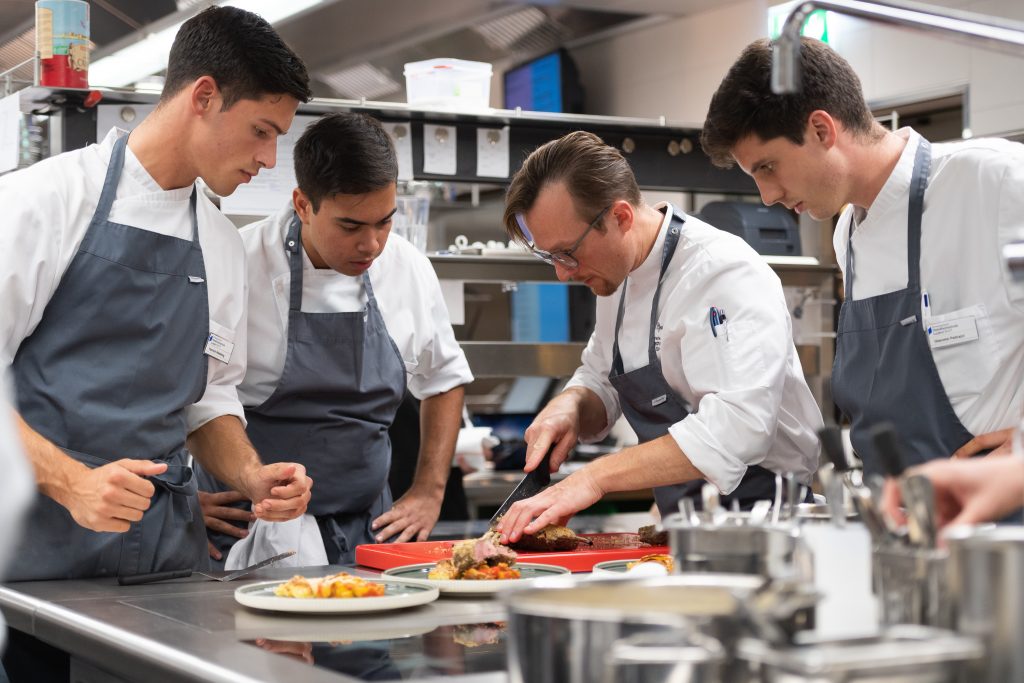
Setting up a strong future
“Although still creating quite a buzz in academic studies, the notion of lifelong learning has been around for a long time and can hardly be considered as a new concept,” Ramstad Kristiansen said. “Keeping up with market dynamics and changes in guests’ needs and high expectations along the entire guest journey can be very challenging. A workforce with professional skills is crucial to deliver top-level service standards at each single touchpoint. Educational institutions must reflect and swiftly implement industry needs in education and training programmes to encourage an agile mindset.
“It’s vital that we build a common understanding where training and education should be seen from a ‘return on investment’ point of view, if we only focus on training and education for the top-executive and management levels of our businesses is short-sighted, especially when the whole workforce in hotels creates a successful product.
“We like to describe the hospitality industry as a people-first business so why shouldn’t we invest in our own people? We should place value on all employees, from the unskilled to the CEO.”
Creating ambassadors for properties
When it comes to looking at a return on investment, organisations should look to the added benefit of having highly competent professionals working across their properties.
Ramstad Kristiansen added: “Guest experience can’t be defined as a single touchpoint, but rather a set of numerous touchpoints and interactions throughout the entire customer journey. Therefore, you need everyone to be able to perform well in their individual functions. Once they understand the concept of the entire guest journey and see their own impact on it, they can work towards creating a guest experience that exceeds expectations. And, when the top management shows interest in the learning process, employees are more likely to apply new skills and knowledge in their daily work.
“From a business perspective, this leads to an increase in recommendations through active word-of-mouth, excellent ratings on- and off-line, as well as higher customer retention rates and additional guests because of all of the above.
“Well-trained employees are not only experts at their jobs and considerably more efficient, they are also more effective, maximising productivity and resulting in overall lower costs.
“In an industry where employee turnover is a real challenge, hospitality organisations that invest in employee education and training will also profit from reduced turnover. In my opinion, hiring unskilled, low-paid workers, is a misguided endeavour, skilled workers will save a company money in the long run and are far more likely to deliver the expected business results.”

Taking learning and development seriously
Ramstad Kristiansen concluded: “At SHL, we appreciate our responsibility to equip individuals and teams with all the necessary hard skills and skills for the future so they can mature into outstanding personalities and high achievers.
“We offer various opportunities for students to display their multifaceted capacities, recognising that superior service quality delivered by humans makes the difference in customer experiences.
“Customer touchpoints and customer experiences are the new arenas to surprise guests, only machines and automated services can’t offer those surprise moments.
“That said, digitalisation is no longer a nice to have, digital technologies are changing the world of all of us. Hospitality is an industry where various skills are crucial in delivering superior customer and guest experiences at every touchpoint.
“From a school’s standpoint I see hospitality education as the quintessence where theory is turned into practice to prepare students for the real guest and customer world.”
Theoretical skills need to be supported by practice to unleash their full potential. That means a working and learning environment where employees can demonstrate their empathy in creating a connection with guests and learn is essential.
Find out more about SHL
For more information, contact Maria Ramstad Kristiansen (maria.kristiansen@shl.ch / +41 79 333 13 38) or visit the website.