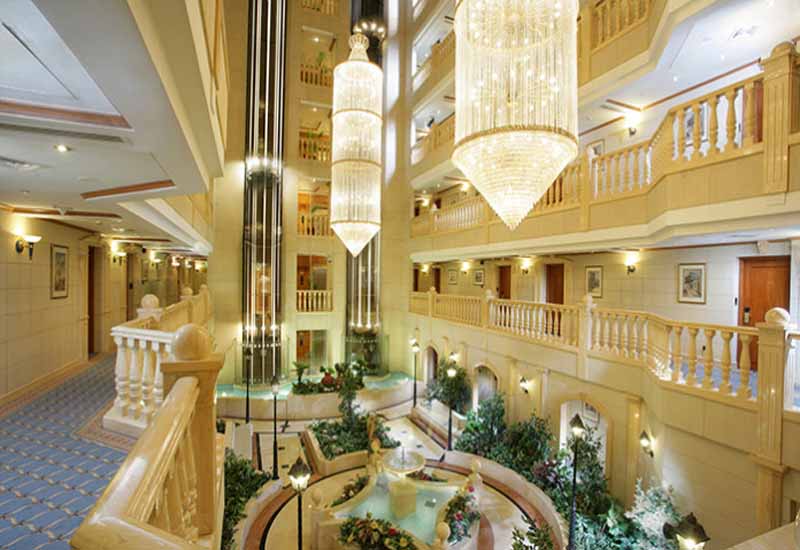
The First Investor Group, primarily a real estate company, expanded its hotel portfolio when it took over the Metropolitan Palace Hotel in Deira, Dubai, and rebranded it as Carlton Palace Hotel. “The deal was in excess of AED 200 million (US $54.45 million),” reveals First Investor Group hospitality division CEO and Carlton Group of Hotels group managing director Hosni Abdelhadi, in an exclusive interview with Hotelier Middle East.
“The reason we bought this hotel from its previous owner was because of its royal touch,” says Abdelhadi. “The previous owners aptly had the word ‘palace’ in its name, which depicts the level of kit, interiors and furniture in the hotel.”
This is the First Investor Group’s third property under the ‘Carlton’ moniker, the others including Imperial Palace Jordan and Carlton Tower Hotel, Dubai. “The purchase followed a lot of due diligence and inspection of the facilities and building itself. Given the structure is not too old, about 17 years, it made sense,” adds Abdelhadi.
The hotel is located on Deira’s most prominent street, and sits opposite the Creek and overlooks the iconic Clock Tower. “It’s very competitive; if you see this street itself, as many as 12 hotels are in operation.” Abdelhadi is conscious of his competition as he glances out of his office window.
“Deira is witnessing a resurgence, with an additional 1,500 to 2,000 hotel rooms going live within the next 24 months,” says Abdelhadi.
The Palm Deira is shaping up well, he says, with both mid-market and five-star properties in development. The former is a market segment of which Abdelhadi has been a strong advocator.
“We have to face facts, the scenario has changed. Hotels have had to rethink their strategy. The market needs a lot more mid-market hotels to attract business travellers. The kind who would previously visit Dubai to make a presentation or chair a meeting and stay back for a day or two. That does not happen anymore, due to companies cutting back on such expenses.”
It’s not just the increase in the number of hotels that has led to hotel operators in Deira having to share the spoils. Abdelhadi minces no words when talking about the decline from traditional feeder markets: “It’s true we lost a lot of Russian and Western European tourists owing to the weakening of the rouble and euro. Our focus has hence shifted to the Indian and Chinese markets.” Abdelhadi adds that there has been a decline from GCC tourists as well.
However, he goes on to laud DTCM’s efforts to attract tourists from new feeder markets. “DTCM’s marketing efforts, and large funds, are being driven towards attracting large number of Chinese tourists to compensate the loss of tourists from other markets. And, we believe in them and have reached out with utmost cooperation. We will support DTCM in all their efforts.”
And a quick glance at the ADR, which stands at AED 550 (US $149.74), reveals that the hotel falls under the affordable range of five-stars in the city. Abdelhadi remains largely modest about the fact that his room rates are reasonable.
“We are competitive. We benchmark ourselves by considering a set of fellow five-star hotels, and throw in a few four-star hotels into the mix. We evaluate our rates on a daily basis after meeting the director of revenue and sales. There are times we change our room rates more than once a day. In general, we keep in tune with the benchmark price and don’t dip too low.”
Abdelhadi, however, feels there are bigger problems: “The competition is crazy. Add to that the problems happening in the wider Middle East, it appears as though it’s unsafe to travel. Travellers need to feel safe, and that’s the reason travel agencies tend to dictate the room rate,” Abdelhadi says.
Service seems to be the Carlton Palace Hotel’s strategy to counter its competition. “Service is our strategy. We spare no expense in looking after our guests. It’s as simple as that. We polish every bit of this hotel, and give guests the best. We also plan on renovating a number of rooms in the hotel, including all of the executive floors, and change restaurant concepts.”
He continues: “In-room technology is going to be high on our agenda. We are dabbling with the idea of having a central system governed by the television in the room, that lets guests order and pay via the TV. We have allocated budget for that, and we will go ahead with it soon. We will look at upgrading the amenities that cater to the business needs, of which we have three floors.”
Although located in the heart of Dubai’s business district, it’s in close proximity to ‘New Dubai’, able to offer the best of both worlds. “Since we are based in the heart of the city, our efforts go out to bring in business travellers. But, we have got a huge number of leisure guests checking in too, those of which seeking the historical element of the city. Since we have six meeting rooms including the ballroom, we are also targeting large groups and convention parties.”
The hotel is quite famous amongst those who have visited it, says Abdelhadi and adds that “22% of our guests are repeat visitors”. Occupancy figures are quite healthy as well, the hotel reported 81% occupancy in the last quarter of 2015, since the takeover. “Our occupancy target is 86% for 2016,” says Abdelhadi.
Looking forward, Abdelhadi looks through his dual hotelier and real-estate hats to predict the outlook for 2016. He says: “The year looks challenging. The problem does not lie in occupancy, but in room rates. The growing inventory of hotels will lead to a further market sharing. Hotels owned and operated by the same company function well, but the ones that are on lease create a bit of a problem with the price. They are ready to dip their rates to any extent in order to meet their monthly rent.”
Challenges or not, the group will not slow down its quest to grow. “We are working on future acquisitions — Paris, Barcelona and Czech Republic. We are the final stages of negotiation with a hotel in Czech Republic, an 85-key boutique property. We are also on the lookout for properties in London and Geneva.”
Abdelhadi says the group plans on expanding in Europe and is not actively seeking properties in the GCC.
HR and training
The Carlton Palace hotel employs 260 staff in its premises and there were a few concerns when the buyout took place.
“We had a mass meeting following the takeover, and I asked them what were their fears and thoughts. So, one of their major concerns was regarding their accommodation, which was located Al Nahda. They were so attached to it and feared that we would move them to either Dubai Investment Park or Al Quoz.”
“Due to this, the group decided to purchase the building they occupied in Al Nahda, which laid all their fears to rest once and for all. They spoke of their accommodation as if to say it was more important than their salary, and we wanted to ensure we kept them happy,” says Abdelhadi.
He, however, remains extremely critical of the hotel’s operations, and strives for improvement. “Following the buyout, we hired an in-house expert to train all areas of the operations as we felt it wasn’t up to the mark. We did not lay off a single employee; however a few decided to move on with their previous employers.”