Meet the Experts
– Gavin Dodd, managing director, A. Ronai
– Alexander Reckzeh, regional director, MENA, Duni
– Glenn Ewart, export business development manager, Churchill
– Borislav Angelov, F&B operations manager, Sheraton Dubai Creek Hotel & Towers
– David Miras, executive chef, Al Maha, A Luxury Collection Desert Resort & Spa
– Andrea Strim, executive assistant manager of food and beverage, Jumeirah Emirates Towers
Caterer’s panel of industry experts get us up-to-date on tableware trends, and advise restaurants on what to look out for when purchasing table-top accessories
WHAT ARE THE LATEST TRENDS IN TABLEWARE?
BORISLAV ANGELOV: I don’t think that there is a trend in tableware anymore. Just take a look around you and see how much diversity there is in the presentation of food in restaurants.
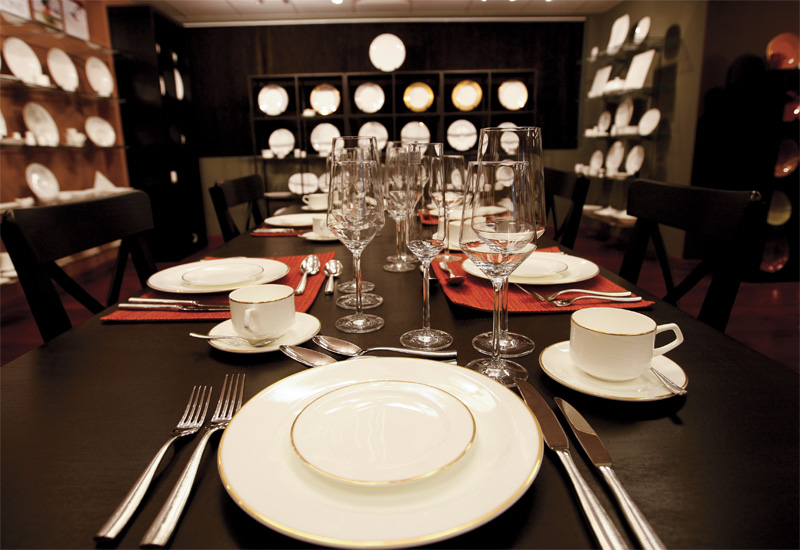
That being said, there is always one style that remains strong and in demand — white porcelain. It’s an all-time favourite for every chef. Nothing replaces a well presented meal on a white plate.
The trend has changed several times over the past 10 years, from coloured plates and unusual cutlery to organic shapes for dishes and cutlery. These days, there appear to be no limits with the imagination: steak on a wood board, shrimp cocktail in a jar, or sushi on a lollipop.
Overall, I feel that the traditional trend will remain strong — urban simplicity, matte finishes and natural materials, such as wood and stone. Additionally, many people are going back to classic 18th and 19th century styles.
ALEXANDER RECKZEH: We have identified three major trends: most restaurants in this part of the world go for classic chic, with a focus on crisp and clean white or cream tableware.
Another trend we observe is the appreciation of nature — sustainability, eco-friendliness, earthy tones and wooden elements. In these fast paced times, some restaurants and especially cafés try to establish themselves as sanctuaries, where guests can relax, unwind and let the world pass by.
These restaurants and cafés often go back in time, playing with vintage furniture, offering cozy seating and healthy food options. It’s like spending time in a second living room away from home.GAVIN DODD: Some of the trends over the last year include asymmetric designs both in glass and chinaware.
Coloured plate ware used as signature pieces has been in use for many years but trends are now leaning towards the complete collection. The Steelite Craft range offers six colours that can be mixed and matched or used alone to highlight a colour feature of the outlet. Chinaware will always be a timeless trend to showcase elegance and exclusivity.
GLENN EWART: The latest trend I see is the combining and mixing and matching of various product type — so for example, at Salero restaurant at Kempinski Mall of the Emirates, you will see stoneware mixed with wood, as well as traditional glass from Spain and then white ceramic plates — it works fantastically well and brings real theatre to the table.
ANDREA STRIM: A lot of new restaurants are very on-trend with fashionable tableware. These days, elaborate tableware can sometimes overpower the appearance of the food, where the cuisine should be the focus.
Function and form are becoming more important in tableware choices, for example they can dictate portion control. There is a shift towards family style dining with elaborate sharing platters encouraging this “homely” feeling to the dining experience, where the tableware complements this trend.
DAVID MIRAS: I think the tableware lines are diverse to cope with the hundreds of interiors of various restaurants and therefore do not particularly follow trends. In Al Maha, for example, we require bespoke and refined tableware; some of those lines were in the market 15 years ago and do not look dated as they have timeless designs.
HOW OFTEN DO YOU THINK TABLEWARE SHOULD BE UPDATED?
ANGELOV: Never, and every year, if that makes sense. These days, it’s all about the opinion of the guest. If they like, keep it; if not, change it until you get it right. Having said that, keep the same tableware and change the arrangement to play with the senses of your diners. There will be an impression that things have been changed around, and diners will never get bored of your arrangement.
RECKZEH: There is no fixed rule about when tableware should be updated. At Duni, we believe that tableware should be replaced often enough to keep the restaurant fresh and attractive.
DODD: Any establishment will be looking for a durable and reliable product that will see them through at least a year or two of service. Ideally restaurants or F&B outlets should look to update their tableware when introducing a new menu or to complement any changes to the interior design of the property. Depending on the budget, this may not always be the case so they need to look at where they can make the most impact, introducing a new signature dish on a specially designed plate will not go unnoticed by their regular clientele.
EWART: Ten years ago, tableware was kept for between three to five years, but now, as with the world around us, time moves fast and we are finding that clients are choosing items to enhance their food presentation constantly and at a much lower cost than waiting for one huge purchase every three to five years. This can be done easily by adding wood and other types of ceramic.
STRIM: I don’t believe there is a standard amount of time to change cutlery and crockery. If properly looked after and well maintained, tableware can service a restaurant for quite some time. It is important to choose the right product for the right place from the beginning. It is better to invest in quality tableware upfront for longevity. One instance where you should consider changing tableware is when the restaurant undergoes renovation or a concept upgrade.
MIRAS: It depends on the budget and vision of the company; we chose to keep our current range at all cost because the uniqueness and elegance of the current tableware used at Al Maha Desert Resort & Spa is unmatched.
WHAT FACTORS SHOULD RESTAURANTS CONSIDER WHEN PURCHASING NEW TABLEWARE?
ANGELOV: Tableware needs to be user friendly and elegant, fitting the overall theme of the restaurant.
RECKZEH: Nowadays, where competition is fierce and restaurant goers demand something new and fresh almost every day, we encourage our users to put quality, flexibility and convenience first.
DODD: Cost is probably the largest factor that is taken into consideration, although customers should consider the cost of life of the product rather than only the initial costs. However, this needs to be reflected against the durability of the product and its expected lifespan. Ensuring that products complement each other in terms of quality and design is also important; discerning guests will notice if any corners have been cut.
EWART: The factors any outlet should consider when purchasing include service of the company they are dealing with — how long have they been in the market, do they sell or do they listen and advise? Durability and financial stability of the supply chain is key — you don’t want to invest money with a company here today and gone tomorrow, or have a false economy of buying a cheaper product.
Is the product fit for the purpose? Does it present your food at its best? Does it fit with the design and ambience you are trying to create? And if you need a replacement product, is it still going to be around when you reorder? All factors are keys for making the right decision.
STRIM: When choosing fashionable items, it must be remembered that practicality plays an important role in the operation of the outlet. Not only aesthetics, but the customer dining experience should also be taken into consideration while choosing tableware for an outlet.
Easy and cost-effective replacement of these items should be kept in mind. Cleanliness of the crockery and cutlery through proper training and upkeep schedules are equally important when purchasing tableware.
MIRAS: It is important to ensure the brand has a renowned supplier with plenty of stock and also serious and professional staff, otherwise the purchasing process can drag on for many months. Then again, it depends on the venue and the hotel’s budgets as some venues do not mind revamping yearly from floor to ceiling.
WHAT MISTAKES DO RESTAURANTS AND F&B OUTLETS TEND TO MAKE WHEN PURCHASING NEW TABLEWARE?
RECKZEH: Some restaurants think it is an “investment for life”. For napkins, that should not be the case. Investing in huge amounts of linen napkins lets restaurateurs often get stuck with what they have, while the quality and state of the linen napkins deteriorate — colours fade, stains remain, linen napkins lose their original shape, and many get damaged or lost.
We believe that we have the better alternative — fresh, clean, and spotless napkins every time the restaurateur decorates the tables. So, instead of bothering about the state of their linen napkins, restaurateurs should focus on the important things such as their guests and the food.
ANGELOV: When someone chooses beauty over user friendliness — you need to always take into consideration the end user experience when making these decisions as they don’t just judge the food on the plate, but the plate itself.
DODD: It’s important to take into account what the product will be used for when choosing the tableware. If it is expected to have a high volume usage and requires repeated washing then durability must be the most critical feature. Another common mistake is to focus on lines that are not in constant supply, if you are unable to find replacements in six months then you will end up having to purchase a completely new product once again.
STRIM: A common error found in restaurants is that in the majority of cases, only the aesthetics of the tableware is considered. This method of purchasing tableware can lead to higher expenses. The right tableware needs to be picked for the right restaurant and the correct usage. For example, you wouldn’t use fine china in an all-day buffet restaurant, where a more durable item is required.
MIRAS: I’ve seen some places going for gimmicky and/or design-led tableware, and the result can be a disaster in the experience of the guests. Let’s not forget that a well-balanced fork is more important than a designer one, a knife should effortlessly cut through a steak, and glassware should allow you to still see your dinner date.
HOW DO TABLEWARE REQUIREMENTS DIFFER BETWEEN UPSCALE AND MID-RANGE RESTAURANTS?
ANGELOV: Upscale restaurants aim for a more polished and refined look to complement the beautifully garnished dishes that they present. Mid-range restaurants aim for a more urban, convenient style, where everything is user friendly and fun for diners.
RECKZEH: No matter whether upscale or midrange restaurants, a focus should be on nice and neat table ware. For both upscale restaurants and mid-range restaurants, staff should always make sure that tableware is clean and in good condition. Upscale restaurants have more choice of materials to play with as the budget allows, but it all comes down to condition and cleanliness.
DODD: The expectations remain high across all restaurants; however, in more upscale outlets the design features will play a bigger role as compared to mid-range, where functionality outweighs any other factor.
EWART: The market of upscale and mid market is beginning to blur — there is a drive for a casualisation of fine dining, where the presentation of the food will be less formal than four to five years ago.
It is happening in US, Europe and is coming here. An example of this is Table 9, where Darren Velvick serves Michelin star cuisine, but it is done in a more casual presentation, which means for a guest, the food is the key component. Great tableware should enhance the visual presentation but should not detract from the main event.
STRIM: In upscale restaurants, you tend to experience an excess in fine tableware. However, there is a shift towards minimalism, which is a style I prefer. When dining in a casual outlet, guests want to feel comfortable in the environment.
As such, excessive and expensive tableware won’t match the restaurant positioning. At the end of the day, you can have the most expensive tableware but what counts is the food or beverage that is served.
MIRAS: I think that cost is the number one difference, but also timeline for delivery has the main impact. We get our bone china from Japan, and lead times are a lot longer than if we went for local manufacturers in Ras Al Khaimah. It also took us two years to find a supplier in Germany who still had stock of our elaborate silverware; those are headaches that mid-scale venues will not face.