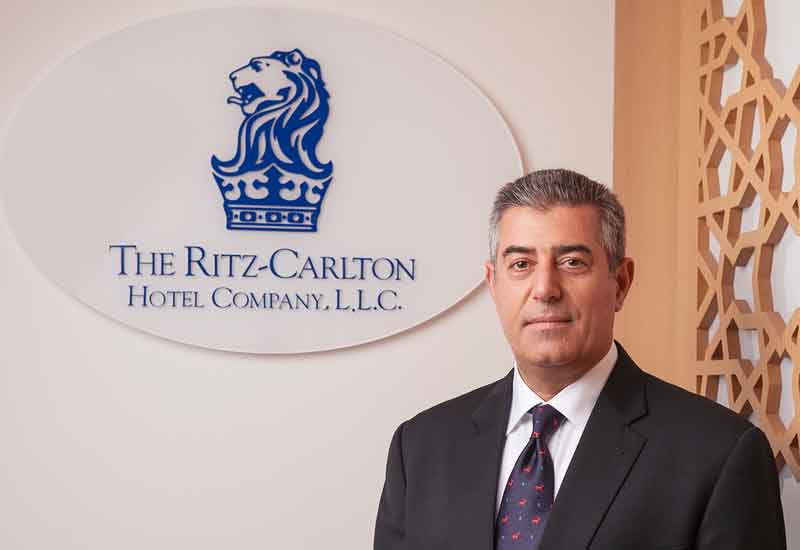
Each morning, general manager of The Ritz-Carlton Bahrain, Mark Neukomm, takes a four-kilometre walk around the 23 villas, serviced apartment building, sports club, and nine food and beverage outlets that make up the 245-room beachside property.
It’s a routine driven by a passion acquired over 30 years in the business; the Swiss national started out as a chef’s apprentice in 1980 at Intercontinental Geneva before entering a management training programme at Hilton Tokyo.
He’s since spent 22 years in Asia, and has been with The Ritz-Carlton Hotel Company L.L.C. since 2000, including holding the GM position at Ritz-Carlton Osaka, Japan. Neukomm came to the Middle East four years ago to take the helm at Ritz-Carlton Bahrain, bringing with him a “very operational and detail oriented” management style.
Most recently, he’s overseen a 12-month renovation resulting in the addition of an infinity pool, two outdoor Jacuzzis, a Thai lounge and chill-out sunbeds, and the Ritz Gourmet Lounge, as well as upgrades to existing restaurants Thai and Primavera.
Granted, his all-seeing eye may allow him to keep the place shipshape, but he’s also aware of the impact it can have on his employees.
“I don’t know if my people really like me that much,” Neukomm admits, “because I see a lot of things sometimes that they don’t see. If I was in their shoes and if the GM spotted something before me, I would be embarrassed. That’s the way I try to get the message across; I show and tell.”
He also sets an example when it comes to personal health and fitness, although again, is aware not all of his 600 colleagues are as keen on the idea.
“I do exercises every morning,” he says. “Everyone is welcome to join but I guess it’s too early for them. I’m up running, swimming, doing Thai Chi — and I always have a small group joining me for that.” Neukomm learned to teach Thai Chi after the original instructor left, by watching videos, and has practised with around 10 of his staff every morning on the beach for the last two years.
“I do things to try and inspire and interest the staff. Some join in, some are too shy or say it’s too early in the morning, but at least the option is there”.
Neukomm also pushes his staff to take an active role in looking after the Bahrain community. “We work with the elderly, with disabled children, and schools — we bring classes into the hotel and give lessons, demonstrating hotel life to children,” he says.
“You have a responsibility in the community to give something back and this is an educational process for staff at the same time. You can’t just make money, you have to do other things too.”
Of caring for his own team, who with their families total 1000 across nine buildings on the hotel grounds, Neukomm says: “You’ve got to have a good group of people to take care of them all. They are far away from their countries and relatives so we create a second home for them here, and that’s a job in itself. We run a small hotel for the guests and a big one for the employees.”
Reeling off Ritz-Carlton’s principles regarding recruitment and training of the company’s ‘ladies and gentlemen’, Neukomm shows off a tatty ‘credo card’ which he describes as “a little bible” for staff motivation and training. “Do you know why it’s not very clean?” he asks of the battered card.
“Every employee has it in their pocket and every day we talk through those values and the motto. That’s how we drive engagement of the employees. You could say Ritz-Carlton focuses first on employees and then on guests.”
He goes on to explain that a lot is invested in training: “We do 250 hours training a year for employees and 350 hours for our leaders — and that really pays off. We keep staff close with one-on-one meetings and that in turn gives us solid service,” he says.
Recruiting in Bahrain of course has its own challenges, particularly in the wake of the political unrest of 2011, fuelled by demands for more rights and an end to discrimination against the majority Shia community.
Following a bomb blast in February this year, which killed a policeman, marking the country’s third anniversary of political uprising, and more recently, a March blast that killed three policemen, it is clear the trouble is not yet over (see pages 50-54).
Neukomm was unable to comment on the impact the recent attacks could have, but in our interview beforehand, he said the incentive to work in Bahrain was getting a foot in the door in the region.
“We bring over European and Asian talent making their first steps into the Middle East. We have a more vibrant market now than a few years ago and we try to help as much as we can and be as active as possible.”
Although the market itself will now likely face setbacks related to the instability, Neukomm says generally, events in Bahrain have increased. During Bahrain International Airshow in January, the hotel catered for more than 30 chalets, serving out 1600 meals in three days.
“We were at the air base until about 4am setting everything up — there was a great momentum around the event,” explains Neukomm.
The next big thing will be the Formula 1 Gulf Air Grand Prix Bahrain on April 4–6, which at the time of going to press was still set to run. “It’s contagious — there’s always something happening,” he adds.